Telepsychiatry in Florida is a video visit with a psychiatrist or psychiatric nurse practitioner licensed in Florida while you are physically in the state. Evaluations, medication management and therapy all work well by video, insurance and Medicare cover it, and most medications including many controlled substances can be prescribed. Office visits remain better for injections and complex geriatric care.
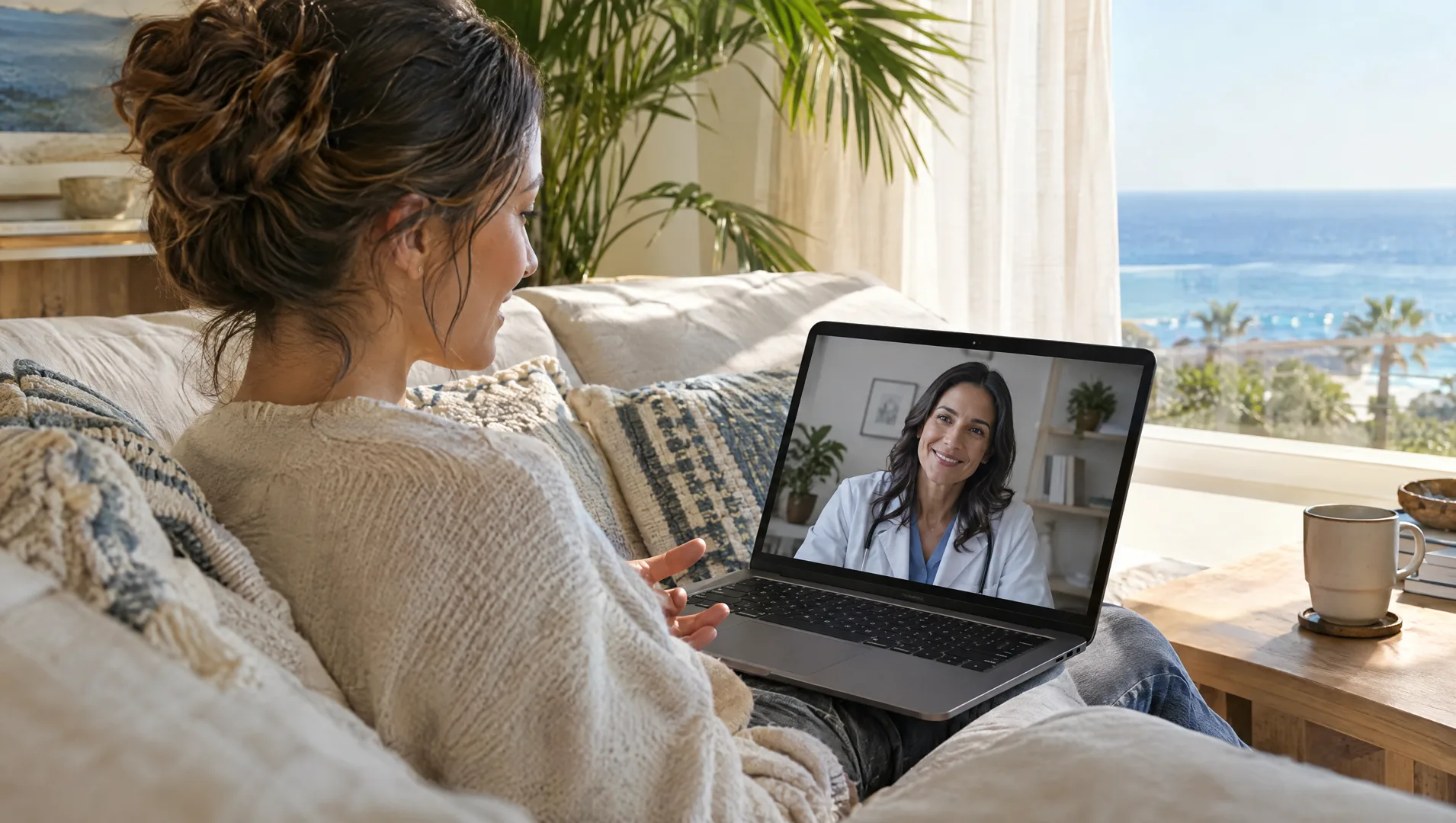
Psychiatry is the medical specialty best suited to telehealth. There is no stethoscope, no wound to inspect and no joint to manipulate. The evaluation is a conversation, and a conversation over good video loses very little. Florida recognized this early and has some of the clearer telehealth laws in the country. The result is that a patient in Jacksonville, Melbourne or a rural county with no psychiatrist within fifty miles can see a Stedfast Psychiatry clinician the same week.
This article explains how it works, what the rules are, what you can and cannot get by video, and how to decide whether it is the right format for you.
The rules in Florida
Florida's telehealth statute, section 456.47, sets the framework. A clinician may provide telehealth to a patient located in Florida if the clinician holds a Florida license, or registers with the state as an out-of-state telehealth provider. The patient's location at the time of the visit is what matters, not where they live. If you are a Florida resident on vacation in Georgia, a Florida-licensed clinician technically cannot see you by video that day unless they are also licensed in Georgia. This surprises people, and it is why our scheduling staff ask where you will be at the time of your appointment.
Florida allows a clinician to establish a new patient relationship by telehealth. No prior in-person visit is required. The standard of care is the same as in person, which means the same evaluation, the same documentation and the same obligation to refer you for in-person care if the video format cannot answer a clinical question.
Audio-only visits are permitted in some circumstances, but video is strongly preferred and most insurers pay for it at the same rate as an office visit. Audio-only is useful as a fallback when the internet fails mid-visit.
What a telepsychiatry visit looks like
You receive a link by text or email. A few minutes before the appointment you click it from a phone, tablet or computer, confirm your identity and location, and wait in a virtual room. The clinician joins and the visit proceeds exactly as an office visit would: for a new patient, 45 to 60 minutes of structured interview; for a follow-up, 15 to 30 minutes reviewing how a medication is working and adjusting the plan.
Screening questionnaires are completed through the patient portal ahead of time. Prescriptions are sent electronically to the pharmacy of your choice. Lab orders go to a lab near you. Follow-ups are scheduled before you log off. The only thing you lose is the drive.
A few practical points make it go better. Use a private space with a door; the car in the driveway counts if the house is full. Use headphones. Have your medication bottles within reach so you can read labels. Plug in the device. And treat the visit with the same attention you would give an office visit, which means not driving, shopping or cooking during it. Clinicians will reschedule a visit that cannot be done safely or privately.
What can be prescribed by video
Nearly everything. Antidepressants, anti-anxiety medications, mood stabilizers, antipsychotics, sleep medications and non-stimulant ADHD medications are all routinely prescribed by telehealth with no special rules.
Controlled substances, which include stimulants for ADHD, benzodiazepines and some sleep medications, are governed by federal law. The Ryan Haight Act normally requires an in-person examination before a controlled substance can be prescribed by telemedicine. During the pandemic the DEA waived that requirement, and the waiver has been extended several times. Under current federal rules, which have been extended several times, a clinician may prescribe controlled substances after a telehealth evaluation without a prior in-person visit; confirm current status when you book, because the DEA has signaled that a permanent special registration framework is coming and the details could change. Florida adds its own requirement that controlled substance prescriptions by telehealth are limited to specific circumstances, including treatment of a psychiatric disorder, which covers ADHD and anxiety. Our article on telehealth and ADHD medication covers this in depth.
Insurance and Medicare
Florida does not have a strict telehealth payment parity law, meaning insurers are not required to pay the same rate for video as for in-person care. In practice, nearly all major commercial plans in Florida cover telepsychiatry at the same copay as an office visit, because behavioral health telehealth has become standard. Check your plan's summary of benefits or ask our billing staff to verify before your first visit.
Medicare covers mental health telehealth permanently, including visits from your home, following legislation that made the pandemic-era policy permanent for behavioral health. Original Medicare pays telepsychiatry at the same rate as in-person care. Medicare Advantage plans cover it as well, sometimes with a lower copay to encourage use. Medicaid managed care plans in Florida cover telepsychiatry for enrolled members.
Self-pay patients pay the same rate for telehealth as in person. At Stedfast Psychiatry the new-patient visit is $185 either way.
Does it work as well?
The evidence says yes for most outpatient psychiatric care. A large body of research, including randomized trials and a review by the American Psychiatric Association's telepsychiatry workgroup, has found that diagnostic accuracy, treatment adherence and symptom outcomes for depression, anxiety, PTSD and ADHD are equivalent between video and in-person care. Patient satisfaction is often higher by video, mostly because of convenience and reduced no-shows.
Where video falls short is in the subtle physical observations that occasionally matter: tremor or stiffness from an antipsychotic, the gait of an older patient, the smell of alcohol, signs of self-neglect. A good telehealth clinician asks about these and asks you to show them on camera when relevant, and refers you in for an office visit when something cannot be assessed remotely.
Who it is right for
Telepsychiatry is a strong fit if you live far from one of our offices, have a demanding schedule, lack reliable transportation, have mobility limits, find the waiting room itself stressful, or are managing a stable condition with periodic medication adjustments. It is also well suited to therapy, where the research on video-delivered CBT is particularly strong.
It is a weaker fit, or needs to be combined with office visits, in a few situations.
- Interventional treatments. Deep TMS at Palm Beach Gardens and Spravato at Boynton Beach, Palm Beach Gardens and Royal Palm Beach are in-office by nature. Spravato in particular requires two hours of monitoring under the REMS program.
- Long-acting injectable medications, which must be given in the office.
- Complex geriatric evaluations where cognition, gait and medication reconciliation need hands-on assessment. Our Stedfast Living program visits assisted living and skilled nursing facilities in person for this reason.
- Acute safety concerns, where a clinician needs to see you in person or direct you to an emergency department.
- Patients without a private space or reliable connection, where the format itself undermines the visit.
Many of our patients use a hybrid: an in-person first visit, then telehealth follow-ups with an office visit once or twice a year. That is often the best of both.
If you split time between Florida and South Carolina
Stedfast Psychiatry has offices and licensed clinicians in both states, which matters for the many patients who move seasonally between the two. If you are in Bluffton in summer and Boynton Beach in winter, you can keep the same clinician as long as that clinician is licensed in the state where you are physically located for each visit. Tell the scheduler where you will be, and they will match you accordingly.
Getting started
Telehealth appointments with Stedfast Psychiatry are booked the same way as office appointments. You will be asked to confirm that you will be physically in Florida or South Carolina at the time of the visit, to complete intake forms online, and to test your video link before the first appointment. No referral is needed. If after the first visit you or the clinician think in-person care would serve you better, switching to one of our 13 offices is a phone call.
Frequently asked questions
Can I see a Florida psychiatrist by telehealth if I am out of state?
Generally no. Florida telehealth law applies to patients located in Florida, and the clinician must be licensed in the state where you are at the time of the visit. If you travel to South Carolina, Stedfast Psychiatry can match you with a clinician licensed there. For other states, the visit must wait until you are back.
Does insurance cover telepsychiatry in Florida?
Almost all major commercial plans cover video psychiatric visits at the same copay as an office visit, though Florida does not legally require payment parity. Medicare covers mental health telehealth permanently, including from your home. Our staff verify your plan before the first visit.
Can a psychiatrist prescribe controlled substances by video in Florida?
Yes, under current federal rules, which have been extended several times, and under Florida's telehealth statute, which allows controlled substance prescribing for psychiatric disorders. Confirm current status when you book, since federal rules may change as the DEA finalizes its telemedicine framework.
Is telepsychiatry as effective as seeing a psychiatrist in person?
For outpatient depression, anxiety, PTSD and ADHD, research finds equivalent diagnostic accuracy and outcomes, with often higher patient satisfaction. In-person care remains better for interventional treatments like TMS and Spravato, injectable medications, complex geriatric evaluations and acute safety concerns.
Related reading
- Can a Psychiatrist Prescribe ADHD Medication Over Telehealth?
- What Happens at Your First Psychiatrist Appointment
- How to Find a Psychiatrist That Accepts Medicare
- Seasonal Depression in Florida: Yes, It Happens
- Hurricane Season Anxiety: Coping Before, During and After the Storm
This article is educational and does not replace evaluation by a licensed clinician. If you are in crisis, call or text 988.