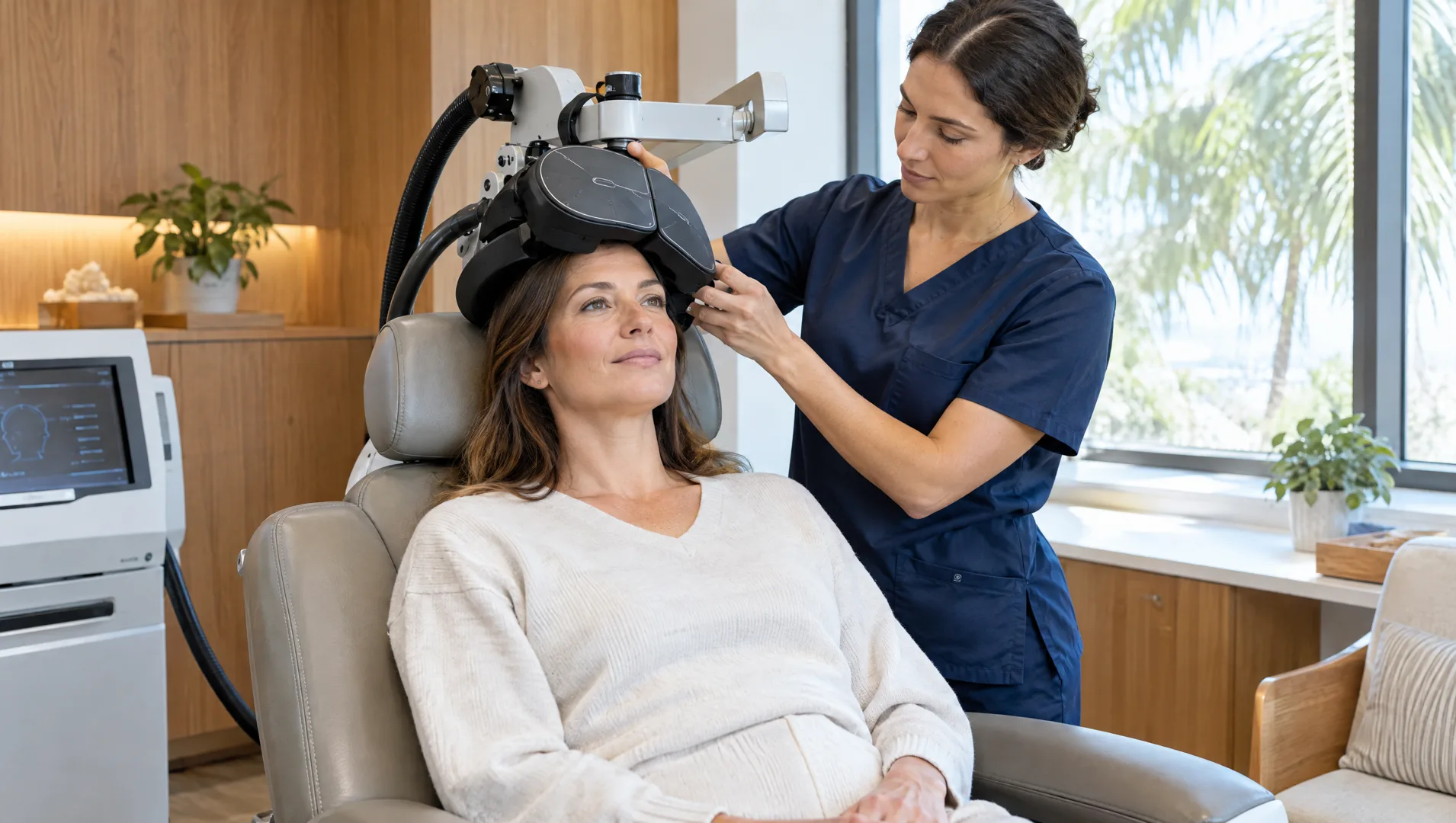
Deep TMS is an FDA-cleared, non-drug treatment for depression and OCD that uses magnetic pulses to stimulate mood-regulating brain circuits. A standard course is 36 sessions of about 20 minutes each over 6 to 9 weeks. Real-world registries report response in roughly 60 to 75 percent of patients. Stedfast Psychiatry delivers Deep TMS at Palm Beach Gardens, and Medicare and most major insurers cover it.
Stedfast Psychiatry offers Deep TMS (H-coil) at our Palm Beach Gardens office. Deep TMS is FDA-cleared for major depressive disorder, obsessive-compulsive disorder, smoking cessation and anxious depression. It is intended for people who have tried antidepressants without adequate relief, or who cannot tolerate medication side effects. Our psychiatrists evaluate every candidate in person, and a dedicated TMS coordinator manages insurance authorization and scheduling.
Who it is for
Deep TMS is for adults with major depressive disorder who have not achieved adequate relief from antidepressant medication, or who stopped medication because of side effects. The STAR*D trial, the largest study of real-world depression treatment, found that only about one third of patients reach remission on their first antidepressant, and the odds fall with each additional medication trial. If you are on your second, third or fourth antidepressant and still symptomatic, you are the kind of patient TMS was built for. Deep TMS is also FDA-cleared for obsessive-compulsive disorder that has not responded to SSRIs and therapy, for depression with significant anxiety symptoms, and as a short-term aid to smoking cessation. It is not appropriate for people with ferromagnetic metal in or near the head, cochlear implants, or certain implanted electronic devices, and we take extra care with anyone who has a seizure history.
How it works
Depression is associated with reduced activity in the left dorsolateral prefrontal cortex and disrupted communication between that region and deeper limbic structures. TMS uses electromagnetic induction, the same physics that powers an MRI scanner, to create brief, focused magnetic pulses that pass painlessly through the skull and induce small electrical currents in the cortex beneath the coil. Repeated pulses delivered at a set frequency change how readily those neurons fire, and over weeks of daily sessions the effect accumulates into lasting changes in circuit activity. Deep TMS uses an H-coil built into a cushioned helmet. The H-coil geometry produces a broader and deeper field than the figure-8 coil used in traditional rTMS, reaching about 4 centimeters below the scalp versus roughly 1.5 to 2 centimeters for a standard coil. That matters because the prefrontal regions involved in mood regulation are not confined to the surface. For OCD, a different coil (the H7) targets the medial prefrontal and anterior cingulate cortex, and each session begins with a brief, individualized symptom provocation so that the circuit being treated is active during stimulation.
Only about one third of patients with depression reach remission on their first antidepressant, and roughly one third remain depressed after four medication steps.
Source: STAR*D trial, American Journal of Psychiatry, 2006
In the pivotal multicenter trial of Deep TMS for treatment-resistant depression, 38.4 percent of patients responded and 32.6 percent remitted at week 16, versus 21.4 and 14.6 percent with sham.
Source: Levkovitz et al., World Psychiatry, 2015
In a post-marketing analysis of 1,351 patients treated at 21 clinics, 82 percent of patients who completed at least 30 Deep TMS sessions responded and 65 percent reached remission.
Source: Roth et al., Psychiatry Research, 2023
In the pivotal OCD trial of Deep TMS, 38.1 percent of patients responded at six weeks compared with 11.1 percent on sham, rising to 45.2 percent at one-month follow-up.
Source: Carmi et al., American Journal of Psychiatry, 2019
What to expect
Your first appointment is a psychiatric evaluation to confirm the diagnosis, review your medication history, screen for contraindications and complete the rating scales your insurer requires. Once authorization is in place, your first treatment day includes motor threshold mapping: we find the lowest pulse intensity that produces a visible twitch in your hand, and all later sessions are dosed as a percentage of that number. A standard depression course is five sessions a week for six weeks, followed by a taper of two sessions a week for three weeks, 36 sessions in total. Each Deep TMS session lasts about 20 minutes, and you are in and out of the office in roughly half an hour. You stay awake, you can talk to the technician, and you drive yourself to work or home afterward. Most people notice early changes in sleep, energy or concentration around week two or three, with mood improvement building through week four to six. A psychiatrist reviews your scores at least every two weeks and adjusts the plan if needed.
Benefits
- FDA-cleared for major depressive disorder (2013), OCD (2018), smoking cessation (2020) and anxious depression (2021)
- No anesthesia, no sedation, no systemic drug exposure, and you drive yourself home
- No weight gain, sexual side effects, emotional blunting or cognitive dulling
- About 20 minutes per session, compatible with a normal work schedule
- Covered by Medicare and most major commercial insurers for treatment-resistant depression
- Can be combined with your existing antidepressant and psychotherapy
- Durable benefit for most responders, with maintenance options if symptoms return
Risks and side effects
The most common side effects are scalp discomfort or a tapping sensation at the coil site and a mild headache after the first few sessions. Both typically fade within the first week as you acclimate, and an over-the-counter pain reliever before the session handles the rest. Some people notice jaw or facial muscle twitching during the pulse train, which stops the moment the pulse stops. The one serious risk is seizure, which is rare: published estimates place it well under 0.1 percent per treatment course, and we screen carefully for seizure history, medications that lower seizure threshold, sleep deprivation and alcohol use before every course. TMS does not cause memory loss, cognitive impairment, sexual dysfunction or weight gain. Hearing protection is worn during every session because the coil produces a loud clicking sound.
Cost and insurance
Medicare covers TMS for major depressive disorder when the clinical criteria in the Florida Medicare contractor's coverage policy are met. Most major commercial insurers, including Aetna, Cigna, UnitedHealthcare, Florida Blue and Humana, cover TMS for depression, usually after documented failure of two to four antidepressant trials and a trial of psychotherapy, with standardized rating scales such as the PHQ-9 or HAM-D on file. Prior authorization is almost always required, and our TMS coordinator submits it for you. OCD coverage is less consistent and varies by plan. If you are uninsured or your plan excludes TMS, ask our TMS coordinator for current self-pay rates and payment options.
Why medication alone is not enough for everyone
Antidepressants help a lot of people, and they remain the first thing we reach for. But the numbers from STAR*D, the largest real-world study of depression treatment ever funded by the National Institute of Mental Health, are sobering. About 37 percent of patients remitted on the first antidepressant. Of those who moved to a second step, about 31 percent remitted. By the third and fourth steps, remission rates fell to roughly 14 and 13 percent. Taken together, around one in three patients was still depressed after four adequate medication trials.
Those patients are not failures and their depression is not untreatable. They have what clinicians call treatment-resistant depression, and TMS was developed specifically for them. It works on the brain circuit directly rather than through neurotransmitter chemistry, which is why people who have cycled through SSRIs, SNRIs, bupropion and augmentation strategies can still respond.
What the FDA has cleared Deep TMS to treat
TMS devices are regulated as medical devices and receive FDA clearance rather than the FDA approval that applies to drugs. Deep TMS with the H-coil has four clearances:
- Major depressive disorder (2013): for adults who have not achieved satisfactory improvement from prior antidepressant medication in the current episode.
- Obsessive-compulsive disorder (2018): as an adjunct for adults with OCD, using a dedicated H7 coil and a protocol that includes brief symptom provocation before each session.
- Smoking cessation (2020): as a short-term aid for adults who want to quit, the first TMS clearance for an addiction indication.
- Anxious depression (2021): for adults whose major depressive disorder is accompanied by comorbid anxiety symptoms, which describes most of the depressed patients we see.
You may see older marketing that lists PTSD, chronic pain, Parkinson's disease, stroke recovery or Alzheimer's disease as TMS indications. Those are research areas, not clearances, and we do not treat them with TMS at Stedfast.
The treatment course, step by step
Consultation and authorization
A Stedfast psychiatrist confirms your diagnosis, documents your medication and therapy history, and completes the PHQ-9 and other scales your insurer wants to see. We screen for metal in the head, implanted devices, seizure history and pregnancy. Our TMS coordinator then submits prior authorization. Commercial approvals typically take one to three weeks; Medicare does not require prior authorization but does require that the coverage criteria be met and documented.
Day one: motor threshold mapping
Your first treatment visit runs about an hour. The technician fits the helmet, then delivers single pulses over the motor cortex while watching your right hand. The lowest intensity that produces a visible thumb or finger twitch in about half of pulses is your motor threshold. Your treatment dose is set at 120 percent of that number for depression. We remeasure if your medications change or if you report a change in sensation.
Weeks one through six: the acute phase
You come in Monday through Friday at a standing appointment time. Each Deep TMS session delivers 55 trains of 18 Hz pulses over about 20 minutes. You hear a rapid clicking and feel tapping on the scalp. Most people read, listen to music or chat with the technician. There is no sedation, so you walk out and resume your day.
Weeks seven through nine: taper
Frequency drops to twice a week. This taper phase helps consolidate the gains and gives us a clear read on how stable your response is before you finish. The full course is 36 sessions over roughly six to nine weeks, depending on holidays and missed days.
After the course
Most responders hold their improvement for a year or longer, particularly when they continue an antidepressant and therapy. If symptoms start to return, a short retreatment course of 10 to 15 sessions usually restores response, and insurers generally cover retreatment for patients who responded the first time.
Deep TMS compared with traditional rTMS
| Feature | Deep TMS (H-coil) | Traditional rTMS (figure-8 coil) |
|---|---|---|
| Coil design | H-coil in a padded helmet | Figure-8 coil on an articulated arm |
| Stimulation depth | About 4 cm below the scalp | About 1.5 to 2 cm below the scalp |
| Field width | Broader, covers more of the prefrontal cortex | Narrow, focal, sensitive to exact placement |
| Session length (standard protocol) | About 20 minutes | About 19 to 37 minutes, or 3 minutes for theta burst |
| FDA-cleared indications | MDD, OCD, smoking cessation, anxious depression | MDD, OCD (some systems), anxious depression (some systems), migraine (some systems) |
| Head-to-head evidence | No large randomized trial has shown one coil type to be clearly superior for depression; both roughly double sham response rates | |
Who should not have TMS
TMS is contraindicated if you have ferromagnetic metal within about 30 centimeters of the coil that cannot be removed: aneurysm clips, metallic stents in the neck or brain, cochlear implants, implanted stimulators, bullet fragments or metallic facial tattoos with iron-based ink. Dental fillings, crowns and titanium plates are fine. We use caution with anyone who has a personal history of seizures, a serious head injury, a brain tumor, or who takes medications that lower the seizure threshold. Bipolar disorder is not a contraindication, but TMS carries a small risk of switching into hypomania, so we monitor closely and prefer patients be on a mood stabilizer. Pregnancy is not an absolute contraindication and TMS has been used safely in pregnancy, but we review the decision with you and your obstetrician.
Why patients choose Stedfast for TMS
Our TMS program sits inside a full psychiatric practice. The same team that prescribes your medication and provides your therapy runs your TMS course, so there is no handoff between a TMS clinic and your regular psychiatrist. A board-certified psychiatrist supervises every course and reviews your rating scales every two weeks. We accept Medicare and most major insurance, and our TMS coordinator manages authorization, scheduling and appeals. If TMS is not the right fit, Spravato is available at Palm Beach Gardens, Boynton Beach and Royal Palm Beach, and we can move you between options without starting over.
Deep TMS in Palm Beach Gardens
Stedfast Psychiatry delivers Deep TMS at our Palm Beach Gardens office, 11641 Kew Gardens Ave, Suite 209, just off PGA Boulevard and I-95. Patients travel to us from Jupiter, West Palm Beach, Boynton Beach, Stuart and Royal Palm Beach, and most find the drive manageable because a Deep TMS session takes about 20 minutes and you drive yourself home. Call (561) 437-2199 to schedule a TMS consultation, or ask your current Stedfast provider for an internal referral. Our TMS coordinator handles insurance verification, prior authorization and scheduling so you can start as soon as approval comes through.
Frequently asked questions
What is TMS therapy?
TMS stands for transcranial magnetic stimulation. It is an FDA-cleared outpatient treatment that uses a magnetic coil placed against the head to deliver brief pulses into the prefrontal cortex, the region that is underactive in depression. Repeated daily sessions over several weeks change how that circuit fires and relieve depressive symptoms in a majority of patients who have not responded to medication. It is not electroconvulsive therapy and does not require anesthesia.
Does TMS work?
Yes, for most people who complete a course. In controlled trials Deep TMS roughly doubled the response rate compared with sham treatment, and in large real-world registries 60 to 75 percent of patients respond and 30 to 50 percent reach full remission. These are patients who had already failed several antidepressants, so the comparison is against a group with poor odds on medication alone. Results are not guaranteed, and about one quarter of patients do not respond meaningfully.
How many TMS sessions will I need?
A standard Deep TMS course for depression is 36 sessions: five sessions a week for six weeks, then a taper of two sessions a week for three weeks. Each session takes about 20 minutes. The OCD protocol is typically 29 sessions over six weeks. Some patients respond early and some insurers approve a shorter course, but we recommend completing the full protocol because response rates rise with session count.
Is TMS covered by insurance?
Medicare covers TMS for major depressive disorder in Florida when coverage criteria are met, and most major commercial plans do as well. Insurers typically require documentation of two to four failed antidepressant trials, a psychotherapy trial, and standardized rating scales such as the PHQ-9 or HAM-D. Prior authorization is required, and our TMS coordinator handles the paperwork. Coverage for OCD and other indications varies by plan.
How much does TMS cost without insurance?
Self-pay pricing depends on the number of sessions in your protocol and whether you need a maintenance course later. We do not publish a flat rate because the right course varies by diagnosis and insurer requirements. Ask our TMS coordinator at the Palm Beach Gardens office for current self-pay rates and payment options. Many patients who start as self-pay are later able to obtain coverage once their medication history is documented.
What are the side effects of TMS?
The common side effects are scalp discomfort at the coil site and a mild headache, both of which usually fade within the first week. Facial muscle twitching during pulses is normal and stops when the pulse stops. The rare serious risk is seizure, estimated at well under 0.1 percent per course. TMS does not cause weight gain, sexual side effects, memory loss or cognitive dulling, and there is no anesthesia or recovery time.
What is the difference between TMS and ECT?
ECT uses electrical current under general anesthesia to induce a brief controlled seizure and is typically reserved for severe, psychotic or life-threatening depression. TMS uses magnetic pulses while you are awake, with no anesthesia, no seizure and no memory side effects. ECT has a higher remission rate in the most severe cases; TMS has a far better side-effect profile and no recovery time. Most patients try TMS first unless the severity of their illness calls for ECT.
Can I keep taking my antidepressant during TMS?
Yes. Most patients continue their current medication during TMS, and insurers generally expect it. TMS and medication work through different mechanisms, and many people who did not respond to medication alone respond to the combination. We review every medication before starting because a few, such as bupropion at high doses or tramadol, lower the seizure threshold and may need adjustment. Do not stop any medication without talking to your prescriber.
Where does Stedfast offer TMS?
Deep TMS is delivered at our Palm Beach Gardens office at 11641 Kew Gardens Ave, Suite 209, near PGA Boulevard and I-95. Patients from Jupiter, West Palm Beach, Boynton Beach, Stuart, Royal Palm Beach and the Treasure Coast travel to this office for their daily sessions. Your evaluation, psychotherapy and medication management can continue at any of our other Florida offices or by telehealth.
Can I do TMS by telehealth?
No. TMS requires the coil to be positioned on your head by a trained technician, so every session is in person at Palm Beach Gardens. What can be done remotely is the consultation, insurance paperwork, follow-up psychiatry visits and psychotherapy. Many patients combine in-person TMS sessions with telehealth visits for the rest of their care so that the only travel is the 20-minute treatment itself.
Where this treatment is offered
Deep TMS Therapy near you
Conditions this treats
If you are in crisis, call or text 988 or go to the nearest emergency room. Educational content; individual results vary. Reviewed by Dr. David Husted, board-certified psychiatrist.