TMS and Spravato are both effective for treatment-resistant depression with roughly comparable response rates. Spravato works faster, sometimes within days, and carries a specific FDA approval for depression with suicidal thoughts, but requires two-hour monitored visits, no driving that day, and ongoing dosing. TMS takes three to four weeks, has no cognitive or dissociative effects, and ends after a 36-session course. Many patients try TMS first.
TMS is a device-based treatment: magnetic pulses, 20 minutes a day, no drug. Spravato is a drug: esketamine nasal spray, taken under observation twice a week at first, with ongoing maintenance dosing. They work through completely different mechanisms, they have different side effects, and they suit different people. This page lays out the comparison.
Who it is for
TMS is the better first choice for people who want a treatment with a defined end, who need to keep driving and working without interruption, who have had trouble with drug side effects, and who have comorbid OCD or anxiety for which Deep TMS holds clearances. Spravato is the better first choice for people who need fast relief, for people with active suicidal ideation, for people who cannot attend daily sessions for six weeks but can manage two visits a week, and for people with contraindications to TMS such as metal implants or a seizure history. Some patients use both: Spravato for rapid stabilization, then TMS to build durable remission, or TMS first with Spravato in reserve if response is partial.
How it works
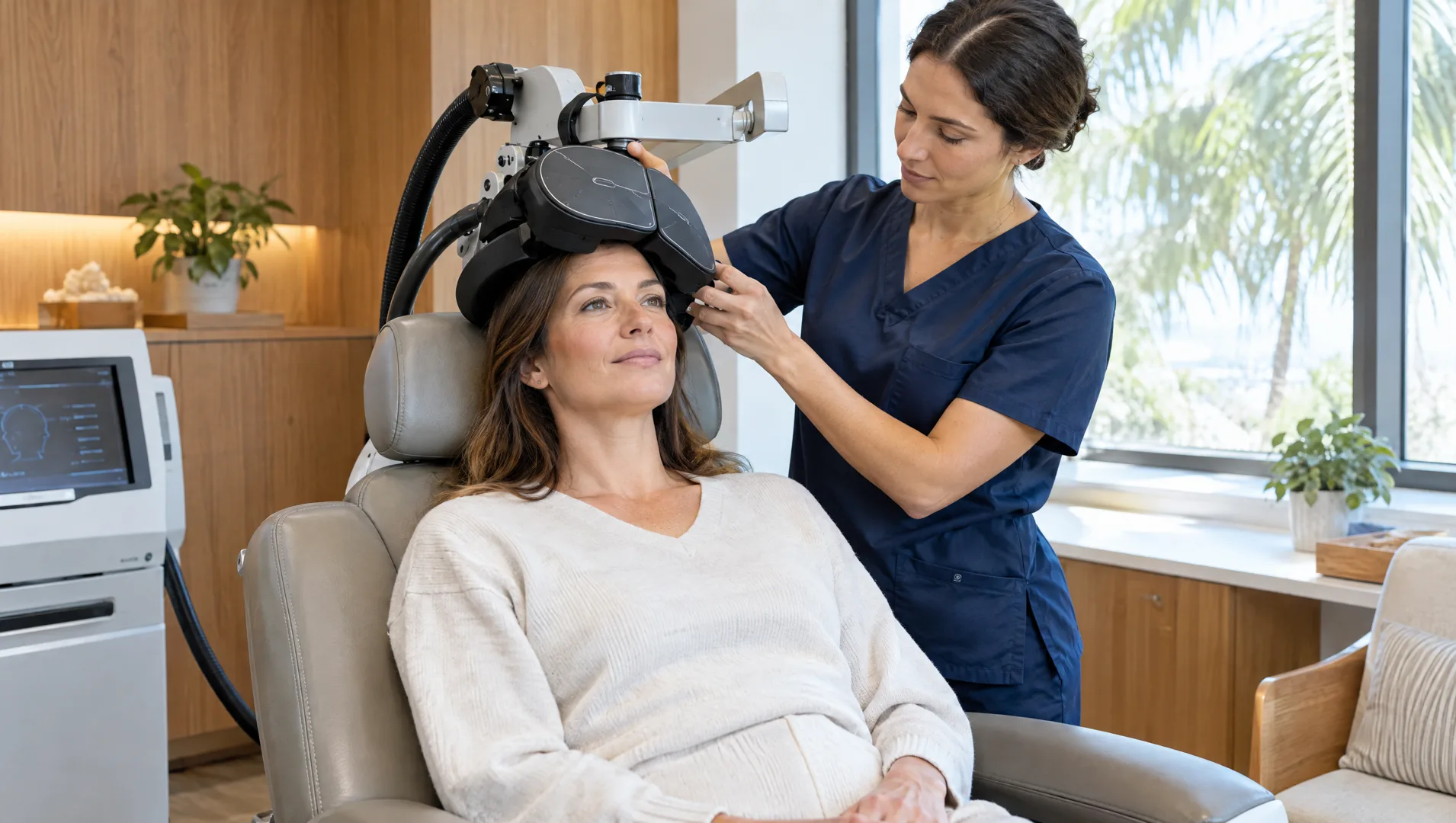
Spravato is esketamine, a form of ketamine, delivered as a nasal spray. It blocks NMDA glutamate receptors, which triggers a rapid surge in glutamate signaling and a burst of synaptic growth in prefrontal circuits. The effect begins within hours, which is why Spravato can relieve symptoms in days rather than weeks. Because esketamine causes dissociation, sedation and transient blood pressure increases, every dose is given in the office under a federal REMS program with two hours of monitoring. Deep TMS uses magnetic pulses to stimulate the left prefrontal cortex directly, gradually increasing activity in an underactive circuit over daily sessions. There is no drug, no dissociation and no monitoring period; the effect builds over weeks and persists after the course ends.
In the TRANSFORM-2 trial, Spravato plus a new oral antidepressant produced response in 69 percent and remission in 52 percent of patients at day 28, versus 52 and 31 percent with placebo spray plus antidepressant.
Source: Popova et al., American Journal of Psychiatry, 2019
In the Deep TMS pivotal trial, response was 38.4 percent and remission 32.6 percent at week 16 versus 21.4 and 14.6 percent with sham; real-world registries report response of 60 to 75 percent.
Source: Levkovitz et al., World Psychiatry, 2015; Roth et al., Psychiatry Research, 2023
In the SUSTAIN-1 trial, continuing Spravato after remission reduced the risk of relapse by 51 percent compared with switching to placebo, demonstrating that ongoing dosing is needed to maintain benefit.
Source: Daly et al., JAMA Psychiatry, 2019
Spravato was FDA-approved in March 2019 for treatment-resistant depression and in August 2020 for major depressive disorder with acute suicidal ideation or behavior.
Source: FDA approval letters, 2019 and 2020
What to expect
A Spravato course begins with an induction phase of two visits a week for four weeks. At each visit you self-administer the spray, then stay for two hours while staff monitor blood pressure and dissociation. You cannot drive until the next day, so you need a ride. After induction, dosing drops to weekly, then every one or two weeks, and continues indefinitely for most responders. A Deep TMS course is five visits a week for six weeks, 20 minutes each, followed by a three-week taper. You drive yourself. When the course ends, treatment ends, with retreatment available if symptoms return months later.
Benefits
- TMS: no drug, no dissociation, drive yourself, finite course, no ongoing dosing, OCD and anxious depression clearances
- Spravato: fastest onset of any outpatient depression treatment, FDA-approved for depression with suicidal thoughts, twice-weekly rather than daily visits
- Both: covered by Medicare and most commercial insurers for treatment-resistant depression
- Both: available at Stedfast Palm Beach Gardens, with Spravato also at Boynton Beach and Royal Palm Beach
Risks and side effects
TMS: scalp discomfort and headache in the first week, facial twitching during pulses, rare seizure risk under 0.1 percent per course, no cognitive or sexual effects. Spravato: dissociation and sedation for one to two hours after each dose, dizziness, nausea, transient blood pressure elevation, and a federal boxed warning for sedation, dissociation, respiratory depression, abuse potential and suicidal thoughts in young adults. Spravato is contraindicated with aneurysmal vascular disease, arteriovenous malformation and history of intracerebral hemorrhage. Long-term effects of ongoing esketamine dosing on bladder and cognition are still being studied.
Cost and insurance
Both are covered by Medicare and most commercial plans for treatment-resistant depression, typically after failure of two antidepressants, and both require prior authorization from commercial plans. Spravato has two costs: the drug, which is often billed through pharmacy benefits or a specialty pharmacy, and the monitoring visit, billed through medical benefits. TMS is a single per-session medical charge. Over a year, Spravato maintenance usually costs more than a single TMS course. For self-pay TMS, ask our TMS coordinator for current self-pay rates.
Side-by-side comparison
| Feature | Deep TMS | Spravato (esketamine) |
|---|---|---|
| Type | FDA-cleared device | FDA-approved drug |
| Mechanism | Magnetic stimulation of prefrontal cortex | NMDA receptor blockade, rapid glutamate surge |
| Onset | 3 to 4 weeks | Hours to days |
| Schedule | 5 days a week for 6 weeks, then taper; 36 sessions, then done | Twice weekly for 4 weeks, then weekly or biweekly indefinitely |
| Visit length | About 20 minutes | About 2 hours of monitoring per dose |
| Driving | Drive yourself | No driving until next day |
| Main side effects | Scalp discomfort, headache, rare seizure | Dissociation, sedation, dizziness, blood pressure rise |
| Cognitive effects | None | Transient during dosing |
| Suicidal ideation indication | No | Yes, approved 2020 |
| OCD, smoking, anxious depression | Cleared | No |
| Durability after stopping | Most responders stay well a year or more | Relapse common without maintenance |
| Regulatory program | None | REMS certification and monitoring |
| Stedfast locations | Palm Beach Gardens | Palm Beach Gardens, Boynton Beach, Royal Palm Beach |
How we decide with you
Speed
If you are in acute distress, especially with suicidal thoughts, Spravato's rapid onset and its specific approval for that indication make it the first choice. TMS can be started alongside or afterward to build a durable response. If your depression is severe but stable, the three to four week wait for TMS is acceptable and its cleaner profile makes it the usual starting point.
Logistics
TMS means 36 short visits in nine weeks and you drive yourself. Spravato means eight long visits in the first month and a driver every time, then ongoing visits. Patients coming to Palm Beach Gardens from Stuart or Boynton Beach often find daily 20-minute visits easier to sustain than twice-weekly two-hour visits with a driver. Patients who live close by, or who have a reliable driver, may prefer the lighter weekly schedule after Spravato induction.
Side-effect tolerance
Some people find esketamine's dissociation unsettling; others find it tolerable or even pleasant. Spravato also raises blood pressure, which matters for patients with uncontrolled hypertension or cardiovascular disease. TMS has nothing comparable. If drug side effects are the reason you stopped prior antidepressants, TMS avoids repeating the experience.
Comorbidities
Deep TMS holds clearances for OCD and anxious depression, so patients with those features get a treatment aimed at both. Spravato is approved for treatment-resistant depression and depression with suicidal thoughts only. Patients with a seizure disorder or metal implants cannot have TMS and may be good Spravato candidates. Patients with a history of substance misuse, aneurysm or intracranial bleeding should avoid Spravato and may be good TMS candidates.
Endpoint
TMS ends. A course is 36 sessions and most responders need nothing further for a year or more. Spravato is a maintenance treatment, and the evidence shows that stopping it raises relapse risk substantially. If having a finite course matters to you, that favors TMS.
Using both in sequence
Because Stedfast delivers both under the same clinical team, moving between them is simple. The two most common sequences are Spravato induction for rapid relief followed by a TMS course to consolidate and allow Spravato to be tapered, and a TMS course first with Spravato added for the minority whose response is partial. Either way, your medication management and therapy continue without interruption, in person at any of our offices or by telehealth.
Deep TMS in Palm Beach Gardens
Stedfast Psychiatry delivers Deep TMS at our Palm Beach Gardens office, 11641 Kew Gardens Ave, Suite 209, just off PGA Boulevard and I-95. Patients travel to us from Jupiter, West Palm Beach, Boynton Beach, Stuart and Royal Palm Beach, and most find the drive manageable because a Deep TMS session takes about 20 minutes and you drive yourself home. Call (561) 437-2199 to schedule a TMS consultation, or ask your current Stedfast provider for an internal referral. Our TMS coordinator handles insurance verification, prior authorization and scheduling so you can start as soon as approval comes through.
Frequently asked questions
Which is more effective, TMS or Spravato?
No randomized trial has compared them head to head, and the trial populations and endpoints differ, so an honest answer is that they are in the same range. Spravato's pivotal trial showed response in 69 percent at four weeks; Deep TMS registry data show response in 60 to 75 percent after a full course. Spravato works faster. TMS is more durable after treatment stops. Your psychiatrist will weigh your specific situation rather than quote a winner.
Which works faster?
Spravato. Some patients feel relief within hours of the first dose, and most responders improve within the first two weeks of induction. TMS takes longer: early changes in sleep and energy around week two, clear mood improvement by week four. If you need rapid relief, particularly if you are having suicidal thoughts, Spravato is the faster path, and TMS can follow to consolidate the response.
Can I drive after Spravato? After TMS?
After TMS, yes; there is no sedation. After Spravato, no. Esketamine causes dissociation and sedation, and the FDA label requires that you not drive or operate machinery until the next day after a restful sleep. You need a ride home from every Spravato visit. For patients who commute to Palm Beach Gardens from Jupiter, Stuart or Boynton Beach without a reliable driver, this is often the deciding factor in favor of TMS.
Do I need to keep doing Spravato forever?
Most responders continue maintenance dosing every one to two weeks for as long as it is helping, because the SUSTAIN-1 trial showed that stopping doubles the relapse rate. Some patients taper successfully after a year or more. TMS is different: a course ends after 36 sessions, most responders stay well for a year or longer, and a short retreatment course is given only if symptoms return. If you want a treatment with an endpoint, TMS is the one.
Can I do TMS and Spravato at the same time?
In principle yes, and some clinics do, but we usually sequence them. Combining them makes it impossible to know which is working, and insurers rarely authorize both at once. A common sequence is Spravato for rapid stabilization followed by TMS, or TMS first with Spravato added if response is partial. Because both are available at Palm Beach Gardens under the same psychiatrists, switching does not require a new evaluation.
Which has fewer side effects?
TMS. Its side effects are local and brief: scalp discomfort and headache in the first week. Spravato causes dissociation, sedation, dizziness and blood pressure elevation at every dose, which is why monitoring is required, and it carries a boxed warning and REMS restrictions. Neither causes weight gain or sexual side effects. Patients who dislike feeling altered generally prefer TMS; patients who tolerate dissociation well often find Spravato manageable.
Which does insurance prefer?
Neither, in general. Both are covered for treatment-resistant depression after two failed antidepressants, and both require prior authorization from commercial plans. Some plans require that you try one before the other, and that varies. Spravato involves a pharmacy benefit plus a medical benefit, which can mean two cost shares per visit. Our coordinators verify both before you decide, so you know the out-of-pocket difference in advance.
Where this treatment is offered
Conditions this treats
If you are in crisis, call or text 988 or go to the nearest emergency room. Educational content; individual results vary. Reviewed by Dr. David Husted, board-certified psychiatrist.