Spravato (esketamine) is an FDA-approved nasal spray for treatment-resistant depression in adults, given in a certified office with two hours of monitoring. Induction is twice weekly for four weeks, then weekly, then every one to two weeks. Most commercial plans and Medicare Part B cover it. Stedfast Psychiatry offers it in Boynton Beach, Palm Beach Gardens and Royal Palm Beach.
Stedfast Psychiatry offers Spravato at three Palm Beach County offices: Boynton Beach, Palm Beach Gardens and Royal Palm Beach. Every session takes place in our office under the Spravato REMS safety program, with at least two hours of monitoring after each dose. If two or more antidepressants have not worked for you, this page explains what Spravato is, who qualifies, what a course of treatment looks like, what it costs and what the evidence honestly shows.
Who it is for
Spravato is for adults 18 and older with treatment-resistant depression, which the FDA label defines as major depressive disorder that has not responded adequately to at least two different oral antidepressants taken at a proper dose for a proper length of time in the current episode. It is also approved for adults with major depressive disorder who are having acute suicidal thoughts or behavior, where the goal is to reduce depressive symptoms quickly while a longer-term plan takes hold.
It is not approved for bipolar depression, PTSD, generalized anxiety disorder or OCD, and we do not prescribe it off-label for those conditions. Before starting, we check your blood pressure history, cardiovascular and cerebrovascular history, substance use history and current medications. People with aneurysmal vascular disease, an arteriovenous malformation or a history of bleeding in the brain cannot take it. People with uncontrolled high blood pressure, a history of substance use disorder, or who are pregnant or breastfeeding need a careful conversation first.
How it works
Ketamine is a mixture of two mirror-image molecules, S-ketamine and R-ketamine. Esketamine is the purified S form, which binds more tightly to its target. That target is the NMDA receptor, a docking site for glutamate, the brain's main excitatory chemical messenger. By briefly blocking NMDA receptors on a specific set of inhibitory neurons, esketamine triggers a surge of glutamate signaling in the prefrontal cortex. That surge switches on growth pathways (BDNF and mTOR are the ones most studied) that help neurons regrow the connections, called synapses, that chronic stress and depression wear down.
The practical result is a drug whose antidepressant effect can begin within hours to days rather than weeks. The dissociation and dizziness you may feel during a session are a separate, short-lived effect of the same receptor action and clear within about two hours. Spravato is a Schedule III controlled substance, which is one reason it is only given in a certified office and never sent home.
Esketamine nasal spray (Spravato) was FDA-approved on March 5, 2019 for treatment-resistant depression with an oral antidepressant, on August 3, 2020 for major depressive disorder with acute suicidal ideation or behavior, and on January 21, 2025 as a standalone treatment for treatment-resistant depression.
Source: U.S. Food and Drug Administration, NDA 211243 approval letters
In TRANSFORM-2, esketamine plus a new oral antidepressant improved MADRS depression scores by about 4 points more than placebo plus a new antidepressant at day 28, with remission in 52.5 percent versus 31 percent of patients.
Source: Popova et al., American Journal of Psychiatry, 2019
In SUSTAIN-1, patients in stable remission who continued esketamine had a 51 percent lower risk of relapse than those switched to placebo (26.7 percent versus 45.3 percent relapsed).
Source: Daly et al., JAMA Psychiatry, 2019
In ESCAPE-TRD, 27.1 percent of patients on esketamine reached remission at week 8 compared with 17.6 percent on extended-release quetiapine, and 21.7 percent versus 14.1 percent stayed relapse-free through week 32.
Source: Reif et al., New England Journal of Medicine, 2023
What to expect
Your first visit is an evaluation with one of our psychiatrists or psychiatric nurse practitioners to confirm the diagnosis, document prior antidepressant trials, review your medical history and check your blood pressure. We handle REMS enrollment and insurance prior authorization before your first dose.
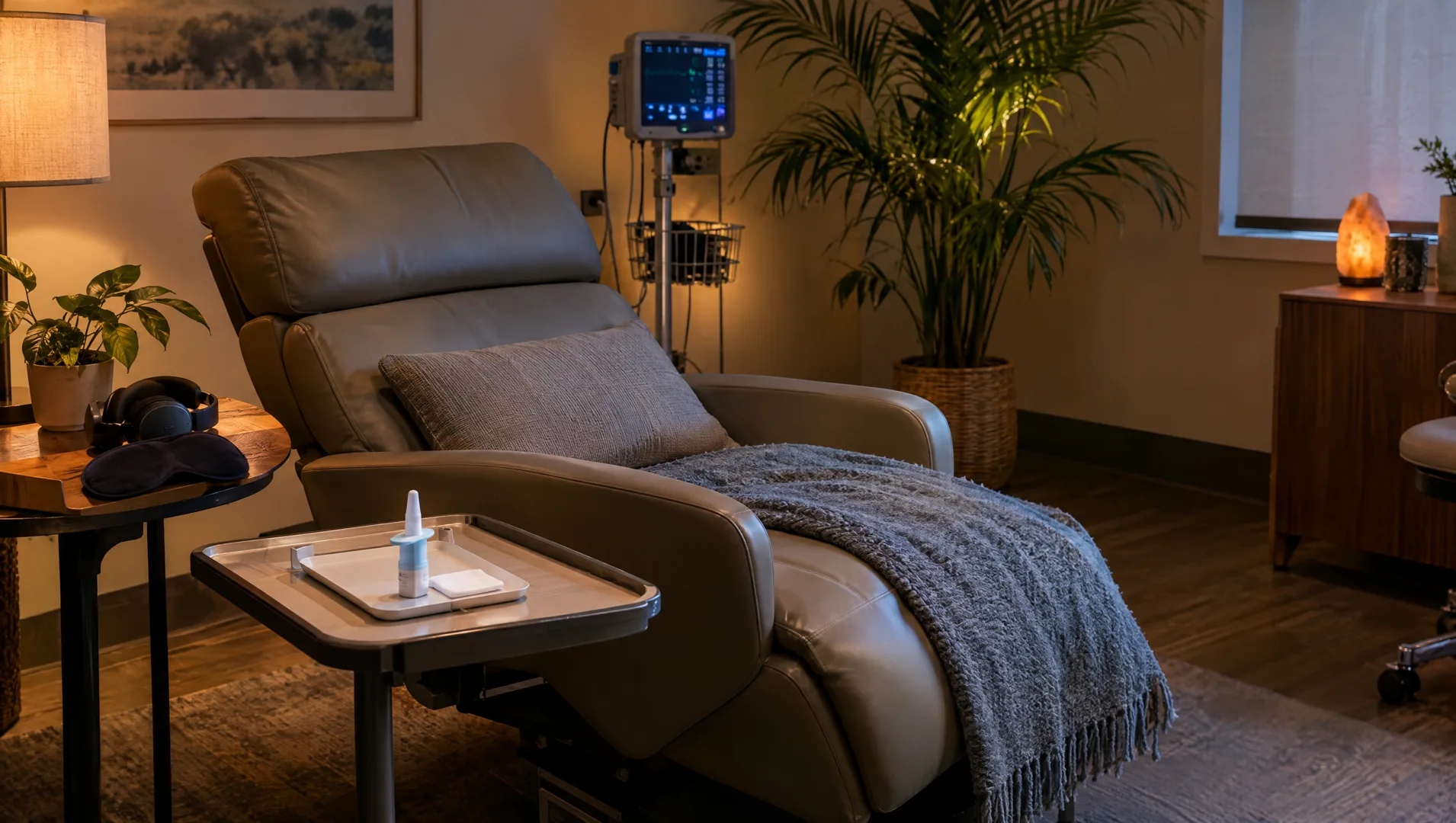
On treatment days, do not eat for two hours before your appointment or drink liquids for 30 minutes before. You will self-administer the spray under supervision: one device (28 mg) per nostril, with a five-minute rest between devices. The first session is 56 mg; later sessions are 56 or 84 mg depending on your response and tolerance. You then rest in a reclining chair for at least two hours while staff check your blood pressure and how you feel. Dissociation, dizziness and sleepiness usually peak within the first 40 minutes to an hour and settle by the end of monitoring. You must have someone drive you home, and you cannot drive until the next day after a restful night's sleep.
Benefits
- Works through a different mechanism (glutamate and NMDA receptors) than SSRIs, SNRIs and other oral antidepressants, so it can help when those have not
- Faster onset than oral antidepressants: many patients notice improvement within the first one to two weeks of induction
- FDA-approved specifically for treatment-resistant depression and for major depressive disorder with acute suicidal ideation or behavior
- Covered by most commercial insurance plans and by Medicare Part B when administered in a certified office, unlike off-label IV ketamine
- Every dose is given with at least two hours of monitoring by trained staff, with blood pressure checks and a structured safety protocol
- In the SUSTAIN-1 trial, continuing Spravato roughly halved the risk of relapse compared with stopping it
- Can be continued as maintenance at weekly or every-two-week intervals for as long as it is helping
Risks and side effects
The most common side effects, from the FDA label pooled trials, are dissociation (about 41 percent of patients), dizziness (29 percent), nausea (28 percent), sedation (23 percent), vertigo (23 percent), reduced sensation or numbness called hypoesthesia (18 percent), anxiety (13 percent) and increased blood pressure (about 10 percent). Blood pressure typically rises by a modest amount and peaks around 40 minutes after the dose, which is why we measure it before dosing, at about 40 minutes and before you leave. These effects almost always resolve within the two-hour monitoring window.
Less common but important: urinary symptoms similar to cystitis, which are known from long-term ketamine misuse and are monitored in the label; the potential for abuse or misuse, which is why the drug is never dispensed to take home; and possible effects on thinking and memory with long-term use, which trial data through one year has not shown but which we still watch. Spravato carries a boxed warning for sedation, dissociation, respiratory depression, abuse and misuse, and suicidal thoughts and behaviors in young adults taking antidepressants. Our Spravato side effects and safety page goes through each of these in detail, including why some patients say it did not work for them.
Cost and insurance
Spravato has two cost components: the drug itself and the office fee for supervised administration and two hours of monitoring. Most commercial plans cover Spravato for treatment-resistant depression after prior authorization that documents your diagnosis and at least two failed antidepressant trials. Medicare Part B covers it when it is given in our office, with the drug and monitoring billed together under specific HCPCS codes; you are responsible for the Part B deductible and 20 percent coinsurance unless a supplemental plan picks that up. Medicare Advantage plans generally cover it but usually require their own prior authorization.
Janssen, the manufacturer, runs a savings program that can bring the per-treatment drug cost to as little as $10 for eligible patients with commercial insurance; it is not available to Medicare or Medicaid patients by federal rule. Our team verifies your benefits and tells you your expected cost before the first session. Self-pay pricing is available on request. Visit our Spravato cost, insurance and Medicare page for a full breakdown.
Why treatment-resistant depression needs a different approach
Standard antidepressants work for many people, but the numbers are humbling. In the NIMH-funded STAR*D study, about one third of patients reached remission on their first antidepressant, and with each additional medication switch the odds of success dropped. After two adequate trials, roughly a third of people were still depressed. That group is what clinicians mean by treatment-resistant depression, and it is the group Spravato was built for.
The drugs that failed those patients almost all work the same way: they adjust serotonin, norepinephrine or dopamine and take four to eight weeks to show an effect. Spravato does something different. It acts on glutamate, the most abundant signaling chemical in the brain, and on the physical connections between neurons. That is why it can help people whose depression has not budged with four, five or six conventional medications.
Spravato, IV ketamine, TMS and ECT at a glance
Patients with treatment-resistant depression usually have four interventional options. The table below is a plain comparison. Stedfast Psychiatry offers Spravato at three Palm Beach County offices and Deep TMS at Palm Beach Gardens; we refer out for ECT and do not offer IV ketamine.
| Treatment | FDA status | Insurance coverage | Setting | Time commitment | Main side effects |
|---|---|---|---|---|---|
| Spravato (esketamine nasal spray) | FDA-approved for TRD and MDD with suicidal ideation | Most commercial plans and Medicare Part B, with prior authorization | Certified office under REMS; nasal spray self-administered under supervision | About 2.5 hours per visit; 8 visits in the first month, then weekly or every 2 weeks | Dissociation, dizziness, nausea, sedation, temporary blood pressure rise |
| IV ketamine infusion | Not FDA-approved for depression (off-label use of an anesthetic) | Rarely covered; typically self-pay | Infusion clinic, IV line, often with less standardized monitoring | About 1 to 1.5 hours per visit; commonly 6 infusions over 2 to 3 weeks, then boosters | Similar to Spravato; dose is weight-based and adjustable |
| Deep TMS (transcranial magnetic stimulation) | FDA-cleared for MDD, OCD, smoking cessation and anxious depression | Most commercial plans and Medicare, with prior authorization | Office; magnetic coil on the scalp, no medication | About 20 to 30 minutes daily, 5 days a week, for 6 to 9 weeks (36 sessions) | Scalp discomfort, headache; rare seizure risk |
| ECT (electroconvulsive therapy) | FDA-regulated device; standard of care for severe or psychotic depression | Covered by most plans and Medicare | Hospital, under general anesthesia | About 6 to 12 sessions over 2 to 4 weeks, each a half-day with recovery | Memory loss around treatment period, headache, muscle aches, anesthesia risks |
What the evidence shows, honestly
Spravato was approved on the strength of a program of trials run by Janssen. The headline efficacy trial, TRANSFORM-2, randomized about 220 adults with treatment-resistant depression to esketamine or placebo spray, each on top of a newly started oral antidepressant. At day 28, the esketamine group improved by about four points more on the MADRS depression scale, a statistically significant but modest difference; roughly half the esketamine patients reached remission versus about a third on placebo. Two other short-term trials, TRANSFORM-1 (fixed doses) and TRANSFORM-3 (adults 65 and older), did not meet their primary endpoints, which is part of why the FDA's review was debated.
The stronger result is in relapse prevention. SUSTAIN-1 took patients who had gotten well on esketamine and randomized them to continue or switch to placebo. Those who continued had a 51 percent lower risk of relapse if they were in stable remission and a 70 percent lower risk if they were stable responders. In 2023, ESCAPE-TRD in the New England Journal of Medicine compared esketamine head to head against extended-release quetiapine, a common add-on for resistant depression, in 676 patients: 27.1 percent reached remission on esketamine at week 8 versus 17.6 percent on quetiapine, and more stayed well through eight months.
In January 2025 the FDA approved Spravato as monotherapy for treatment-resistant depression based on a placebo-controlled trial in which 22.5 percent of patients reached remission at four weeks on Spravato alone versus 7.6 percent on placebo. For people who cannot tolerate oral antidepressants, that removes a barrier.
The takeaway: Spravato helps a meaningful fraction of people whom nothing else has helped, and it keeps them well better than stopping it. It does not help everyone, and the average benefit over placebo is moderate. We tell you this up front so that you can decide with realistic expectations.
What a full course looks like
- Weeks 1 to 4 (induction): two sessions per week, eight sessions total. First dose 56 mg, then 56 mg or 84 mg.
- Weeks 5 to 8: one session per week at the dose that worked for you.
- Week 9 onward (maintenance): one session every week or every two weeks, using the lowest frequency that holds your improvement.
- Review points: we use the PHQ-9 and MADRS at baseline and throughout, and we evaluate continuation at the end of induction and at regular intervals after that.
Each visit lasts about two and a half hours including check-in, the dose, monitoring and discharge. Plan for roughly 24 to 30 visits in the first six months.
The Spravato REMS program, in plain terms
Because of sedation, dissociation and the potential for misuse, the FDA requires Spravato to be given through a Risk Evaluation and Mitigation Strategy. In practice that means three things. The office must be certified, with a plan for monitoring patients and for storing the drug securely. The pharmacy that supplies the drug must be certified and ships it to the office, never to the patient. And every patient is enrolled in the program and is informed of the risks and the monitoring requirement before the first dose. Stedfast Psychiatry handles the enrollment paperwork for you.
Spravato at our Palm Beach County offices
We administer Spravato at three locations, each with a dedicated treatment room and REMS-trained staff:
- Boynton Beach: 10301 Hagen Ranch Rd, Suite D720, Boynton Beach, FL 33437. Serves Boynton Beach, Delray Beach, Lake Worth Beach, Lantana and western communities along Hagen Ranch Road.
- Palm Beach Gardens: 11641 Kew Gardens Ave, Suite 209, Palm Beach Gardens, FL 33410. Serves Palm Beach Gardens, Jupiter, North Palm Beach, Juno Beach and Lake Park. Deep TMS is also available here.
- Royal Palm Beach: 420 South State Road 7, Suite 112, Royal Palm Beach, FL 33414. Serves Royal Palm Beach, Wellington, Loxahatchee, Greenacres and the western county.
If you are an existing Stedfast patient at another office, your provider can refer you to the nearest Spravato location while you continue your regular care where you are. If you are new to us, the first step is an evaluation, in person or by telehealth, to confirm you are a candidate. Call us or request an appointment online.
Crisis resources
Spravato is not an emergency treatment. If you are in immediate danger or thinking about ending your life right now, call or text 988 (Suicide and Crisis Lifeline) or go to the nearest emergency room. If you are safe but struggling, call us and tell the front desk it is urgent; we prioritize same-week evaluations for patients with active suicidal thoughts.
Frequently asked questions
What is Spravato used for?
Spravato (esketamine) nasal spray is FDA-approved for two uses in adults: treatment-resistant depression, meaning major depressive disorder that has not responded to at least two oral antidepressants, and major depressive disorder with acute suicidal thoughts or behavior. Since January 2025 it can be used alone for treatment-resistant depression; before that it had to be paired with an oral antidepressant. It is not approved for bipolar disorder, PTSD, anxiety disorders or chronic pain, and we do not prescribe it for those.
Is Spravato the same as ketamine?
Not exactly. Ketamine is a mix of two mirror-image molecules. Spravato contains only one of them, esketamine, which is the more potent half at the NMDA receptor. Spravato is given as a nasal spray at a fixed dose in a certified office and is FDA-approved for depression. IV ketamine infusions use the full mixture, are dosed by weight, and are an off-label use not approved by the FDA for depression, which is why insurance rarely covers them.
How long does Spravato take to work?
Faster than oral antidepressants, but not instantly for everyone. In the clinical trials, separation from placebo was measurable within 24 hours in the suicidal ideation studies and by the end of the four-week induction phase in the treatment-resistant depression studies. In practice, many patients notice a shift in mood, energy or hopelessness within the first one to two weeks. We assess your response formally at the end of induction before deciding whether to continue.
How is Spravato administered?
You spray it yourself, under supervision, in our office. Each device delivers 28 mg, one spray per nostril. A 56 mg dose is two devices and an 84 mg dose is three, with five minutes of rest between devices. You cannot take Spravato home. After the dose you stay in a monitored room for at least two hours while staff check your blood pressure and alertness, then a companion drives you home.
How much does Spravato cost and why is it expensive?
The list price for the drug alone runs in the high hundreds to over a thousand dollars per session depending on dose, plus an office fee for the supervised two-hour visit. The price reflects a patented brand-name drug with no generic and the staffing a REMS-monitored visit requires. With commercial insurance and the manufacturer savings program, many patients pay as little as $10 per treatment for the drug. Medicare Part B covers it with the standard 20 percent coinsurance. We verify your cost before you start.
Does Medicare cover Spravato?
Yes. Medicare Part B covers Spravato when it is administered in a certified doctor's office such as ours, because it is a physician-administered drug rather than a pharmacy prescription. Medicare bundles the drug and the two-hour monitoring under specific billing codes. You are responsible for the Part B deductible and 20 percent coinsurance unless you have a Medigap or other supplemental plan. Medicare Advantage plans cover it too but usually require prior authorization through the plan.
What are the side effects of Spravato?
The most common are dissociation (feeling detached from your body or surroundings), dizziness, nausea, sleepiness, vertigo, numbness and a temporary rise in blood pressure. These start within minutes of the dose, peak in the first 40 to 60 minutes and almost always clear by the end of the two-hour monitoring period. Serious problems are uncommon in a monitored setting. The drug has a boxed warning for sedation, dissociation, respiratory depression, and abuse or misuse, which is why it is only given under REMS supervision.
Can I drive after Spravato?
No. You must arrange a ride home after every session, and you should not drive, operate machinery or do anything that requires full alertness until the next day after a restful night's sleep. This is an FDA requirement, not a suggestion. Uber or Lyft is fine as long as you are not driving. We will not administer a dose if you do not have transportation arranged.
What is the Spravato success rate?
In the pivotal trial, about 70 percent of patients on esketamine plus a new antidepressant responded (at least a 50 percent drop in symptom score) by day 28 and about half reached remission, compared with roughly 52 percent and 31 percent on placebo plus a new antidepressant. That is a meaningful but not dramatic gap, and about one in three patients get little benefit. Among people who do respond and continue maintenance, roughly three in four stay well over the following months.
Where can I get Spravato near me in Palm Beach County?
Stedfast Psychiatry offers Spravato at three offices: Boynton Beach (10301 Hagen Ranch Rd, Suite D720), Palm Beach Gardens (11641 Kew Gardens Ave, Suite 209) and Royal Palm Beach (420 South State Road 7, Suite 112). Each has a dedicated monitoring room and staff trained under the Spravato REMS program. We serve patients from Delray Beach, Lake Worth, Wellington, Jupiter, North Palm Beach and across Palm Beach County. Call the office nearest you or request an appointment online.
Where this treatment is offered
- Boynton Beach, FL
10301 Hagen Ranch Rd, Suite D720 and Suite B710 - Palm Beach Gardens, FL
11641 Kew Gardens Ave, Suite 209 - Royal Palm Beach, FL
420 South State Road 7, Suite 112
Spravato (Esketamine) Treatment near you
Conditions this treats
If you are in crisis, call or text 988 or go to the nearest emergency room. Educational content; individual results vary. Reviewed by Dr. David Husted, board-certified psychiatrist.