Spravato's most common side effects are dissociation, dizziness, nausea, sedation, vertigo, numbness and a temporary blood pressure rise peaking around 40 minutes after dosing. Nearly all resolve within the two-hour monitoring period. Serious risks are rare in a certified setting. It is contraindicated with aneurysms, AV malformations and prior brain hemorrhage, and about one in three patients get little benefit.
This page lists every meaningful side effect with the numbers from the clinical trials, explains the contraindications and cautions, describes what the two-hour monitoring protocol actually does, and addresses directly why some people have bad experiences. Stedfast Psychiatry administers Spravato at three Palm Beach County offices, and we would rather you walk in with clear eyes than walk out surprised.
Who it is for
This page is for anyone considering Spravato who wants the full picture, for family members who will be driving a patient home and want to know what to expect, and for people who have read frightening accounts online and need a clinician's perspective on which risks are real, which are rare, and which are a matter of expectations. It is also for current patients who want to understand a side effect they experienced.
How it works
Esketamine blocks NMDA receptors across the brain. The receptors involved in mood are also involved in how the brain assembles a sense of self, body and time, which is why dissociation is the signature side effect. The drug also increases sympathetic nervous system activity, which raises heart rate and blood pressure, and it affects the vestibular system, which causes dizziness and vertigo. All of these track the blood level of the drug: they begin within minutes of the spray, peak at 40 minutes to an hour, and fade over the next hour as esketamine is metabolized. The monitoring protocol is built around that curve.
In pooled short-term trials, dissociation occurred in 41 percent of Spravato patients versus 9 percent on placebo, and dizziness in 29 percent versus 8 percent.
Source: Spravato prescribing information, FDA
Esketamine raised systolic blood pressure by a mean of about 7 to 9 mm Hg and diastolic by 4 to 6 mm Hg, peaking around 40 minutes after dosing; about 8 to 17 percent of patients had a rise above 180/110 mm Hg or an increase of 40 mm Hg or more at some point in the trials.
Source: Spravato prescribing information, FDA
In SUSTAIN-2, a 52-week open-label safety study of 802 patients, there was no evidence of cognitive decline on a standardized computerized battery, and 6.9 percent discontinued for adverse events.
Source: Wajs et al., Journal of Clinical Psychiatry, 2020
Dissociation severity, measured with the CADSS scale, generally decreased with repeated dosing over the induction phase.
Source: Spravato prescribing information and TRANSFORM trial analyses
What to expect
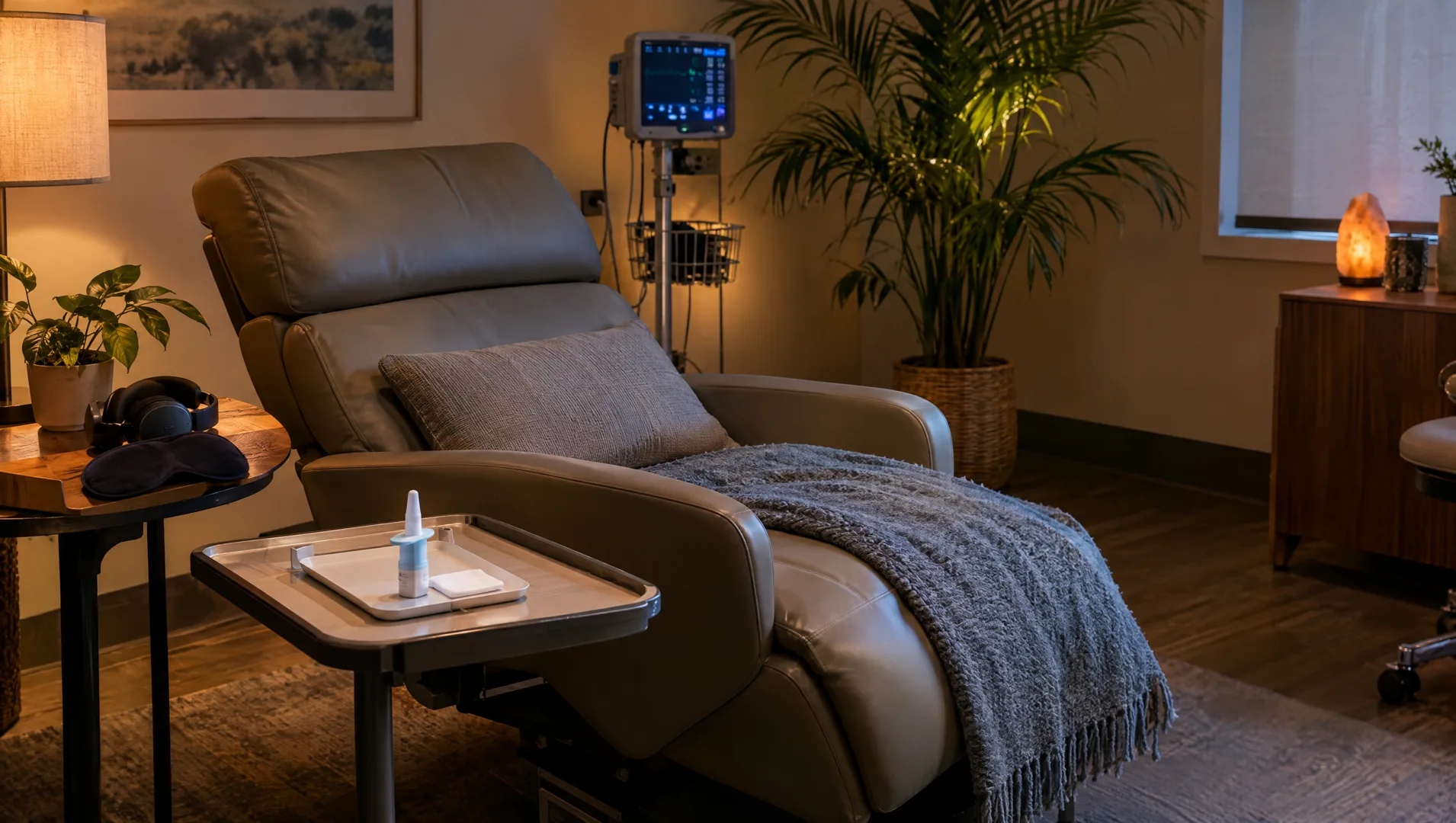
During a session, about four in ten people experience some dissociation: a feeling of floating, watching yourself from outside, distorted time, or surroundings looking unreal. For most it is mild to moderate and strange rather than frightening, and it helps to know in advance that it is coming and will pass. Roughly a quarter feel dizzy or nauseated, and a quarter get sleepy. Staff check your blood pressure before the dose, around 40 minutes after, and before discharge. You rest in a reclining chair in a quiet room; many patients bring headphones. You are not left alone. By the end of two hours most people feel close to normal but somewhat tired, and you go home with your driver.
Benefits
- Side effects are predictable, dose-related and almost always confined to the two-hour window in the office
- Blood pressure, sedation and dissociation are monitored by trained staff with a protocol for every outcome
- No take-home drug means no risk of unsupervised use or overdose at home
- Long-term data through one year show no cognitive decline on standardized testing
- Serious adverse events in the trials were rare and comparable to placebo
Risks and side effects
Common (from pooled short-term trials, Spravato versus placebo): dissociation 41 percent versus 9 percent; dizziness 29 versus 8; nausea 28 versus 9; sedation 23 versus 10; vertigo 23 versus 3; hypoesthesia (numbness) 18 versus 2; anxiety 13 versus 6; lethargy 11 versus 5; increased blood pressure 10 versus 3; vomiting 9 versus 2; feeling drunk 5 versus 1. Serious but uncommon: a large blood pressure spike, which is why we withhold the dose if your baseline is high; respiratory depression, seen in rare cases, especially with concurrent sedatives; and loss of consciousness, rare and usually brief. Long-term concerns from ketamine misuse that we monitor for in maintenance patients: urinary tract symptoms resembling cystitis, and cognitive effects, neither of which has appeared at meaningful rates in trial data through 52 weeks. Boxed warning: sedation, dissociation, respiratory depression, abuse and misuse, and suicidal thoughts and behaviors in young adults on antidepressants.
Cost and insurance
Safety monitoring is part of the cost structure. The two-hour observation is billed as part of each session and is covered along with the drug by commercial plans and Medicare Part B. If your blood pressure is too high to dose on a given day, you are not charged for the drug.
Side effects by frequency
| Side effect | Spravato plus antidepressant | Placebo plus antidepressant | Timing |
|---|---|---|---|
| Dissociation | 41% | 9% | Starts within 20 minutes, peaks about 40 minutes, resolves by about 90 minutes |
| Dizziness | 29% | 8% | During session |
| Nausea | 28% | 9% | During session; reduced by fasting beforehand |
| Sedation | 23% | 10% | During session, can linger as tiredness into the evening |
| Vertigo | 23% | 3% | During session |
| Numbness (hypoesthesia) | 18% | 2% | During session |
| Anxiety | 13% | 6% | Usually early in session |
| Increased blood pressure | 10% | 3% | Peaks at about 40 minutes, back to baseline by 2 hours |
| Vomiting | 9% | 2% | During session |
| Headache | 20% | 17% | During or after session |
Source: Spravato prescribing information, pooled short-term trials in treatment-resistant depression.
Who should not take Spravato
Contraindicated: aneurysmal vascular disease (aortic, intracranial or peripheral arterial aneurysm), arteriovenous malformation, history of intracerebral hemorrhage, and known hypersensitivity to esketamine or ketamine. The reason is the blood pressure rise: a spike in someone with a weakened vessel could cause a rupture.
Use with caution and extra monitoring: uncontrolled hypertension or unstable cardiovascular disease; history of substance use disorder; pregnancy and breastfeeding; history of psychosis; significant hepatic impairment; concurrent use of benzodiazepines, opioids, stimulants or MAOIs; and age 65 and older, where blood pressure effects can be larger.
How the monitoring protocol protects you
- Before dosing: blood pressure and pulse; brief check-in about mood, sleep, alcohol and medications; confirmation of your ride home. If systolic pressure is above about 140 or diastolic above 90, we wait and recheck; if it stays high, we do not dose that day.
- At about 40 minutes: blood pressure recheck at the expected peak, plus a dissociation and sedation check.
- Throughout: a staff member is available at all times; pulse oximetry is used when sedation is significant; emergency equipment and protocols are on site.
- Before discharge: blood pressure must be back near baseline, you must be alert and steady on your feet, and your driver must be present. If any of these is not met, you stay longer.
Why some people say Spravato did not work for them
We take the negative accounts seriously, because they point to things that go wrong when the treatment is delivered badly or sold badly. Here is what we see behind them.
Expectations were set wrong
Spravato is marketed with words like breakthrough. The trial data say something more modest: in the pivotal study, about half of patients reached remission versus about a third on placebo, and about 30 percent did not respond at all. A clinic that promises relief without those numbers sets patients up to feel cheated. We give you the numbers before you start, and we assess your response at the end of induction so that you are not continuing indefinitely without benefit.
The dissociation was not what they signed up for
For a minority of patients, dissociation is distressing: panic, a feeling of dying, or reliving trauma. It is more likely in people with a trauma history, with high baseline anxiety, or who are dosed in a noisy or clinical environment without preparation. We describe it in detail beforehand, start with the lower 56 mg dose, use a quiet room and let you bring music, and staff stay with you if it turns difficult. If it remains intolerable, we stop; nobody is obligated to push through.
The cost was a surprise
Patients who were told "insurance covers it" and then received bills for observation fees, for deductibles, or for sessions outside an authorization window are right to be angry. We give you a written estimate before the first dose and track your authorization so that sessions are not delivered outside it.
It was prescribed for something it does not treat
Some patients received Spravato or ketamine for PTSD, anxiety, bipolar depression or chronic pain, off-label, and got nothing or got worse. Spravato is approved for treatment-resistant major depression and for major depression with suicidal ideation. We do not prescribe it outside those indications.
It is not a cure
Spravato reduces symptoms in people who respond, and continuing it keeps most of them well. It does not fix the circumstances that made life hard, does not replace therapy, and for many people does not allow stopping all other treatment. Patients who expected a reset and got a partial improvement that requires ongoing visits sometimes describe that as failure. We would call it a realistic outcome, and we tell you so at the beginning.
Monitoring was inadequate
Blood pressure events, falls and severe sedation happen when clinics cut the monitoring short or staff the room thinly. The two-hour minimum and the vital-sign protocol are the floor, not a formality. We staff every session to meet them.
When to call us
Call the office if you have chest pain, severe headache, confusion or vision changes after a session; if dissociation persists into the next day; if you develop painful or frequent urination; or if your mood worsens, especially with thoughts of self-harm. For emergencies, call 911 or 988.
Spravato at Stedfast Psychiatry
We offer Spravato at three Palm Beach County offices, each with a dedicated monitoring room and staff trained under the Spravato REMS program:
- Boynton Beach: 10301 Hagen Ranch Rd, Suite D720, Boynton Beach, FL 33437
- Palm Beach Gardens: 11641 Kew Gardens Ave, Suite 209, Palm Beach Gardens, FL 33410
- Royal Palm Beach: 420 South State Road 7, Suite 112, Royal Palm Beach, FL 33414
Call the office nearest you or request an appointment online. The first step is an evaluation, in person or by telehealth, to confirm you are a candidate and to start insurance authorization.
Frequently asked questions
What does Spravato dissociation feel like?
Patients describe floating, heaviness, watching themselves from a distance, time slowing or stretching, colors or sounds seeming different, or a sense that the room is not quite real. Some find it calming; some find it unpleasant; a minority find it frightening, especially the first time. It starts within 10 to 20 minutes of the spray, peaks around 40 minutes and is largely gone by 90 minutes. It tends to lessen with repeated sessions. Staff are present throughout and can help you ground if it becomes distressing.
Is Spravato dangerous?
In a certified office with monitoring, serious harm is rare. The real risks are a large blood pressure spike, severe sedation or breathing suppression, and these are why you are observed for two hours with vital sign checks, why we screen for aneurysms and uncontrolled hypertension, and why we ask about sedatives and alcohol. Outside that setting, ketamine products carry real danger, which is why Spravato cannot be taken home. The trials, including a year-long safety study, did not find serious adverse events above placebo rates.
Can Spravato cause long-term brain damage?
There is no evidence that it does at approved doses and frequencies. The concern comes from chronic heavy recreational ketamine use, where cognitive problems and bladder damage are documented. In SUSTAIN-2, patients tested over 52 weeks of Spravato showed no decline on a cognitive battery. We still monitor maintenance patients, use the lowest frequency that holds the benefit, and would stop if cognitive or urinary symptoms appeared.
Does Spravato raise blood pressure?
Yes, temporarily. The average rise is about 7 to 9 points systolic, peaking around 40 minutes after the dose and returning to baseline within about two hours. A minority of patients have larger spikes. This is why we take a reading before the dose, will not dose if your pressure is above a safe threshold, recheck at about 40 minutes and again before you leave, and why people with aneurysms or a history of brain bleeding cannot take Spravato.
Can Spravato make depression worse?
For some people, a session can bring up difficult emotions, and a minority report feeling worse the day after. The boxed warning about suicidal thoughts applies to all antidepressants in young adults and is not specific to Spravato; in the trials, suicidal ideation decreased on average. If your mood worsens between sessions, tell us. Sometimes it signals that the drug is not working for you, and continuing is not the right answer.
Is Spravato addictive?
Esketamine is a Schedule III controlled substance with abuse potential, which is one reason it exists only within the REMS program and is never dispensed to take home. In that structure, physical dependence and addiction have not been a significant problem in trials or in practice. People with a current substance use disorder are at higher risk and need careful assessment. If you notice craving for sessions beyond their mood benefit, we want to know.
Why do some people say Spravato ruined their life?
Reading those accounts closely, a few patterns recur: the dissociation was far more intense or frightening than they expected; they had a blood pressure or medical event that was not well managed; the cost was higher than promised; they were given it for a condition it is not approved for; or they got no benefit after a large investment of time, money and hope. Each of these is a failure of screening, monitoring, communication or expectation-setting, and each is preventable. The sections below address them one by one.
What should I avoid before and after a session?
Before: no food for two hours and no liquids for 30 minutes to reduce nausea; no alcohol the day before; take your usual medications unless we tell you otherwise, but let us know about benzodiazepines, stimulants and blood pressure drugs; use nasal decongestant sprays an hour before if needed, not right before. After: no driving, machinery or important decisions until the next day after a full night's sleep; no alcohol or sedatives that evening; rest.
Where this treatment is offered
- Boynton Beach, FL
10301 Hagen Ranch Rd, Suite D720 and Suite B710 - Palm Beach Gardens, FL
11641 Kew Gardens Ave, Suite 209 - Royal Palm Beach, FL
420 South State Road 7, Suite 112
Conditions this treats
If you are in crisis, call or text 988 or go to the nearest emergency room. Educational content; individual results vary. Reviewed by Dr. David Husted, board-certified psychiatrist.