Spravato is FDA-approved for adults with major depressive disorder and acute suicidal ideation or behavior, taken with an oral antidepressant. In the ASPIRE trials it reduced depression severity within 24 hours of the first dose. It is not an emergency treatment and does not replace hospitalization, but it can shorten a dangerous period for outpatients who are safe to treat.
In August 2020 the FDA approved Spravato for adults with major depressive disorder who have acute suicidal ideation or behavior. It was the first antidepressant approved for that use. The reason is speed: in the ASPIRE trials, esketamine reduced depressive symptoms within 24 hours of the first dose, which no oral antidepressant can do. This page explains what the indication covers, what the trials actually showed about suicidal thinking, how we use Spravato alongside a safety plan at Stedfast Psychiatry, and what it does not replace.
Who it is for
Adults 18 and older with a current major depressive episode who are having active suicidal thoughts with some intent, or who have had recent suicidal behavior, and who can be managed safely as outpatients. In the trials, that meant patients who were initially hospitalized and then treated, or patients assessed as needing urgent treatment but not continuous inpatient care. Unlike the treatment-resistant depression indication, prior antidepressant failures are not required. An oral antidepressant is required alongside Spravato for this indication. People with bipolar disorder, psychosis or active substance intoxication are not candidates, and anyone who cannot be kept safe between twice-weekly visits needs a higher level of care first.
How it works
Suicidal thinking in depression tracks closely with the severity of hopelessness, anhedonia and agitation. Oral antidepressants take weeks to touch those, which leaves a long window of risk. Esketamine's effect on glutamate and synaptic function begins within hours, and in the ASPIRE trials the improvement in overall depression at 24 hours was significantly larger with esketamine than placebo, with both groups receiving standard care including hospitalization and a new oral antidepressant. On the specific measure of suicidality (the CGI-SS-r scale), esketamine was not significantly better than placebo at 24 hours, and both groups improved substantially, likely because of hospitalization and intensive care. We are explicit about that: Spravato reduces depression quickly, which is the engine of suicidal thinking, but it has not been shown to reduce suicidal ideation itself beyond what intensive standard care achieves.
The FDA approved Spravato for major depressive disorder with acute suicidal ideation or behavior in adults on August 3, 2020, the first antidepressant approved for this indication.
Source: U.S. Food and Drug Administration, NDA 211243 supplement approval
In ASPIRE I and II, esketamine plus standard care reduced MADRS depression scores at 24 hours by 3.8 and 3.9 points more than placebo plus standard care, with about 54 percent of patients having attempted suicide in the prior month.
Source: Fu et al. and Ionescu et al., Journal of Clinical Psychiatry, 2020
In ASPIRE I and II, the improvement in clinician-rated severity of suicidality at 24 hours did not differ significantly between esketamine and placebo; both groups improved substantially with hospitalization and standard care.
Source: Fu et al. and Ionescu et al., Journal of Clinical Psychiatry, 2020
Suicide was the 11th leading cause of death in the United States in 2022, with more than 49,000 deaths, and over 90 percent of people who die by suicide have a diagnosable mental health condition, most often depression.
Source: Centers for Disease Control and Prevention; National Institute of Mental Health
What to expect
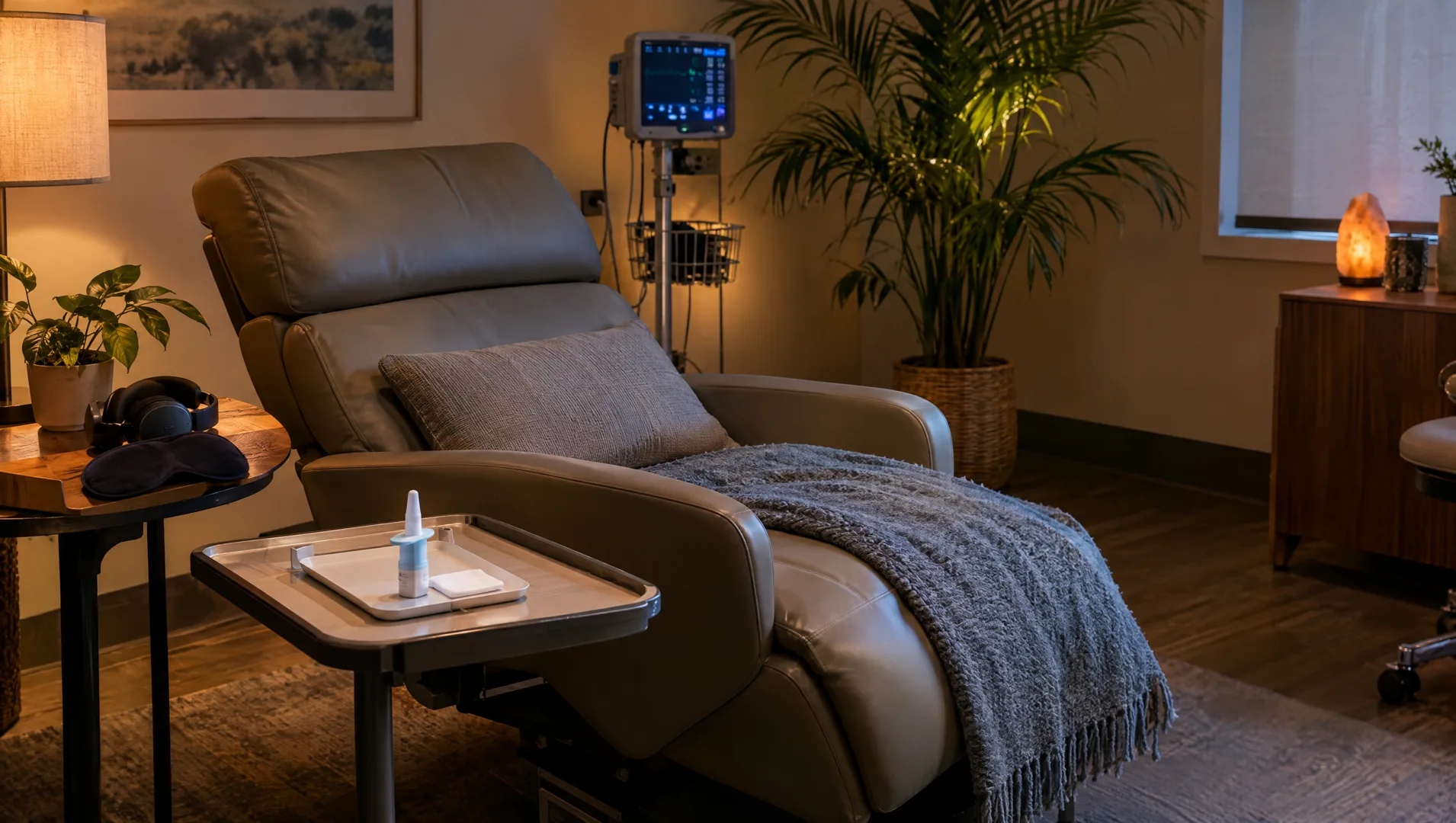
The first step is a same-week evaluation, in person, with a safety assessment using the Columbia scale and a written safety plan that includes means restriction, crisis contacts and a support person. If you are a candidate, we start Spravato twice weekly for four weeks at the standard 56 or 84 mg dose alongside an oral antidepressant, with the usual two-hour monitoring and ride home. Visits during this period include a brief suicidality check each time. At four weeks we reassess; the label recommends evaluating whether continuation is needed based on the depression, and many patients transition to the standard maintenance schedule. Throughout, you have the office number and 988.
Benefits
- Measurable improvement in depression within 24 hours of the first dose in the ASPIRE trials
- An FDA-approved option specifically studied in patients with acute suicidal ideation, not extrapolated from other populations
- Twice-weekly contact with a clinical team during the highest-risk period
- No prior medication failures required for this indication
- Can be started after an emergency room visit or hospital discharge to bridge the gap before oral antidepressants take effect
Risks and side effects
The side effects are the same as for any Spravato use: dissociation, dizziness, nausea, sedation and a temporary blood pressure rise. In this population, two risks need extra attention. First, dissociation can be frightening for someone already in crisis, so we prepare carefully and start at the lower dose. Second, the antidepressant boxed warning about increased suicidal thoughts in young adults applies to the oral antidepressant that must accompany Spravato. In the ASPIRE trials, suicidal ideation decreased on average in both groups and there was no signal of worsening with esketamine, but close monitoring is built into the plan. Spravato is not approved for bipolar depression with suicidal ideation, and misdiagnosed bipolar disorder is a risk we screen for.
Cost and insurance
Commercial plans and Medicare cover Spravato for this indication; prior authorization is generally faster than for treatment-resistant depression because the medical urgency is clear and no history of failed medications is required. We expedite the request. Our cost and insurance page covers the structure in detail.
What the ASPIRE trials showed
ASPIRE I and ASPIRE II enrolled a total of 456 adults with major depression who were assessed as being at imminent risk for suicide. All of them were hospitalized initially and started on a new oral antidepressant. Half received esketamine 84 mg twice weekly for four weeks; half received a placebo spray. The main outcome was the change in depression severity (MADRS) 24 hours after the first dose.
- Esketamine reduced MADRS scores by about 16 points at 24 hours, versus about 12 points for placebo, a difference of roughly 4 points that was statistically significant in both trials.
- At day 25, remission rates were about 41 percent on esketamine versus about 34 percent on placebo in the pooled data.
- The clinician-rated severity of suicidality improved markedly in both groups at 24 hours, with no significant difference between esketamine and placebo.
- Side effects were the familiar ones: dissociation, dizziness, sedation, nausea. There were no completed suicides during the double-blind phase in either group.
The interpretation: esketamine produces a faster antidepressant effect than standard care alone, in the sickest outpatient population studied, and it does so safely. It did not demonstrate a specific anti-suicidal effect beyond what hospitalization and intensive care provide. That is a meaningful result and a limited one, and we present it as both.
How Spravato fits into a safety plan
| Element | Role |
|---|---|
| Safety assessment and plan | Foundation. Columbia scale, warning signs, coping steps, contacts, means restriction. Updated at each visit |
| Hospitalization when needed | For anyone who cannot be kept safe between visits. Spravato can start in or after the hospital |
| Oral antidepressant | Required alongside Spravato for this indication; carries the long-term treatment |
| Spravato twice weekly for 4 weeks | Bridges the gap until the oral antidepressant works; twice-weekly clinical contact |
| Psychotherapy | CBT or DBT skills for suicidal thinking; begins during induction |
| Support person | Drives you home, holds the safety plan, knows the warning signs |
| 988 and emergency services | Always available; using them is part of the plan, not a failure of it |
Who should not use Spravato for this purpose
- Anyone who needs inpatient care right now. Outpatient Spravato is for people who are safe between visits.
- People with bipolar disorder; the depression indication does not apply, and esketamine was not studied in bipolar depression.
- People with active psychosis or current intoxication.
- People with aneurysms, arteriovenous malformations, prior brain hemorrhage or uncontrolled hypertension.
- Anyone under 18. A trial in adolescents did not show benefit.
For family members
If you are reading this because someone you love is in a dark place, the most useful things you can do are concrete: ask them directly whether they are thinking about suicide, remove or lock up firearms and large medication supplies, stay with them or arrange for someone to, and get them in front of a clinician this week. Spravato may be part of what that clinician recommends. It will not be the whole answer, and it does not work without a person who is willing to come twice a week and a plan to keep them safe in between.
Crisis resources in Palm Beach County
- 988 Suicide and Crisis Lifeline: call or text 988, 24 hours a day.
- 211 Palm Beach and Treasure Coast: dial 211 for local crisis and referral support.
- Emergency: call 911 or go to the nearest emergency department.
- Stedfast Psychiatry: call any office and tell the front desk it is urgent; we prioritize same-week evaluations for patients with active suicidal thoughts.
Spravato at Stedfast Psychiatry
We offer Spravato at three Palm Beach County offices, each with a dedicated monitoring room and staff trained under the Spravato REMS program:
- Boynton Beach: 10301 Hagen Ranch Rd, Suite D720, Boynton Beach, FL 33437
- Palm Beach Gardens: 11641 Kew Gardens Ave, Suite 209, Palm Beach Gardens, FL 33410
- Royal Palm Beach: 420 South State Road 7, Suite 112, Royal Palm Beach, FL 33414
Call the office nearest you or request an appointment online. The first step is an evaluation, in person or by telehealth, to confirm you are a candidate and to start insurance authorization.
Frequently asked questions
Is Spravato an emergency treatment for suicidal thoughts?
No. If you are in danger right now, you need the emergency room or 988, not a scheduled nasal spray. Spravato is for people who have been assessed as safe enough for outpatient treatment but whose depression is severe and dangerous and who cannot wait weeks for an oral antidepressant to work. In the trials, most patients started Spravato while hospitalized or right after discharge.
Does Spravato stop suicidal thoughts?
It reduces depression quickly, and suicidal thinking usually eases as depression lifts. But in the ASPIRE trials, the specific measure of suicidality improved about as much with placebo plus intensive care as with esketamine, so the honest statement is that Spravato speeds recovery from the depression driving the thoughts rather than acting directly on the thoughts. It works alongside a safety plan, therapy and support, not instead of them.
Do I need to have failed antidepressants to get Spravato for suicidal ideation?
No. This indication is based on the acute situation, not on treatment history, so a first episode of severe depression with suicidal thoughts can qualify. You do need to be on an oral antidepressant at the same time, and you need a diagnosis of major depressive disorder rather than bipolar disorder. Insurance authorization for this indication is usually fast because the urgency is clear.
Can I get Spravato after leaving the hospital?
Yes, and that is one of the most common ways it is used. The weeks after a psychiatric hospitalization carry the highest suicide risk, partly because oral antidepressants started in the hospital have not yet taken effect. Starting Spravato at discharge, with twice-weekly visits, bridges that gap. Ask the hospital team to refer you to us before discharge so that the first session can be scheduled within days.
How quickly does Spravato work for severe depression?
In ASPIRE, the esketamine group had a significantly larger drop in depression severity at 24 hours after the first dose, and the difference persisted through the four-week treatment period. Individual responses vary: some people feel a clear lift after the first session, others improve more gradually over the first two weeks. Patients who notice nothing after the first few sessions still sometimes respond by week three or four.
What if my family member is suicidal and refuses treatment?
If they are in immediate danger, call 911 or take them to the emergency room; in Florida, the Baker Act allows involuntary evaluation when someone is a danger to themselves. If they are not in immediate danger but are struggling, 988 can advise you, and you are welcome to call our office to discuss how to get them evaluated. Spravato requires a willing patient who can commit to twice-weekly visits; it cannot be given to someone who does not consent.
What happens after the four weeks?
We reassess. If the depression has improved, we usually transition to the standard treatment-resistant depression maintenance schedule (weekly, then every two weeks) if you meet those criteria, or taper off Spravato and continue the oral antidepressant and therapy. If the depression has not improved, we reconsider the diagnosis and treatment plan, including Deep TMS or a referral for ECT. The safety plan continues regardless.
Where this treatment is offered
- Boynton Beach, FL
10301 Hagen Ranch Rd, Suite D720 and Suite B710 - Palm Beach Gardens, FL
11641 Kew Gardens Ave, Suite 209 - Royal Palm Beach, FL
420 South State Road 7, Suite 112
Conditions this treats
If you are in crisis, call or text 988 or go to the nearest emergency room. Educational content; individual results vary. Reviewed by Dr. David Husted, board-certified psychiatrist.