Spravato is FDA-approved for depression, covered by most insurance and Medicare, and given as a nasal spray in a certified office with two hours of monitoring. IV ketamine is off-label, almost never covered, and dosed by weight through an infusion. No large head-to-head trial shows one is more effective; the practical differences are coverage, regulation and consistency.
Stedfast Psychiatry offers Spravato and not IV ketamine. That is a deliberate choice we explain below. We also think there are situations where infusions are a defensible option, and we say so. This page gives you a side-by-side comparison so that you can choose with your prescriber rather than with a clinic's marketing.
Who it is for
Spravato is the better fit for most insured patients with treatment-resistant depression, for Medicare beneficiaries, for anyone who values a standardized safety protocol, and for patients who need long-term maintenance with ongoing coverage. IV ketamine is sometimes chosen by patients who have failed Spravato and want a weight-based, adjustable dose; by uninsured patients for whom self-pay infusions cost less than self-pay Spravato; or in settings where no REMS-certified provider is available. Neither is appropriate for bipolar depression, active psychosis or unmanaged substance use.
How it works
Both drugs block NMDA receptors and trigger the glutamate surge and synapse growth described on our how Spravato works page. Spravato contains only esketamine, the S-enantiomer, which has higher affinity for the receptor. Racemic ketamine contains both S and R forms; R-ketamine has weaker NMDA binding but some animal data suggest it contributes antidepressant effects through other pathways. Whether that matters clinically is unresolved. The route matters more in practice: an infusion delivers a precise, weight-based dose (typically 0.5 mg/kg over 40 minutes) directly into the bloodstream, while the nasal spray delivers a fixed 56 or 84 mg dose with about half absorbed. Infusion clinics can titrate the dose session by session; Spravato has two dose options.
Esketamine (Spravato) is FDA-approved for treatment-resistant depression and for major depressive disorder with acute suicidal ideation; racemic ketamine is FDA-approved only as an anesthetic and its use for depression is off-label.
Source: U.S. Food and Drug Administration
A 2023 randomized trial of 403 patients found IV ketamine non-inferior to ECT for non-psychotic treatment-resistant depression, with 55 percent responding to ketamine versus 41 percent to ECT.
Source: Anand et al., New England Journal of Medicine, 2023 (ELEKT-D)
A 2021 meta-analysis of 24 trials found both IV ketamine and intranasal esketamine superior to placebo for depression, with a larger pooled effect size for IV ketamine, but noted the comparison was indirect and the esketamine trials used stricter designs.
Source: Bahji et al., Journal of Affective Disorders, 2021
In SUSTAIN-1, continuing esketamine reduced relapse risk by 51 percent in stable remitters; no comparable randomized maintenance trial exists for IV ketamine.
Source: Daly et al., JAMA Psychiatry, 2019
What to expect
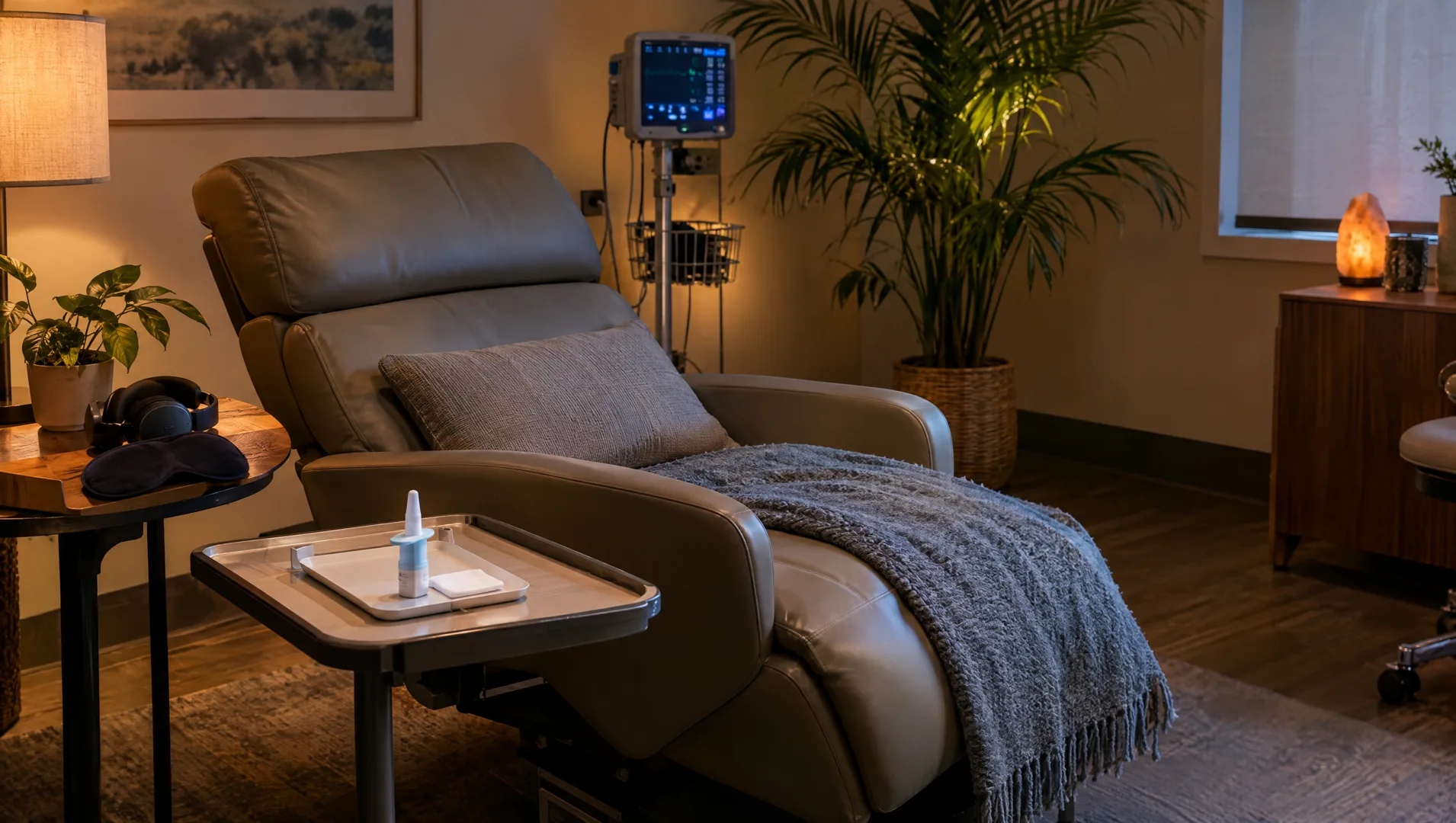
A Spravato session: fasting beforehand, self-administered spray under supervision, at least two hours of monitoring with blood pressure checks, a ride home. A ketamine infusion session: an IV line, a 40-minute infusion, usually 30 to 60 minutes of recovery, a ride home. Infusion clinics vary widely in monitoring intensity and in who is present; some are run by anesthesiologists, some by nurses, some by non-psychiatric physicians, and the psychiatric follow-up is often minimal. Spravato is delivered within a mental health practice that is also managing your overall treatment, which we think is the more important difference.
Benefits
- Spravato: FDA-approved, insurance and Medicare coverage, standardized REMS monitoring, delivered within ongoing psychiatric care, long-term relapse prevention data
- Spravato: fixed-dose nasal route means no IV and no anesthesia provider required
- IV ketamine: adjustable weight-based dosing, shorter visits, sometimes cheaper for uninsured patients, available for people who did not respond to esketamine
- Both: rapid onset compared with oral antidepressants, similar side-effect profile
Risks and side effects
The side effects are the same family for both: dissociation, dizziness, nausea, sedation, blood pressure rise. IV dosing can produce more intense dissociation because the full dose arrives faster, and higher doses are sometimes used off-label. The regulatory difference matters for safety: Spravato clinics must meet REMS certification, monitoring and reporting requirements, while infusion clinics operate under general medical licensing with no ketamine-specific standard. Some clinics also offer at-home oral or sublingual ketamine, which removes supervision entirely; serious adverse events and misuse have been reported with that model, and we do not recommend it.
Cost and insurance
Spravato: covered by most commercial plans and Medicare Part B with prior authorization; patient cost is usually a coinsurance share, often reduced by the manufacturer savings program for commercial patients. IV ketamine: off-label, so coverage is rare; typical self-pay pricing in South Florida runs $400 to $800 per infusion, with a six-infusion series of $2,500 to $5,000 and boosters afterward. For an insured patient, Spravato almost always costs less out of pocket. For an uninsured patient, infusions may cost less per session.
Side-by-side comparison
| Feature | Spravato (esketamine nasal spray) | IV ketamine infusion |
|---|---|---|
| Active drug | Esketamine (S-enantiomer only) | Racemic ketamine (S and R) |
| FDA status for depression | FDA-approved: TRD (2019), MDD with suicidal ideation (2020), TRD monotherapy (2025) | Off-label; approved only as an anesthetic |
| Insurance coverage | Most commercial plans and Medicare Part B, with prior authorization | Rarely covered; self-pay |
| Typical self-pay cost | Drug plus administration, roughly $1,000 to $1,800 per session at list; most patients pay far less with coverage | $400 to $800 per infusion; $2,500 to $5,000 for an initial series |
| Dosing | Fixed: 56 mg or 84 mg | Weight-based, typically 0.5 mg/kg, adjustable |
| Route | Nasal spray, self-administered under supervision | IV line placed by staff |
| Setting | REMS-certified office; psychiatric practice | Infusion clinic; variable staffing and oversight |
| Monitoring | At least 2 hours, blood pressure protocol required | Varies by clinic; commonly 30 to 60 minutes after infusion |
| Induction schedule | Twice weekly for 4 weeks (8 sessions) | Commonly 6 infusions over 2 to 3 weeks |
| Maintenance | Weekly or every 2 weeks; randomized relapse-prevention data | Boosters every few weeks; no randomized maintenance trial |
| Time per visit | About 2.5 hours | About 1 to 1.5 hours |
| Driving | Not until next day | Not until next day |
| Side effects | Dissociation, dizziness, nausea, sedation, blood pressure rise | Same; can be more intense at higher doses |
What the evidence actually compares
Patients often hear that infusions are stronger. The source of that claim is a set of meta-analyses that pooled trials of IV ketamine and trials of esketamine and found a larger average effect for IV. That comparison is indirect: the IV trials were mostly small, short (often a single dose with a one-week follow-up) and compared ketamine with saline, while the esketamine trials were larger, lasted four weeks and compared esketamine plus a new antidepressant against placebo plus a new antidepressant, a design that produces high placebo response. Larger effect sizes in weaker trials are not evidence of a stronger drug.
One important recent study, ELEKT-D, compared IV ketamine with ECT in 403 patients and found ketamine non-inferior, with 55 percent response. That is a strong result for ketamine, and it is fair to say IV ketamine is an effective treatment. It does not show that infusions beat esketamine, which has never been directly tested at scale. The single small randomized comparison published to date found no significant difference.
What esketamine has that ketamine does not is maintenance data. SUSTAIN-1 randomized responders to continue or stop and showed a halving of relapse risk with continuation. For a chronic, relapsing illness, that evidence shapes how we treat long term, and it is the main reason we built our program around Spravato.
When we refer for infusions
- You completed a full Spravato induction with no meaningful response and want to try the racemic form before moving to ECT.
- You are uninsured, do not qualify for the manufacturer assistance program, and the per-session cost of infusions is the only way to access any ketamine-based treatment.
- You cannot tolerate nasal administration because of chronic sinus disease or nasal surgery.
In those cases we coordinate with the infusion provider, continue your psychiatric care, and track your response with the same rating scales.
Bottom line
If you have insurance or Medicare and meet criteria for treatment-resistant depression, Spravato is the more accessible, more standardized and better-studied option for long-term care, and it is what we offer at Boynton Beach, Palm Beach Gardens and Royal Palm Beach. IV ketamine is a reasonable alternative in specific circumstances, and a clinic that tells you it is categorically better is overstating the evidence.
Spravato at Stedfast Psychiatry
We offer Spravato at three Palm Beach County offices, each with a dedicated monitoring room and staff trained under the Spravato REMS program:
- Boynton Beach: 10301 Hagen Ranch Rd, Suite D720, Boynton Beach, FL 33437
- Palm Beach Gardens: 11641 Kew Gardens Ave, Suite 209, Palm Beach Gardens, FL 33410
- Royal Palm Beach: 420 South State Road 7, Suite 112, Royal Palm Beach, FL 33414
Call the office nearest you or request an appointment online. The first step is an evaluation, in person or by telehealth, to confirm you are a candidate and to start insurance authorization.
Frequently asked questions
Is Spravato the same as ketamine?
No. Spravato contains esketamine, one of the two mirror-image molecules in ketamine. It is a different product with its own FDA approval, its own fixed-dose nasal spray, and its own safety program. Ketamine infusions use the full racemic mixture, which is approved as an anesthetic and used off-label for depression. They share a mechanism and similar side effects but differ in regulation, coverage and delivery.
Which works better, Spravato or ketamine infusions?
There is no definitive answer. No large randomized head-to-head trial has been completed. An indirect meta-analysis found a larger effect size for IV ketamine, but the IV trials were smaller and shorter with less rigorous designs, and the esketamine trials included a new antidepressant in both arms, which raised the placebo response. In clinical practice, response rates for both are roughly 50 to 70 percent. Some patients who do not respond to one respond to the other.
Why does insurance cover Spravato but not ketamine?
Because Spravato went through FDA trials for depression and has an approved indication, while ketamine for depression is off-label. Insurers and Medicare cover FDA-approved uses with evidence; they rarely cover off-label infusions of a generic anesthetic. The irony that the cheaper generic is not covered and the expensive brand is covered is real, but it reflects the approval system rather than the pharmacology.
Why does Stedfast Psychiatry offer Spravato and not ketamine infusions?
Three reasons. Coverage: most of our patients are insured or on Medicare, and Spravato is accessible to them in a way self-pay infusions are not. Safety structure: the REMS program gives us a standardized protocol and accountability that we think patients deserve. Evidence for maintenance: Spravato has randomized relapse-prevention data; infusions do not. We refer patients to infusion clinics in specific situations, such as esketamine non-response.
Is esketamine weaker than ketamine?
Per milligram, esketamine is more potent at the NMDA receptor. The total drug exposure per session can be lower with the nasal spray than with an infusion, because only about half the sprayed dose is absorbed, and some clinicians believe the R-enantiomer in racemic ketamine adds benefit. Neither point has been proven to matter for outcomes in a rigorous trial.
Can I switch from ketamine infusions to Spravato?
Yes, and patients do it in both directions. If you have been getting infusions out of pocket and your insurance would cover Spravato, switching can make long-term maintenance affordable. You will need an evaluation to document treatment-resistant depression and prior antidepressant trials, and insurance will not count ketamine infusions as one of those trials. If you responded to infusions, you are reasonably likely to respond to esketamine, though not guaranteed.
What about at-home ketamine lozenges or telehealth ketamine?
Several companies ship sublingual or oral ketamine for home use after a video visit. The evidence is weak, dosing is imprecise, there is no monitoring of blood pressure or dissociation, and reports of misuse and adverse events have increased. The FDA has warned about compounded ketamine products. We do not recommend this model. Spravato exists in a monitored setting for the same reasons that at-home ketamine concerns us.
Does Spravato or ketamine work for anxiety, PTSD or OCD?
Spravato is not approved for any of them, and we do not prescribe it off-label. Small studies of IV ketamine in PTSD and OCD show short-lived effects that fade within days to weeks, with no established maintenance strategy. Some clinics market infusions for these conditions; the evidence does not support it as a routine treatment. If you have PTSD or anxiety with co-occurring treatment-resistant depression, Spravato may be appropriate for the depression.
Where this treatment is offered
- Boynton Beach, FL
10301 Hagen Ranch Rd, Suite D720 and Suite B710 - Palm Beach Gardens, FL
11641 Kew Gardens Ave, Suite 209 - Royal Palm Beach, FL
420 South State Road 7, Suite 112
Conditions this treats
If you are in crisis, call or text 988 or go to the nearest emergency room. Educational content; individual results vary. Reviewed by Dr. David Husted, board-certified psychiatrist.