A Spravato session takes about two and a half hours. You arrive fasting (no food for two hours, no liquids for 30 minutes), staff check your blood pressure, you self-administer the nasal spray under supervision, then rest in a monitored room for at least two hours. Dissociation and dizziness peak at about 40 minutes and fade. A companion drives you home.
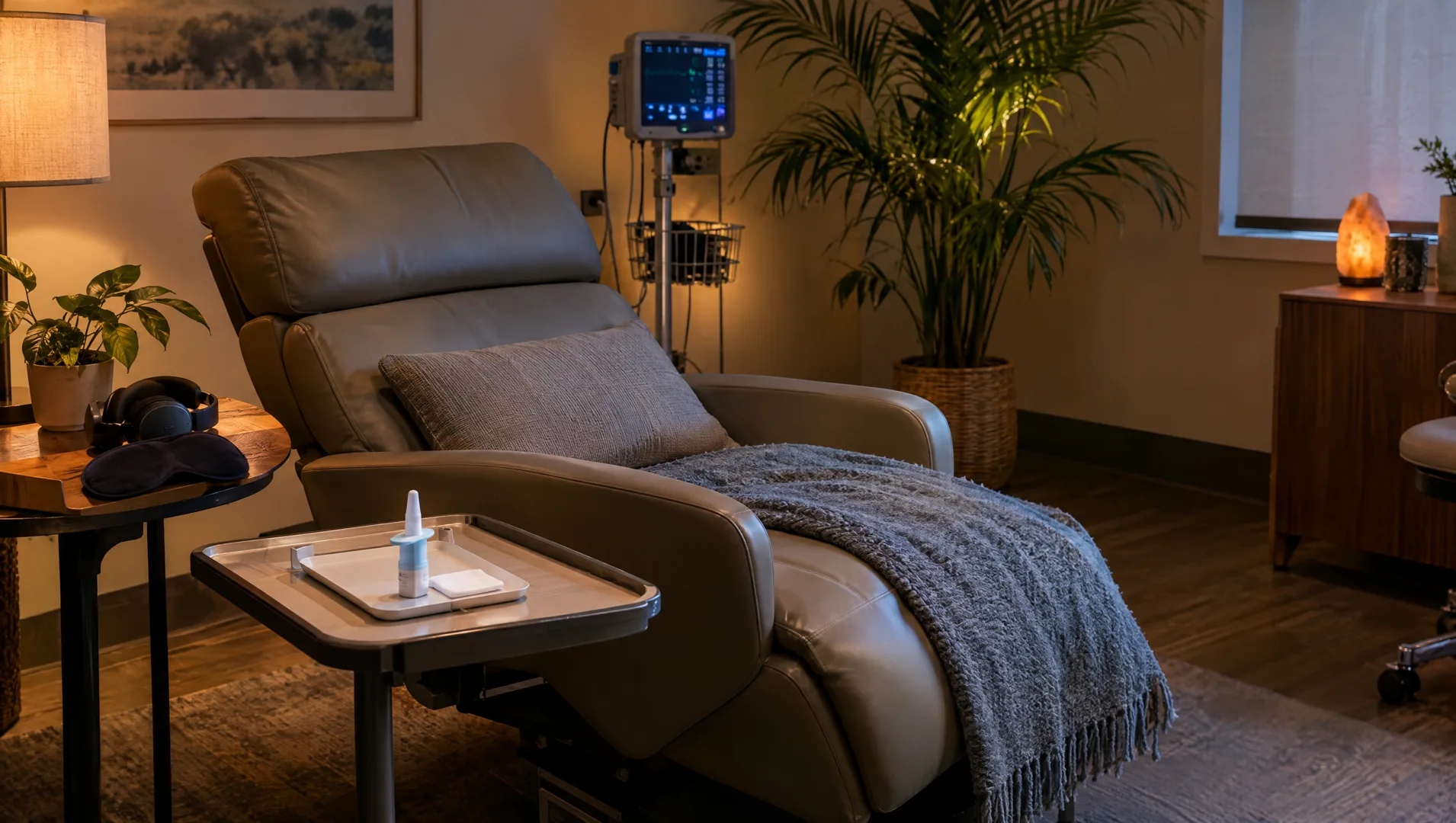
The short version: you arrive fasting, we check your blood pressure, you spray the medication yourself under supervision, you rest in a reclining chair in a quiet room for at least two hours while staff check on you, and someone drives you home. The dissociation and dizziness peak within the first hour and are largely gone by the time you leave.
Who it is for
New Spravato patients preparing for induction, family members or friends who will be the designated driver, and patients who had a difficult first session and want to understand what happened. If you have not yet been evaluated, start with our candidate page; this page assumes you have been approved and scheduled.
How it works
Each Spravato device holds 28 mg of esketamine in two sprays, one per nostril. A 56 mg dose uses two devices, 84 mg uses three, with a five-minute rest between devices to allow absorption. About half the dose is absorbed through the nasal lining into the bloodstream over 20 to 40 minutes; the rest is swallowed and mostly inactivated by the liver. Blood levels peak at about 40 minutes, which is when dissociation, blood pressure and sedation peak. Esketamine is then metabolized over the following hours, and the subjective effects fade well before the drug is fully cleared, which is why driving is restricted until the next day.
Each Spravato nasal spray device delivers a total of 28 mg of esketamine, 14 mg per nostril; two devices are used for a 56 mg dose and three for 84 mg, five minutes apart.
Source: Spravato prescribing information, FDA
Peak esketamine plasma concentration occurs 20 to 40 minutes after the last spray, with absolute bioavailability of about 48 percent by the nasal route.
Source: Spravato prescribing information, FDA
In the trials, dissociation symptoms measured on the CADSS scale typically began within 10 to 20 minutes, peaked at about 40 minutes and resolved by 1.5 hours.
Source: Spravato prescribing information and TRANSFORM trial data
Patients must be monitored for at least two hours after each dose and must not drive until the next day after a restful sleep, under the Spravato REMS.
Source: Spravato REMS program, FDA
What to expect
Before: no food for two hours, no liquids for 30 minutes, no alcohol the day before, nasal decongestant at least an hour before if you need it. Take your regular medications unless told otherwise. Wear comfortable clothes; bring headphones, a blanket if you like, and your driver's contact details. Arrival: check-in, blood pressure and pulse, a short mood check-in, confirmation of your ride. Dosing: you sit reclined, blow your nose first, tilt your head back slightly, and spray one device into each nostril as a staff member guides you. Rest five minutes, repeat for the second (and third) device. Monitoring: lights dimmed, a staff member checks on you regularly and takes blood pressure at about 40 minutes. You can listen to music, close your eyes or talk to staff; we discourage phone use and work. Discharge: blood pressure rechecked, a walking and alertness check, and you leave with your driver.
Benefits
- Every step is explained before it happens, and staff are present for the whole session
- A quiet, dimmed room with a reclining chair, not a busy clinic bay
- Blood pressure and alertness checked on a protocol, so problems are caught early
- Side effects almost always resolve before you leave, with a clear plan for the evening
- Follow-up questions answered at the next session rather than left to the internet
Risks and side effects
During the session: dissociation (about four in ten patients), dizziness, nausea, sedation, vertigo, numbness, anxiety and a temporary blood pressure rise. After the session: tiredness, mild headache and occasionally lingering fogginess into the evening. Rarely: vomiting, a significant blood pressure spike requiring extended monitoring, or a panic reaction during dissociation. Over the first few sessions, most patients find the effects become familiar and less intense. Full details, including the boxed warning and contraindications, are on our side effects and safety page.
Cost and insurance
The session is billed as the drug plus an administration and observation service and is covered by most commercial plans and Medicare Part B. If your blood pressure is too high to dose, you are not charged for the drug. See our cost and insurance page for details.
A session timeline
| Time | What happens |
|---|---|
| 2 hours before | Last food |
| 30 minutes before | Last liquids |
| 0:00 | Check-in. Blood pressure, pulse, mood check-in, ride confirmed |
| 0:10 | Device 1: one spray each nostril. Rest 5 minutes |
| 0:15 | Device 2 (and device 3 for 84 mg, after another 5 minutes) |
| 0:20 to 0:40 | Effects begin: floating, heaviness, altered perception, dizziness |
| 0:40 to 1:00 | Peak effects. Blood pressure check at about 40 minutes |
| 1:00 to 2:00 | Effects fade. Rest, music, light conversation if you want it |
| 2:00 to 2:20 | Discharge check: blood pressure, walking, alertness. Leave with your driver |
What dissociation feels like, from patients
Common descriptions: sinking into the chair, limbs feeling heavy or far away, the room looking larger or tilted, time passing slowly or in jumps, music sounding richer, a sense of watching yourself from slightly outside. Less common: brief confusion about where you are, vivid imagery with eyes closed, strong emotion surfacing. Unpleasant versions: a feeling of losing control, nausea with the room spinning, or anxiety that something is wrong. Staff will tell you in advance that these can happen and that they pass. Most patients say the second session is much easier than the first because the unknown is gone.
Tips from our staff
- Use the restroom right before dosing. Getting up during peak effects is unsteady.
- Bring headphones with a playlist you find calming. Avoid anything with lyrics that could become intrusive.
- Keep your eyes closed or focused on one fixed point during the first hour if you feel dizzy.
- If you get nauseated, tell staff; an anti-nausea medication can be given before future sessions.
- Write down anything you notice about your mood over the following days. Patterns emerge over weeks, not hours.
The first few sessions versus later ones
Session one is the strangest because it is unfamiliar and because the dose is set at 56 mg to see how you respond. By session three or four most patients have a routine, know what the peak feels like and how long it lasts, and settle into the chair rather than bracing. Blood pressure responses also tend to be consistent from session to session, so staff know what to expect from you. By maintenance, many patients describe the sessions as a scheduled quiet time rather than a medical ordeal.
Spravato at Stedfast Psychiatry
We offer Spravato at three Palm Beach County offices, each with a dedicated monitoring room and staff trained under the Spravato REMS program:
- Boynton Beach: 10301 Hagen Ranch Rd, Suite D720, Boynton Beach, FL 33437
- Palm Beach Gardens: 11641 Kew Gardens Ave, Suite 209, Palm Beach Gardens, FL 33410
- Royal Palm Beach: 420 South State Road 7, Suite 112, Royal Palm Beach, FL 33414
Call the office nearest you or request an appointment online. The first step is an evaluation, in person or by telehealth, to confirm you are a candidate and to start insurance authorization.
Frequently asked questions
What should I do the night before a Spravato session?
Sleep well, skip alcohol, and plan the next morning so that you can arrive without rushing. Eat a normal dinner. If your session is in the morning, eat breakfast at least two hours before and stop drinking liquids 30 minutes before; a cup of coffee early is fine. Confirm your ride. Pack headphones and anything that helps you relax.
Why can I not eat or drink before Spravato?
Nausea and vomiting are common side effects, and an empty stomach reduces both. The label specifies no food for two hours and no liquids for 30 minutes before the dose. Vomiting during a session can also waste the dose if it happens soon after the spray. If you have diabetes or another condition that makes fasting risky, tell us and we will adjust the timing or schedule you first thing in the morning.
Can I take my regular medications before Spravato?
Usually yes. Take blood pressure medication as prescribed, because a well-controlled pressure is what we want. Tell us about benzodiazepines (clonazepam, lorazepam, alprazolam), which can blunt the response and add sedation; we may ask you to skip a dose that morning. Tell us about stimulants, which can raise blood pressure. Nasal steroid or decongestant sprays should be used at least an hour before, not right before.
What does the Spravato room look like?
A private or semi-private room with a reclining chair, dimmable lighting and a blood pressure monitor. It is quiet. Staff are nearby and check on you regularly. You are welcome to bring an eye mask, a blanket or music. We ask that you not bring work, because concentration is impaired and screens can worsen dizziness.
Can someone stay with me during the session?
Generally your driver waits in the lobby or returns at discharge time, since the room is kept quiet and we want you to be able to rest. If you are anxious about the first session, we can arrange for a companion to sit with you for part of it; let us know when you schedule. Staff are present regardless, and you are never left alone during the peak of the dose.
What happens if I feel panicked during dissociation?
Tell the staff member; they are trained for this. Grounding techniques (feeling the chair, slow breathing, having someone speak to you calmly) help most people within minutes. The feeling is time-limited and peaks early. If a reaction is severe, we can stop the session before the second or third device, and we will start the next session at the lower dose. Severe panic is uncommon and tends not to recur once you know what to expect.
How will I feel the rest of the day?
Most people feel tired and a little foggy for the rest of the day, similar to the afternoon after a poor night's sleep. Some feel noticeably calmer or lighter. Plan a quiet evening: no driving, no alcohol, no important decisions or paperwork. Eat normally. You can return to work and driving the next morning after a full night's sleep.
Can I use Uber or Lyft to get home?
Yes. The requirement is that you do not drive; a ride-share driver satisfies it. We recommend having a friend or family member for the first session if possible, in case you feel unsteady, but it is not required. We will confirm your ride before dosing and will not administer the dose if you intend to drive yourself.
Where this treatment is offered
- Boynton Beach, FL
10301 Hagen Ranch Rd, Suite D720 and Suite B710 - Palm Beach Gardens, FL
11641 Kew Gardens Ave, Suite 209 - Royal Palm Beach, FL
420 South State Road 7, Suite 112
Conditions this treats
If you are in crisis, call or text 988 or go to the nearest emergency room. Educational content; individual results vary. Reviewed by Dr. David Husted, board-certified psychiatrist.