Spravato and TMS are both insurance-covered options for depression that has not responded to medication, with similar response rates of roughly 50 to 60 percent. Spravato is a drug with dissociative effects, works faster and needs a ride home; TMS is drug-free, requires daily visits for six to nine weeks and has milder side effects. The choice depends on history, urgency and schedule.
The short version: both are effective for roughly half of patients with treatment-resistant depression, both are covered by most insurance and Medicare, and the right choice usually comes down to medical history, how fast you need relief, and which schedule you can actually complete.
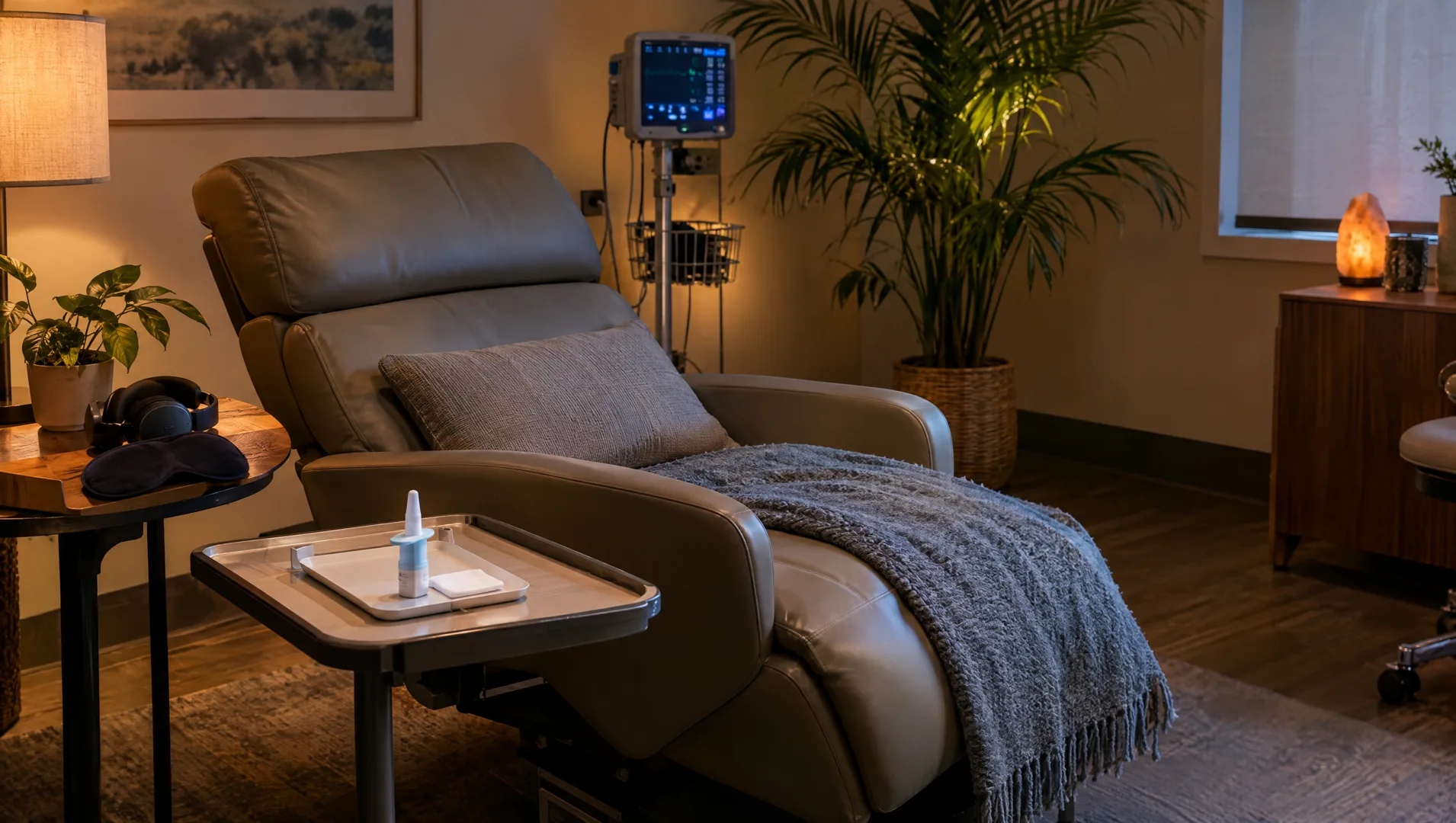
Who it is for
Spravato tends to suit patients who need rapid improvement, including those with acute suicidal ideation; patients whose schedule cannot absorb daily visits but can handle twice-weekly half-days; and patients who have a contraindication to TMS such as metal implants near the head or a seizure disorder. TMS tends to suit patients who want to avoid medication effects entirely; patients with a contraindication to esketamine such as aneurysm, uncontrolled hypertension or substance use disorder; patients who cannot arrange a driver twice a week; and patients who are pregnant, where TMS has a better safety record. Both require an adult with major depressive disorder and prior antidepressant failures; TMS requires one failure for most insurers, Spravato requires two.
How it works
Spravato is esketamine, a drug that blocks NMDA glutamate receptors and triggers synapse growth in the prefrontal cortex. It is chemical and systemic: it affects the whole brain and body for a couple of hours, and the antidepressant effect emerges over days. Deep TMS uses a magnetic coil in a helmet to deliver brief pulses that induce small electrical currents in the prefrontal cortex, stimulating underactive circuits directly. It is physical and focal: nothing enters the bloodstream, there is no dissociation and no monitoring period, and the effect builds gradually over weeks of daily stimulation. Both ultimately increase activity and connectivity in the same mood-regulating circuits by different routes.
Deep TMS was FDA-cleared for major depressive disorder in 2013, OCD in 2018, smoking cessation in 2020 and anxious depression in 2021; Spravato was FDA-approved for treatment-resistant depression in 2019 and MDD with suicidal ideation in 2020.
Source: U.S. Food and Drug Administration clearance and approval records
In the Deep TMS pivotal trial, 38.4 percent of patients responded and 32.6 percent remitted after 16 weeks versus 21.4 and 14.6 percent with sham; in real-world registry data, response rates run higher, around 60 to 70 percent.
Source: Levkovitz et al., World Psychiatry, 2015; BrainsWay post-marketing data
In TRANSFORM-2, 69 percent of patients on esketamine plus a new antidepressant responded and 52.5 percent remitted at day 28, versus 52 and 31 percent on placebo plus a new antidepressant.
Source: Popova et al., American Journal of Psychiatry, 2019
No randomized head-to-head trial of esketamine versus TMS has been completed; a 2022 network meta-analysis found both superior to sham or placebo with overlapping confidence intervals.
Source: Network meta-analyses of interventional treatments for TRD, 2022
What to expect
Spravato: about 2.5 hours per visit, twice weekly for four weeks, then weekly, then every one to two weeks for as long as it helps. Fasting beforehand, dissociation during, a ride home after. Deep TMS: about 20 to 30 minutes per visit, five days a week for six weeks, then a three-week taper, 36 sessions in total. No preparation, you drive yourself, and you return to work immediately. Some scalp discomfort during the first week. After a TMS course, some patients stay well for a year or more; others need a repeat course or maintenance sessions. After Spravato induction, ongoing maintenance sessions are usual.
Benefits
- Spravato: faster onset, FDA-approved for suicidal ideation, fewer total visits in the first two months, no issue with metal implants or seizure history
- TMS: no drug, no dissociation, no driving restriction, no blood pressure concern, safe in pregnancy, durable response in many patients without ongoing sessions
- Both: covered by most commercial plans and Medicare, delivered in a psychiatric practice, roughly 50 to 60 percent response in treatment-resistant depression
- Both offered by Stedfast Psychiatry, so the recommendation is based on your history rather than what a clinic sells
Risks and side effects
Spravato: dissociation, dizziness, nausea, sedation, temporary blood pressure rise, a boxed warning for sedation, dissociation, respiratory depression and misuse; contraindicated with aneurysms, arteriovenous malformations and prior brain hemorrhage. TMS: scalp pain or discomfort at the stimulation site, headache, jaw or facial twitching during pulses, rarely a seizure (roughly 1 in 30,000 sessions); contraindicated with non-removable ferromagnetic metal in or near the head, cochlear implants, and some implanted devices. TMS has no systemic side effects and no cognitive effects. Neither treatment is approved for bipolar depression, though TMS is sometimes used off-label for it with a mood stabilizer.
Cost and insurance
Both are covered by most commercial plans and Medicare with prior authorization. Spravato is billed per session as drug plus observation; TMS is billed per session as a procedure with a separate initial mapping fee. Spravato typically requires two documented antidepressant failures; TMS typically requires one failure plus a trial of therapy, though some plans require more. Self-pay pricing differs considerably; a full TMS course and a full Spravato induction plus three months of maintenance are in a similar range at list price. Our cost pages for each treatment give specifics.
Side-by-side comparison
| Feature | Spravato (esketamine) | Deep TMS |
|---|---|---|
| What it is | Nasal spray drug | Magnetic stimulation device |
| FDA status | FDA-approved: TRD, MDD with suicidal ideation, TRD monotherapy | FDA-cleared: MDD, OCD, smoking cessation, anxious depression |
| Insurance | Most commercial plans and Medicare, prior authorization, usually 2 failed antidepressants | Most commercial plans and Medicare, prior authorization, usually 1 failed antidepressant plus therapy |
| Setting | REMS-certified office, monitored room | Office treatment chair |
| Session length | About 2.5 hours | About 20 to 30 minutes |
| Schedule | Twice weekly for 4 weeks, weekly for 4 weeks, then every 1 to 2 weeks ongoing | Daily, 5 days a week, 6 weeks plus 3-week taper; 36 sessions |
| Onset | Hours to 2 weeks | 2 to 4 weeks |
| Driving | Not until next day | Immediately |
| Main side effects | Dissociation, dizziness, nausea, sedation, blood pressure rise | Scalp discomfort, headache; rare seizure |
| Contraindications | Aneurysm, AV malformation, brain hemorrhage, uncontrolled hypertension; caution with substance use disorder and pregnancy | Ferromagnetic metal near head, cochlear implant, some implanted devices; caution with seizure disorder |
| Maintenance | Ongoing sessions usual | Often none; repeat course or maintenance sessions if relapse |
| Stedfast locations | Boynton Beach, Palm Beach Gardens, Royal Palm Beach | Palm Beach Gardens |
How we decide with you
At the evaluation we look at five things. Medical contraindications first: metal near the head or a seizure history points to Spravato; aneurysm, uncontrolled blood pressure, pregnancy or substance use disorder points to TMS. Urgency second: active suicidal ideation or a crisis that cannot wait a month points to Spravato. Schedule third: daily 30-minute visits versus twice-weekly half-days with a driver, whichever you can finish. Preference fourth: some people want no drug; some want the fastest option. History fifth: a prior response to ketamine suggests Spravato; a prior response to TMS suggests a repeat course.
Sequencing both
Patients who respond partially to one treatment often do well adding the other in sequence. A common path is Spravato induction for rapid stabilization, followed by a TMS course to consolidate and allow Spravato to be tapered. Another is a TMS course first for a patient who wants to avoid medication, with Spravato as the next step if TMS does not produce remission. We also use both as alternatives to ECT, which remains the most effective option for the most severe cases and which we refer out for.
What neither treatment does
Neither cures depression or replaces therapy, sleep, exercise and attention to alcohol and stress. Neither is approved for bipolar depression. Neither works for everyone; roughly four in ten patients will not get a satisfactory response from either one, and for those patients we move to the next option rather than repeating what failed. Both are serious medical treatments for a serious illness, and both have given many of our patients a response they had stopped expecting.
Spravato at Stedfast Psychiatry
We offer Spravato at three Palm Beach County offices, each with a dedicated monitoring room and staff trained under the Spravato REMS program:
- Boynton Beach: 10301 Hagen Ranch Rd, Suite D720, Boynton Beach, FL 33437
- Palm Beach Gardens: 11641 Kew Gardens Ave, Suite 209, Palm Beach Gardens, FL 33410
- Royal Palm Beach: 420 South State Road 7, Suite 112, Royal Palm Beach, FL 33414
Call the office nearest you or request an appointment online. The first step is an evaluation, in person or by telehealth, to confirm you are a candidate and to start insurance authorization.
Frequently asked questions
Is Spravato or TMS more effective?
The evidence does not show one is clearly better. No head-to-head trial exists. Both separate from placebo or sham in controlled trials and both produce response in roughly half of patients with treatment-resistant depression in practice. Spravato works faster; TMS results often last longer without ongoing sessions. The honest answer is that they are comparable, and the choice is about fit.
Can I do Spravato and TMS at the same time?
Not usually at the same time, but they are commonly done in sequence. A patient who responds partially to one may add the other. We generally do not run them simultaneously because it becomes impossible to tell which is working and because the combined schedule is heavy. If you have done one without success, the other is a reasonable next step before considering ECT.
Which has fewer side effects, Spravato or TMS?
TMS. Its side effects are local: scalp discomfort and headache in the first week, which fade. There is no dissociation, no nausea, no blood pressure effect, no sedation and no driving restriction. Spravato's side effects are systemic and occur at every session, though they are confined to the two-hour monitoring window and most patients tolerate them. For someone who wants to avoid drug effects, TMS is the clear choice.
Which works faster, Spravato or TMS?
Spravato. Measurable improvement can occur within 24 hours and most responders see change within one to two weeks. TMS typically takes two to four weeks of daily sessions before patients notice improvement, with the full effect by the end of the six-week course. For acute suicidal ideation, only Spravato has an FDA indication, which is why it is the usual choice when speed matters most.
Which is easier to fit around work?
It depends on your job. TMS is 20 to 30 minutes a day, five days a week for six weeks; you drive yourself and go straight back to work, but it is 30 separate appointments. Spravato is eight half-day appointments in the first month with a ride home and no work that afternoon, then one a week, then one every two weeks. People with flexible mornings often prefer TMS; people who can block two half-days a week but not a daily slot prefer Spravato.
Does insurance treat Spravato and TMS differently?
Somewhat. Both are covered by most commercial plans and Medicare with prior authorization. TMS criteria usually require one failed antidepressant and a therapy trial; Spravato usually requires two failed antidepressants. TMS authorization covers a defined course of about 36 sessions; Spravato authorization covers an initial period and then requires documented response for maintenance. Patient cost share depends on your plan's deductible and coinsurance for procedures versus drugs.
Which is better for someone over 65?
Both are used. TMS has no systemic effects, which is an advantage in older adults with cardiovascular disease or multiple medications. Spravato's trial in adults 65 and older did not meet its primary endpoint, though it showed a trend toward benefit, and older adults start at a lower dose with closer blood pressure monitoring. Medicare covers both. We weigh cardiovascular history, mobility, transportation and how urgently relief is needed.
Where does Stedfast Psychiatry offer each?
Deep TMS is at our Palm Beach Gardens office, 11641 Kew Gardens Ave, Suite 209. Spravato is at Palm Beach Gardens, Boynton Beach (10301 Hagen Ranch Rd, Suite D720) and Royal Palm Beach (420 South State Road 7, Suite 112). Patients from any Stedfast office can be referred to these locations for interventional treatment while continuing routine care with their regular provider.
Where this treatment is offered
- Boynton Beach, FL
10301 Hagen Ranch Rd, Suite D720 and Suite B710 - Palm Beach Gardens, FL
11641 Kew Gardens Ave, Suite 209 - Royal Palm Beach, FL
420 South State Road 7, Suite 112
Conditions this treats
If you are in crisis, call or text 988 or go to the nearest emergency room. Educational content; individual results vary. Reviewed by Dr. David Husted, board-certified psychiatrist.