You are likely a TMS candidate if you are an adult with major depressive disorder, have tried at least one antidepressant at an adequate dose for six weeks or more without enough relief, and have no ferromagnetic metal in your head or seizure disorder. Insurers usually require two to four failed medication trials plus psychotherapy. Deep TMS is also cleared for OCD, anxious depression and smoking cessation.
This page lays out both sets of criteria so you can get a realistic sense of where you stand before you call. If you recognize yourself in the first section and nothing in the contraindications section applies, you are very likely a candidate, and our TMS coordinator at Palm Beach Gardens can confirm coverage within a few days.
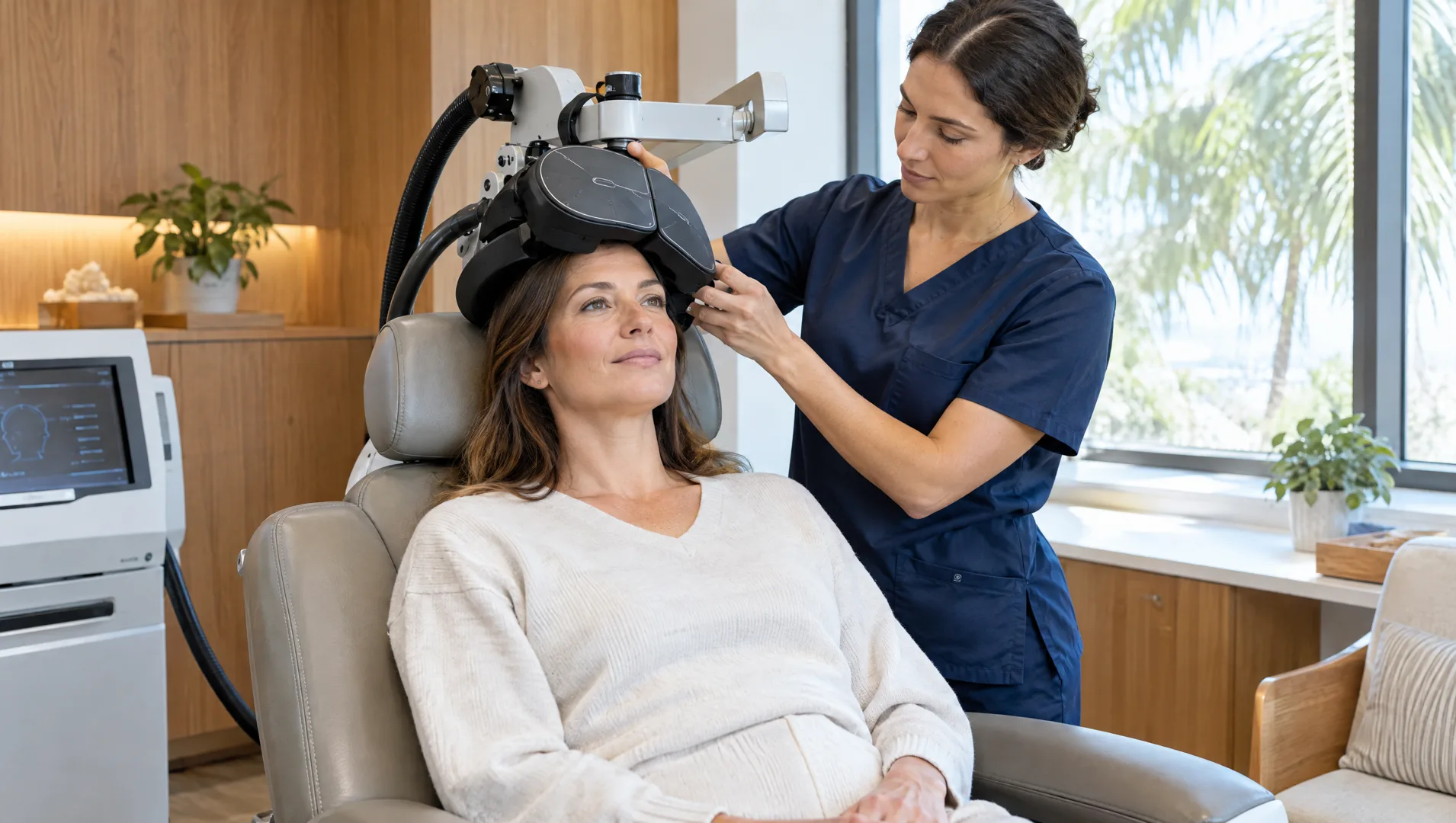
Who it is for
The core candidate is an adult, 18 or older, with a current episode of major depressive disorder of at least moderate severity, who has tried antidepressant medication without reaching remission or who could not tolerate it. That describes a large share of the patients we see for medication management. Beyond depression, Deep TMS is FDA-cleared for OCD that has not responded to an SSRI and exposure therapy, for depression with prominent anxiety, and as a short-term aid to quitting smoking. Patients with bipolar depression are treated case by case, usually on a mood stabilizer, because TMS can occasionally trigger hypomania. We also see many older adults: there is no upper age limit, Medicare covers TMS, and late-life depression that has not responded to medication is one of the clearest indications.
How it works
Candidacy is determined at a consultation with a Stedfast psychiatrist. We confirm the diagnosis with a structured interview, document the severity with the PHQ-9 and, when the insurer requires it, the HAM-D or MADRS. We build a timeline of every antidepressant you have tried, with dose and duration, because an adequate trial means at least six weeks at a therapeutic dose. We record psychotherapy history, since most insurers want a documented trial. Then we screen for contraindications: metal in the head, implanted devices, seizure history, head injury, pregnancy and medications that lower the seizure threshold. If you qualify clinically, the TMS coordinator checks your specific plan's criteria and submits prior authorization.
Roughly one third of patients with major depressive disorder do not reach remission after four sequential medication steps, meeting the common definition of treatment-resistant depression.
Source: STAR*D trial, Rush et al., American Journal of Psychiatry, 2006
The Florida Medicare local coverage determination for TMS requires a confirmed diagnosis of severe major depressive disorder and failure of or intolerance to at least one antidepressant trial, ordered by a psychiatrist after a face-to-face evaluation.
Source: First Coast Service Options, LCD L34522
Absolute contraindications to TMS, per international safety guidelines, are ferromagnetic or conductive metal in the head and implanted electronic devices within 30 centimeters of the coil.
Source: Rossi et al., Clinical Neurophysiology, 2021
In the Deep TMS pivotal trial, participants had failed one to four antidepressant trials in the current episode and still showed a remission rate more than double that of sham.
Source: Levkovitz et al., World Psychiatry, 2015
What to expect
Bring a list of every psychiatric medication you have taken, with approximate dates and doses, and the names of therapists you have worked with. If you have records from a prior psychiatrist, request them in advance or sign a release so we can. The consultation takes about an hour and can be done by telehealth, though the first treatment day must be in person at Palm Beach Gardens. Expect a decision on clinical candidacy at the end of the visit and an insurance decision within one to three weeks for commercial plans. Medicare patients can usually start within days once documentation is complete.
Benefits
- Clear clinical criteria: most patients know within one visit whether TMS fits
- No upper age limit, and Medicare coverage makes TMS accessible for older adults
- Can start while you continue your current antidepressant and therapy
- Our TMS coordinator verifies coverage before you commit to a schedule
- If you do not qualify for TMS, Spravato and medication options are available in the same practice
Risks and side effects
The screening exists to keep the already small risks small. Metal in the head can heat or move in the magnetic field. A history of seizures raises the chance that stimulation triggers one. Medications such as bupropion above 300 mg, clozapine, tramadol and high-dose stimulants lower the seizure threshold and may need adjustment before you start. Sleep deprivation and heavy alcohol use raise seizure risk during a course, and we ask you to avoid both.
Cost and insurance
Medicare covers TMS for major depressive disorder in Florida when the diagnosis is documented, at least one antidepressant trial has failed or been intolerable, and a psychiatrist orders the treatment after an in-person evaluation. Commercial insurers set a higher bar: typically two to four failed antidepressant trials from at least two different classes, a trial of psychotherapy, a PHQ-9 or HAM-D score in the moderate to severe range, and no active substance use disorder. Prior authorization is required. If you are not covered, ask our TMS coordinator for current self-pay rates.
Clinical criteria: the psychiatrist's checklist
- Diagnosis: major depressive disorder, single or recurrent episode, confirmed by clinical interview. Also OCD, anxious depression or nicotine dependence under the respective clearances.
- Severity: at least moderate, which on the PHQ-9 usually means a score of 10 or above and for most insurers 15 or above.
- Medication history: at least one adequate antidepressant trial (six or more weeks at a therapeutic dose) that did not produce remission, or a trial stopped for intolerable side effects.
- Psychotherapy: a documented trial of evidence-based therapy, or a reason it was not feasible.
- No active substance use disorder that would interfere with attendance or raise seizure risk.
- No psychotic features in the current episode, which usually call for ECT or antipsychotic augmentation first.
- Able to attend daily sessions for six weeks at Palm Beach Gardens.
Contraindications: what rules TMS out
| Finding | Status | Notes |
|---|---|---|
| Aneurysm clips, cochlear implant, deep brain stimulator, vagus nerve stimulator | Absolute | Ferromagnetic or electronic, within the field |
| Metallic fragments in the eye or skull | Absolute | Shrapnel, bullet fragments, some welding injuries |
| Pacemaker or implanted defibrillator | Relative | Usually acceptable at chest distance with cardiology clearance; confirm device model |
| History of epilepsy or unprovoked seizure | Relative | Requires neurology records; often excluded if seizure within one year |
| Traumatic brain injury with loss of consciousness, brain tumor, stroke | Relative | Reviewed case by case with imaging |
| Dental fillings, crowns, braces, titanium plates | Not a contraindication | Non-ferromagnetic |
| Pregnancy | Not a contraindication | Shared decision with obstetrician |
Insurance criteria: the payer's checklist
Commercial payers write their own TMS policies, but they converge on a common set of requirements. You will generally need a PHQ-9 of 15 or higher, or a HAM-D of 18 or higher, at the time of authorization. You will need documentation of two to four antidepressant trials of adequate dose and duration, usually from at least two different pharmacologic classes, and some plans want one augmentation trial as well. You will need a documented course of psychotherapy, or a documented reason it was not possible. Your psychiatrist must attest that you have no contraindications and that you can comply with the daily schedule.
Medicare in Florida, administered by First Coast Service Options, is simpler: a diagnosis of severe major depressive disorder, failure of or intolerance to at least one antidepressant, and an order from a psychiatrist who has examined you in person. Medicare covers an acute course of up to six weeks and allows retreatment for patients who responded previously.
Common situations and how we handle them
You have tried many medications but the records are scattered
This is the most common obstacle, not the medical criteria. Pharmacy records from your pharmacy chain, old patient portals and prior psychiatrists' notes all count. Our coordinator will help you assemble a medication timeline, and in many cases a pharmacy printout is enough to satisfy the payer.
Your depression is severe and you are thinking about suicide
TMS is appropriate for severe depression, but it takes weeks to work. If you are in crisis, call or text 988 or go to the nearest emergency room. For patients with active suicidal ideation who need faster relief, Spravato, which carries a specific FDA approval for depression with suicidal thoughts, or ECT may be more appropriate first, with TMS as a follow-on to maintain the gains.
You have depression and anxiety together
This is the typical presentation, and it is exactly what the 2021 anxious depression clearance covers. In pooled trial data, patients with comorbid anxiety responded to Deep TMS about as well as those without, and their anxiety scores fell alongside their depression scores.
You tried TMS before at another clinic
Prior TMS does not disqualify you. If you responded before and relapsed, insurers typically cover retreatment. If you did not respond to figure-8 rTMS, Deep TMS with a different coil and protocol is a reasonable next step, though the evidence on switching coil types is limited and we will be honest about that.
Deep TMS in Palm Beach Gardens
Stedfast Psychiatry delivers Deep TMS at our Palm Beach Gardens office, 11641 Kew Gardens Ave, Suite 209, just off PGA Boulevard and I-95. Patients travel to us from Jupiter, West Palm Beach, Boynton Beach, Stuart and Royal Palm Beach, and most find the drive manageable because a Deep TMS session takes about 20 minutes and you drive yourself home. Call (561) 437-2199 to schedule a TMS consultation, or ask your current Stedfast provider for an internal referral. Our TMS coordinator handles insurance verification, prior authorization and scheduling so you can start as soon as approval comes through.
Frequently asked questions
How many antidepressants do I need to have tried before TMS?
Clinically, one adequate trial is enough for a psychiatrist to recommend TMS. For insurance, it depends on the plan. Medicare in Florida requires failure of or intolerance to at least one medication. Most commercial plans require two to four trials from at least two classes, each lasting six weeks or more at a therapeutic dose. Intolerance counts: if you stopped a medication because of side effects, that is a documented trial.
Can I have TMS if I have bipolar disorder?
Possibly. Deep TMS is cleared for major depressive disorder, not bipolar depression, so coverage is often off-label and less predictable. Clinically, TMS has been used in bipolar depression with reasonable results, but there is a small risk of switching into hypomania or mania, so we treat only patients who are stable on a mood stabilizer and we monitor closely. Our psychiatrist will discuss the tradeoffs with you at the consultation.
Is there an age limit for TMS?
Deep TMS is FDA-cleared for adults 22 and older for depression; we treat patients 18 and up based on the broader TMS literature and clinical judgment. There is no upper limit. Late-life depression responds well to TMS, and Medicare coverage removes the cost barrier for many older patients. Adolescent TMS is an active research area, but it is not yet cleared and we do not offer it.
Can I have TMS if I have anxiety but not depression?
Not under current clearances. Deep TMS is cleared for anxious depression, meaning depression with significant anxiety symptoms, and that covers most anxious patients we see because the two usually travel together. Generalized anxiety disorder on its own is not a cleared indication, insurers do not cover it, and the evidence is still developing. If anxiety is your main problem, medication and therapy remain the first-line options.
Do I need to stop my medications before TMS?
No. Most patients continue their antidepressant throughout, and registry data suggest that continuing medication improves outcomes. We review your full medication list because a few drugs lower the seizure threshold and may need a dose adjustment. Benzodiazepines at high doses can blunt TMS response and we may suggest tapering. Never stop or change a medication on your own before a TMS consultation.
What if I have had a seizure before?
A history of epilepsy or unprovoked seizures is a relative contraindication, meaning we weigh it carefully rather than ruling TMS out automatically. A single febrile seizure in childhood is usually not a barrier. Active epilepsy, a seizure in the past year, or a structural brain lesion generally is. If you have a seizure history we will ask for neurology records and may request an EEG before deciding.
Can I have TMS while pregnant?
TMS does not expose the fetus to medication, and the magnetic field does not reach the uterus, so it is considered a reasonable option in pregnancy when depression is significant and medication is a concern. Several studies have reported safe use. It is not an FDA-cleared indication, however, and we make the decision together with you and your obstetrician after reviewing the alternatives.
What happens if I am not a candidate?
You still have options in the same practice. Spravato (esketamine) nasal spray is available at Palm Beach Gardens, Boynton Beach and Royal Palm Beach for treatment-resistant depression and has different contraindications than TMS. Medication augmentation strategies, including lithium, atypical antipsychotics and thyroid hormone, remain underused. And if the barrier is insurance rather than clinical fit, our TMS coordinator can discuss self-pay rates and appeals.
Where this treatment is offered
Conditions this treats
If you are in crisis, call or text 988 or go to the nearest emergency room. Educational content; individual results vary. Reviewed by Dr. David Husted, board-certified psychiatrist.