Deep TMS and traditional rTMS are both FDA-cleared, both roughly double sham response rates, and no head-to-head trial has shown one to be clearly superior for depression. Deep TMS uses an H-coil that reaches about 4 cm deep over a broader area; figure-8 rTMS reaches about 2 cm with more precision. Deep TMS also holds OCD, smoking cessation and anxious depression clearances. Stedfast uses Deep TMS.
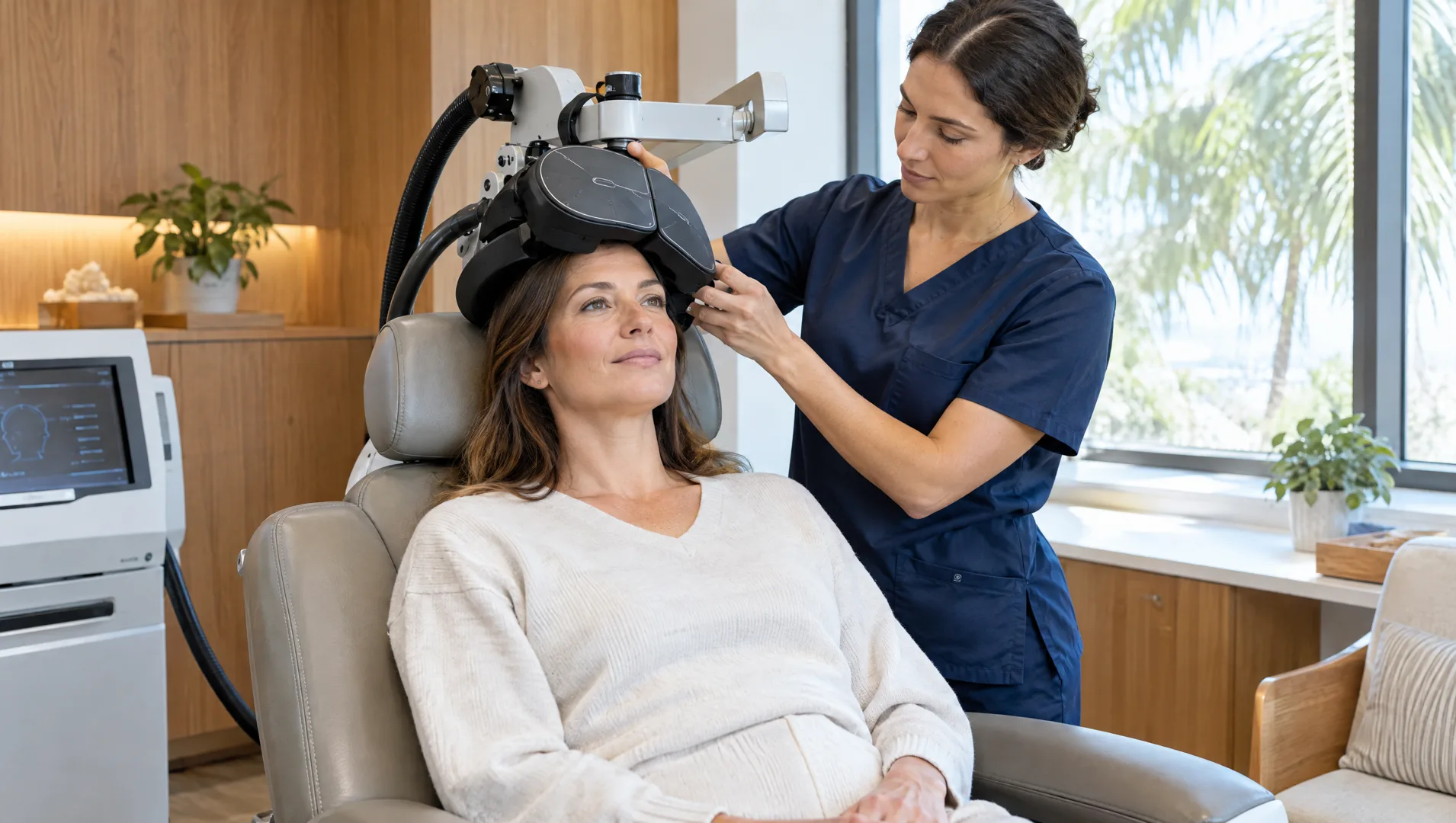
Traditional rTMS uses a figure-8 coil that produces a focused, shallow field. Deep TMS uses an H-coil built into a helmet that produces a broader, deeper field. Stedfast Psychiatry uses Deep TMS at Palm Beach Gardens. This page explains the real differences, what the evidence does and does not show, and how to think about the choice.
Who it is for
Both systems treat the same core patient: an adult with major depressive disorder who has not responded to medication. The practical differences matter in a few situations. If you have OCD, Deep TMS with the H7 coil is the system with a dedicated clearance and pivotal trial. If you want to quit smoking, Deep TMS is the only system cleared for it. If you did not respond to figure-8 rTMS at another clinic, trying Deep TMS is a reasonable next step because the coil and protocol are different, though the evidence on switching is limited. If you have a specific need for very focal stimulation, for example in a research protocol or with an unusual target, figure-8 is the better tool. For ordinary treatment-resistant depression, either system is a sound choice.
How it works
A figure-8 coil consists of two circular windings placed side by side. Current flows in opposite directions in the two loops, and the magnetic field is strongest at the junction, producing a focal hotspot about a centimeter across that penetrates roughly 1.5 to 2 centimeters. The coil sits on an articulated arm and must be positioned precisely, often with neuronavigation. The H-coil used in Deep TMS has windings that wrap around the head inside a padded helmet, arranged so that the field decays more slowly with distance. Modeling studies place its effective depth at about 4 centimeters, with a stimulated area several times larger than a figure-8. The helmet sits on the head with reference marks, so placement is less sensitive to small errors. Both systems deliver high-frequency trains over the left prefrontal cortex at 120 percent of motor threshold; Deep TMS uses 18 Hz and figure-8 systems typically 10 Hz, or intermittent theta burst for the shortened 3-minute protocol.
Figure-8 coils stimulate to roughly 1.5 to 2 cm below the scalp; the H-coil stimulates to about 4 cm, with a broader field, according to electric-field modeling and phantom measurements.
Source: Deng, Lisanby and Peterchev, Brain Stimulation, 2013; Roth et al., Journal of Clinical Neurophysiology, 2007
The pivotal figure-8 rTMS trial reported remission of 14.2 percent active versus 5.5 percent sham; the pivotal Deep TMS trial reported 32.6 versus 14.6 percent. Different populations and endpoints make direct comparison unreliable.
Source: O'Reardon et al., Biological Psychiatry, 2007; Levkovitz et al., World Psychiatry, 2015
A network meta-analysis of 81 rTMS trials found several active protocols superior to sham but did not find a consistent, statistically significant difference between Deep TMS and high-frequency figure-8 rTMS.
Source: Brunoni et al., JAMA Psychiatry, 2017
A 2016 multicenter trial of 3 months of Deep TMS vs figure-8 rTMS in 20 patients, and a 2019 comparison of 228 patients, each found no significant difference in depression outcomes between coil types.
Source: Filipcic et al., Journal of Psychiatric Research, 2019
What to expect
From the patient's chair the differences are modest. A Deep TMS session is about 20 minutes; a standard figure-8 session is about 19 to 37 minutes depending on protocol, or about 3 minutes with theta burst. Deep TMS feels like a helmet; figure-8 feels like a paddle resting on one spot. Scalp discomfort is reported at similar rates. Both courses run five days a week for six weeks with a taper. Both involve motor threshold mapping on day one. Both let you drive yourself home.
Benefits
- Deep TMS: broader and deeper field, less sensitive to placement error, four FDA clearances including OCD and smoking cessation
- Traditional rTMS: more focal, longer track record since 2008, theta burst option shortens sessions to about 3 minutes
- Both: no anesthesia, no systemic side effects, covered by Medicare and most insurers for depression
- Both: response and remission rates in the same range in trials and registries
Risks and side effects
Side-effect profiles are nearly identical. Scalp discomfort, headache and facial twitching are the common effects with both coils. Seizure risk is in the same rare range for both; some analyses suggest the H-coil's broader field slightly raises the theoretical risk, but reported rates in clinical use remain under 0.1 percent per course. Hearing protection is required with both. Contraindications are the same.
Cost and insurance
Insurers do not distinguish between coil types. Medicare and commercial plans cover TMS for major depressive disorder using the same CPT codes (90867, 90868, 90869) regardless of device. OCD coverage, where available, applies to Deep TMS because it holds the clearance. Self-pay pricing varies by clinic rather than by coil type; ask our TMS coordinator for current self-pay rates.
Side-by-side comparison
| Feature | Deep TMS (H-coil) | Traditional rTMS (figure-8 coil) |
|---|---|---|
| Coil form | H-shaped windings inside a padded helmet | Two adjacent circular windings on an articulated arm |
| Effective depth | About 4 cm | About 1.5 to 2 cm |
| Field size | Broad, covers much of the prefrontal cortex | Focal, about 1 cm hotspot |
| Placement | Helmet with reference marks; tolerant of small errors | Precise; often neuronavigation or the 5.5 cm rule |
| Standard depression protocol | 18 Hz, 55 trains, about 20 minutes | 10 Hz, 75 trains, about 19 to 37 minutes |
| Short protocol | Not standard | Intermittent theta burst, about 3 minutes |
| Course length | 36 sessions over 6 to 9 weeks | 36 sessions over 6 to 9 weeks |
| FDA clearances | MDD 2013, OCD 2018, smoking cessation 2020, anxious depression 2021 | MDD 2008 (NeuroStar), anxious depression and OCD on some systems, migraine on some systems |
| Pivotal trial remission | 32.6 percent vs 14.6 percent sham | 14.2 percent vs 5.5 percent sham |
| Head-to-head evidence | Small comparative studies and network meta-analyses find no consistent difference | |
| Insurance | Same codes, same coverage for depression | |
What the pivotal trials actually showed
Clinics sometimes compare the Deep TMS remission figure of 32.6 percent with the NeuroStar pivotal figure of 14.2 percent and conclude Deep TMS is twice as effective. That is not a fair reading. The two trials ran a decade apart, with different inclusion criteria, different primary endpoints, different rating scales and different durations. The NeuroStar trial measured remission at six weeks with no taper; the Deep TMS trial measured it at week 16 after a 12-week continuation phase. Later open-label NeuroStar data and registries report remission in the 30 to 40 percent range, and Deep TMS registry data report higher figures than its trial too. Both systems clearly work, and the honest summary is that they work about equally well.
Where the H-coil has a genuine advantage
The strongest case for Deep TMS is not depression but OCD. The H7 coil was designed to reach the medial prefrontal cortex and anterior cingulate, structures that sit on the midline and several centimeters deep. A figure-8 coil cannot reach them effectively from the scalp. The Carmi 2019 trial in the American Journal of Psychiatry used the H7 coil with a symptom provocation protocol and produced the clearance that made TMS an OCD treatment. Figure-8 OCD protocols exist and some have since received clearance, but the evidence base is thinner.
The second advantage is placement tolerance. Figure-8 coils must be positioned within a few millimeters of the target, and drift during a session reduces the dose. The helmet's broader field means a few millimeters of variation does not matter. That makes Deep TMS easier to deliver consistently in a busy clinic.
Where figure-8 has a genuine advantage
Focality. If a protocol needs to stimulate one small region while sparing its neighbors, only a figure-8 can do that. This matters in research and in some newer accelerated protocols that use MRI-guided targeting of a specific prefrontal subregion. The theta burst protocol, which compresses a session to about 3 minutes and was validated in a large 2018 non-inferiority trial, was developed on figure-8 systems and is not a standard Deep TMS offering. For patients who cannot spare 20 minutes a day, that is a real consideration.
The brand names you will encounter
NeuroStar is the most widely installed figure-8 system in the United States and was the first cleared, in 2008. MagVenture and Magstim are figure-8 systems common in academic centers. BrainsWay is the manufacturer of the H-coil Deep TMS system. You will see clinics advertise the brand; what matters is that the device is FDA-cleared, that the protocol follows the clearance, and that a psychiatrist is supervising the course.
How to choose a TMS clinic
Ask who supervises the course and how often they review your rating scales. Ask whether the clinic is part of a full psychiatric practice that can adjust your medication and provide therapy alongside TMS, or a standalone TMS center that sends you back to your prescriber. Ask how insurance authorization is handled and whether a written cost estimate is provided before you start. Ask about retreatment policy if you relapse. The coil type belongs on the list, but near the bottom.
Deep TMS in Palm Beach Gardens
Stedfast Psychiatry delivers Deep TMS at our Palm Beach Gardens office, 11641 Kew Gardens Ave, Suite 209, just off PGA Boulevard and I-95. Patients travel to us from Jupiter, West Palm Beach, Boynton Beach, Stuart and Royal Palm Beach, and most find the drive manageable because a Deep TMS session takes about 20 minutes and you drive yourself home. Call (561) 437-2199 to schedule a TMS consultation, or ask your current Stedfast provider for an internal referral. Our TMS coordinator handles insurance verification, prior authorization and scheduling so you can start as soon as approval comes through.
Frequently asked questions
Is Deep TMS better than NeuroStar?
There is no high-quality evidence that one is better for depression. Both are FDA-cleared, both roughly double sham response rates, and the comparisons that exist show similar outcomes. Deep TMS reaches deeper and covers a broader area; NeuroStar's figure-8 coil is more focal. Deep TMS holds additional clearances for OCD, smoking cessation and anxious depression. The choice between clinics should rest on the clinician's experience, scheduling and insurance fit more than the coil brand.
What does deep in Deep TMS mean?
It refers to the depth of effective stimulation. A standard figure-8 coil produces a field strong enough to fire neurons to about 1.5 to 2 centimeters below the scalp. The H-coil's winding geometry produces a field that stays above threshold to roughly 4 centimeters. This lets it reach prefrontal tissue folded into sulci and, with specialized coils, deeper targets like the anterior cingulate used in the OCD protocol.
Which one has shorter sessions?
A Deep TMS depression session is about 20 minutes. A standard figure-8 session is about 19 to 37 minutes depending on the protocol. The shortest option is intermittent theta burst stimulation on a figure-8 system, which takes about 3 minutes and was shown to be non-inferior to the 37-minute protocol in a large 2018 trial. Including check-in and setup, plan on 30 minutes in the office with any system.
If figure-8 rTMS did not work for me, will Deep TMS?
It might. The coil geometry, stimulation frequency and field distribution are different, and case series report responses in patients who had failed figure-8 treatment. The evidence is limited and we will not promise a result. If you responded partially to figure-8, Deep TMS is a reasonable next step. If you had no response at all, Spravato or ECT may be more appropriate, and we will discuss all three at your consultation.
Does Deep TMS have more side effects because it goes deeper?
No meaningful difference has been found. Scalp discomfort, headache and facial twitching occur at similar rates with both coils. Some researchers have noted that a broader field could theoretically raise seizure risk, but reported rates in clinical use remain in the same rare range. Discontinuation for side effects was under 5 percent in the Deep TMS pivotal trial, comparable to figure-8 trials.
Why does Stedfast use Deep TMS?
We chose Deep TMS because it carries clearances for depression, OCD, anxious depression and smoking cessation on a single platform, because the helmet design is forgiving of small placement variations, and because the 20-minute session fits patients' schedules. The decision was not based on claims of superior efficacy for depression; we do not believe the evidence supports that for either system.
Does insurance treat Deep TMS and rTMS differently?
No, for depression. Both bill under the same CPT codes and are covered under the same policies by Medicare and commercial insurers. For OCD, coverage where it exists is tied to the Deep TMS clearance, since figure-8 systems with OCD clearance are newer and less widely available. Smoking cessation is not currently a covered TMS indication under any system.
Where this treatment is offered
Conditions this treats
If you are in crisis, call or text 988 or go to the nearest emergency room. Educational content; individual results vary. Reviewed by Dr. David Husted, board-certified psychiatrist.