Stedfast Psychiatry provides telepsychiatry by secure video to patients located in Florida or South Carolina, covering new-patient evaluations, medication management and psychotherapy. Same-day and next-day video visits are often available. Most insurance and Medicare cover telehealth. Certain controlled substance prescriptions and some patients require an in-person visit.
Telehealth is regulated by state, and our providers are licensed in Florida and South Carolina. You must be physically in one of those two states at the time of your visit. Some situations still require an office visit, mostly involving controlled substances and patients who need a hands-on examination, and we explain those below.
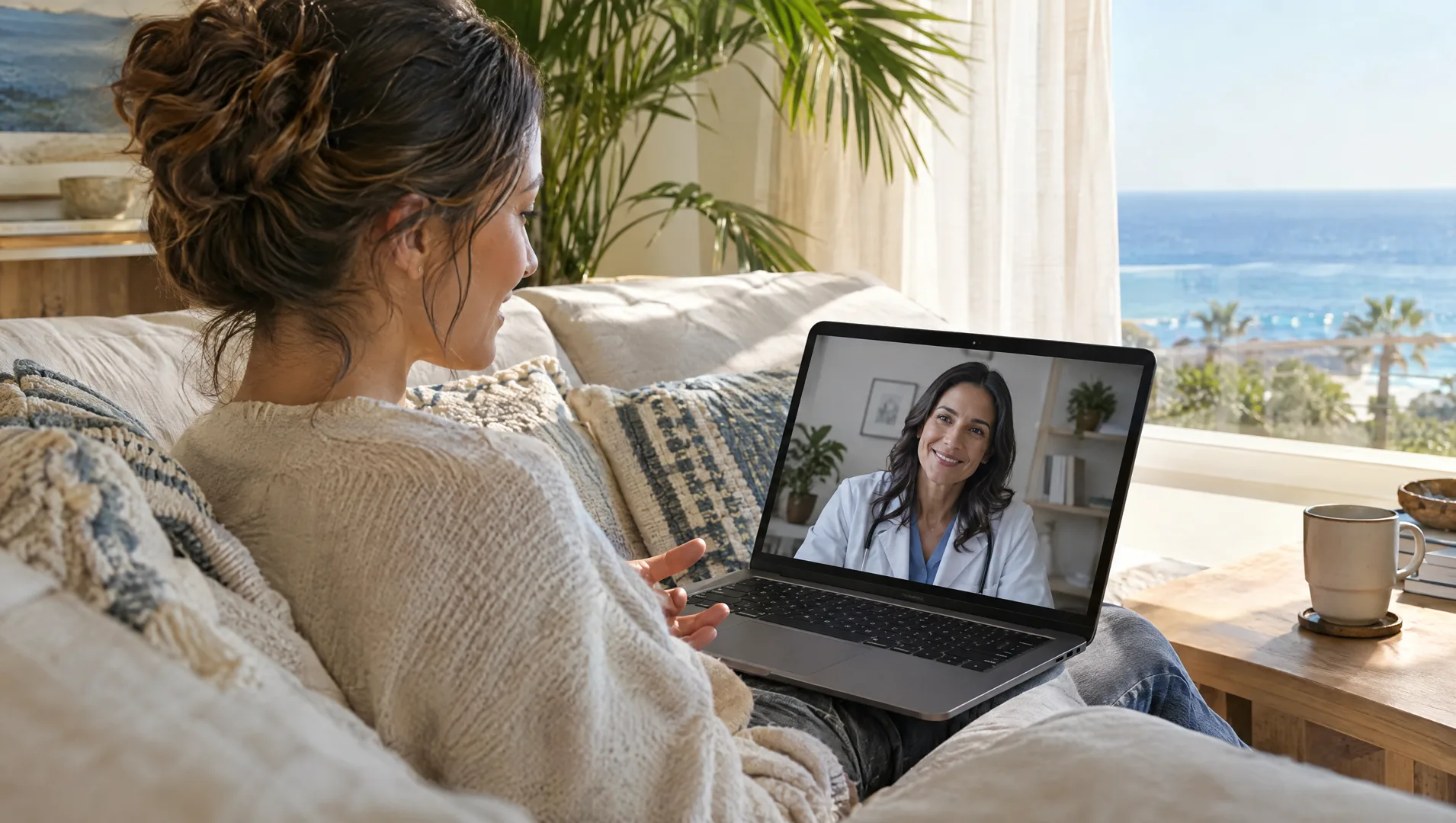
Who it is for
Telepsychiatry suits most adults and many adolescents with depression, anxiety, ADHD, PTSD, OCD, insomnia, bipolar disorder and related conditions. It is especially useful for people who live far from one of our 13 offices, cannot easily take time off work, lack transportation, care for children or an older relative, have mobility limits, or find the office setting itself a barrier. It also keeps care going when you travel within Florida or South Carolina or move between the two.
It is a good fit for established patients on stable regimens, for therapy, and for the frequent short check-ins that medication adjustments require. It is less suited to patients in acute crisis, those who need a physical examination, very young children, and patients whose home environment is not private enough to speak freely. We also see patients who alternate: an office visit for the evaluation, then video for follow-ups, or video most of the year and an office visit when a controlled substance rule requires it.
How it works
Visits run on a HIPAA-compliant video platform through our patient portal. You receive a link before the appointment; it works on a phone, tablet or computer with a camera and microphone, and no account on a third-party app is required. Before the visit you complete the same intake forms and screening scales (PHQ-9, GAD-7 and others) you would in the office. Your clinician sees your chart, labs and prior notes exactly as they would in person.
During the visit we confirm your identity and your current physical location, which state law requires. The clinical content is the same: a structured interview, review of scales, discussion of options, and a plan. Prescriptions for non-controlled medications are sent electronically to your pharmacy. Labs are ordered to a laboratory near you. If a controlled substance is appropriate, we check the state prescription monitoring program (E-FORCSE in Florida, SCRIPTS in South Carolina) and apply the rules described below. Therapy sessions by video follow the same structure as office sessions, including homework and measured progress.
Our providers hold Florida and South Carolina licenses, and we do not treat patients located in other states, even briefly, because licensing follows the patient's location. If you spend part of the year outside those states, tell us and we will help you plan care around it.
Telehealth accounted for more than a third of all outpatient mental health and substance use visits in the United States in 2021, far above its share of other specialties.
Source: KFF analysis of Epic Cosmos data, 2022
Meta-analyses of randomized trials find no significant difference in clinical outcomes between video-delivered and in-person psychiatric care for depression and anxiety.
Source: Hubley et al., World Journal of Psychiatry, 2016; Batastini et al., Clinical Psychology Review, 2021
No-show rates for telepsychiatry visits are consistently lower than for in-person psychiatric visits across health systems studied.
Source: Journal of Medical Internet Research, 2021 systematic review
More than 150 million Americans live in federally designated mental health professional shortage areas, where telepsychiatry is often the only route to a psychiatrist.
Source: HRSA Health Workforce, 2023
What to expect
Find a private, quiet spot with reliable internet; a parked car is acceptable, a shared office is not. Have your medication list, pharmacy name and a photo ID ready for the first visit. Test your camera and microphone a few minutes early. If the video connection fails, your clinician will call you by phone to finish the visit when that is clinically appropriate.
Same-day or next-day video appointments are often available for new patients and for urgent follow-ups, because video slots are not tied to a single office. New-patient video evaluations are 60 minutes; medication follow-ups 20 to 30; therapy 45 to 55. At the end you will have a plan, a next appointment and any prescriptions sent. If your clinician decides an in-person visit is needed, we schedule it at the office closest to you.
Benefits
- Same-day and next-day availability for many visits
- The same clinicians, scales, and prescribing as an office visit
- No travel, parking or time off work for routine follow-ups
- Continuity of care anywhere in Florida or South Carolina
- Easier access for patients with mobility limits or caregiving duties
- HIPAA-compliant platform with no third-party app account required
Risks and side effects
The clinical risks of telepsychiatry are the same as any psychiatric care. The practical risks are specific. A clinician cannot take your blood pressure, check your weight, examine for tremor or stiffness, or see subtle signs that an office visit would reveal, so some medications and some patients need periodic in-person checks. Privacy depends on your environment; if you cannot speak freely, say so and we will reschedule. Technology fails occasionally, and a phone call is the backup.
Telehealth is not the right setting for an emergency. If you are in crisis, call or text 988, call 911, or go to the nearest emergency department. If during a video visit your clinician believes you are not safe, we will help you get to in-person care, including contacting emergency services at your location if needed. That is one reason we confirm your address at every visit.
Cost and insurance
Most commercial insurers and Medicare cover telepsychiatry at the same rates as in-person visits, and Florida and South Carolina both have laws addressing coverage of telehealth services. Your cost is the usual specialist or behavioral health copay or coinsurance. Medicare has permanently covered telehealth for mental health services, including from home, with a requirement for a periodic in-person visit in some circumstances that we track for you. A few plans still treat telehealth differently, and we verify your benefits before the first video visit.
Self-pay rates are the same for video and office visits: $185 for a new-patient evaluation, with lower rates for follow-ups. There is no technology or platform fee.
What can and cannot be done by video
Can: new-patient evaluations, medication management for non-controlled medications, most medication management for controlled medications once the required in-person steps are met, individual psychotherapy including CBT, CBT-I and ERP, screening scales, lab ordering, care coordination with your other doctors, and letters and forms. Our Stedfast Living team also uses telepsychiatry to cover assisted living and skilled nursing facilities between on-site rounds.
Cannot: physical and neurological examinations, vital signs, injections, drug screens, and emergency care. Deep TMS and Spravato are in-office treatments by nature, although the follow-up visits around them can be by video. Some controlled substance prescriptions require an in-person examination under state or federal law.
Licensing and the two-state rule
A clinician must hold a license in the state where the patient is physically located during the visit. Our psychiatrists, nurse practitioners and physician assistants hold Florida and South Carolina licenses, and many hold both, which is why a patient who splits time between the two can keep the same provider. We do not see patients located in Georgia, North Carolina or elsewhere, and we ask your location at the start of every visit. This is not a formality; treating a patient across a state line without a license is a licensing violation for the clinician and can void insurance coverage for the patient.
Controlled substances by telehealth
This is the area where rules are most complex and change most often. At the federal level, the Ryan Haight Act normally requires an in-person examination before a controlled substance is prescribed by telehealth; that requirement was waived during the COVID-19 public health emergency and the waiver has since been extended by the DEA several times while permanent rules are finalized. Florida's telehealth statute separately restricts telehealth prescribing of Schedule II controlled substances, with exceptions for certain circumstances. South Carolina's telemedicine law also places limits. Our policy is to follow the most restrictive rule that applies on the date of the visit, to check the prescription monitoring database every time, and to schedule an in-person visit when required. We would rather inconvenience you once than put your prescription at risk.
Technology and privacy
You need a device with a camera and microphone, a stable connection (a phone's cellular data is usually fine), and a private space. The link arrives through the patient portal; nothing is downloaded and no account with an outside video service is needed. Sessions are encrypted end to end and are not recorded. If the connection drops, your clinician will attempt to reconnect and then call you by phone. Headphones improve privacy in a shared home.
Same-day access
One of the quiet advantages of telepsychiatry is scheduling. An office has one waiting room and a fixed roster of clinicians; a video schedule draws on providers across the whole practice. That is why a same-day or next-day video visit is often available when the nearest office is booked out for two weeks. For a patient whose medication has run out, whose symptoms have shifted, or who has simply decided today is the day to get help, that difference matters.
Frequently asked questions
Do I have to be in Florida or South Carolina for a video visit?
Yes, physically, at the time of the visit. Medical licensing follows the patient's location, and our providers are licensed in Florida and South Carolina. Your home address does not matter if you are elsewhere that day. If you travel outside those states for an extended period, tell us so we can plan prescriptions and visits around it.
Can I get a new-patient evaluation by video?
Yes. A 60-minute video evaluation covers the same ground as an office visit, including screening scales, history and a written plan. The exceptions are young children, patients who need a physical examination, and some situations where a controlled substance is likely to be prescribed, where state rules may require an in-person visit first. We will tell you at scheduling.
Can stimulants or benzodiazepines be prescribed by telehealth?
Sometimes, and the rules are specific. Federal flexibilities currently permit telehealth prescribing of controlled substances under conditions that have been extended several times, and Florida law restricts telehealth prescribing of Schedule II drugs such as stimulants unless specific conditions are met. South Carolina applies its own limits. In practice, many of our patients on stimulants need at least one in-person visit, and we check the state monitoring database before every controlled prescription. We follow whatever rule is in force on the date of your visit.
Which patients must be seen in person?
Patients in acute crisis, those needing a physical or neurological examination (for example to check for medication-related movement effects), very young children, patients starting certain medications that need baseline vitals, and some patients prescribed controlled substances. Patients on long-acting injectable antipsychotics come in for the injection. Everyone else can usually be seen by video, with periodic office visits as needed.
Is video as effective as an office visit?
For evaluation, medication management and therapy of depression, anxiety, ADHD and most other conditions, randomized trials show equivalent outcomes. Attendance is usually better by video, which itself improves results. Some patients simply prefer the office, and that preference is legitimate; you can use either or alternate.
How soon can I be seen by video?
Often the same day or the next business day for new patients and urgent follow-ups, because video appointments draw on clinicians across all 13 offices rather than one. Routine follow-ups are scheduled at the interval your clinician sets. Call or book online and ask for the earliest video slot.
Is my video visit private and secure?
The platform is HIPAA-compliant and encrypted, and sessions are not recorded. Your side of the privacy equation matters too: choose a space where you can talk freely. We confirm your location at each visit, both because the law requires it and so we can send help if there is ever an emergency.
What does telepsychiatry cost?
The same as an office visit. Most commercial plans and Medicare cover telehealth mental health visits at parity with in-person care; your copay or coinsurance applies. Self-pay is $185 for a new-patient evaluation and less for follow-ups. There is no platform fee. We verify your plan's telehealth coverage before the first visit.
Where this treatment is offered
- Boynton Beach, FL
10301 Hagen Ranch Rd, Suite D720 and Suite B710 - Palm Beach Gardens, FL
11641 Kew Gardens Ave, Suite 209 - Stuart, FL
729 SW Federal Hwy, Suite 104 - Royal Palm Beach, FL
420 South State Road 7, Suite 112 - Jacksonville, FL
2950 Halcyon Lane, Suite 605 - Port St. Lucie, FL
266 NW Peacock Blvd, Suite 203 - Melbourne, FL
6300 North Wickham Road, Suite 110 - Fort Lauderdale, FL
3107 Stirling Road, Suite 107 - Jupiter, FL
3893 Military Trail, Suite 3 - Goose Creek, SC
118 Springhall Drive, Suites B and F - Lexington, SC
120 Brookside Parkway, Suite C - Bluffton, SC
25 Clarks Summit Drive, Suite F201 - Hilton Head Island, SC
19 Shelter Cove Lane, Suite 202
Conditions this treats
If you are in crisis, call or text 988 or go to the nearest emergency room. Educational content; individual results vary. Reviewed by Dr. David Husted, board-certified psychiatrist.