Spravato works by blocking NMDA glutamate receptors with esketamine, the S-enantiomer of ketamine. That brief blockade triggers a glutamate surge in the prefrontal cortex and switches on growth signals (BDNF, mTOR) that rebuild synapses lost to chronic depression. The result is an antidepressant effect that can begin within days rather than the weeks typical of SSRIs.
This page explains the mechanism in plain language: what esketamine is, what it does at the NMDA receptor, why that leads to new synapses, and what the clinical trials show actually happens to patients. If you want the practical details of a treatment course, see our Spravato treatment schedule and what to expect pages.
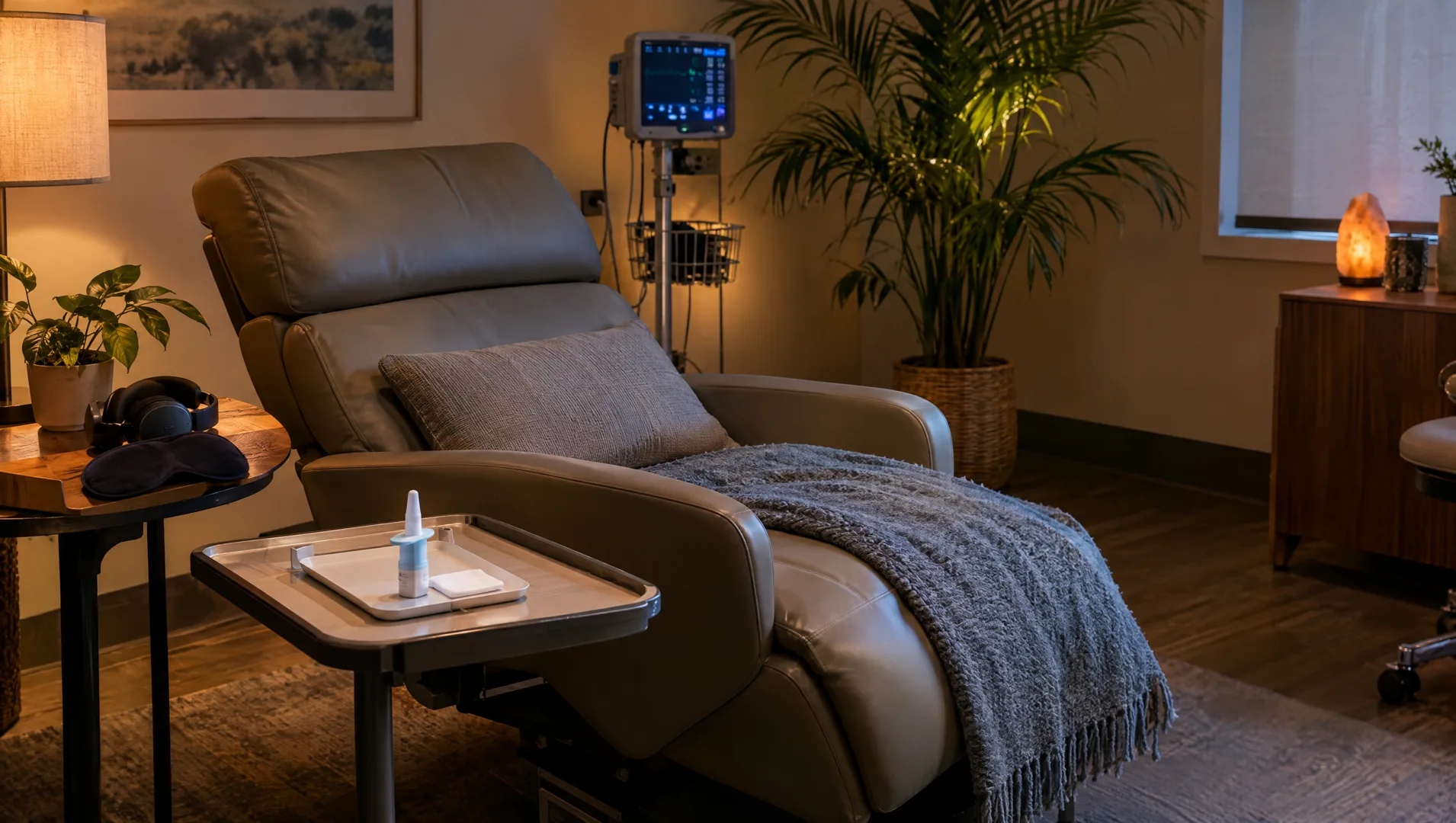
Who it is for
Understanding the mechanism matters most for two groups. The first is people with treatment-resistant depression who have been told, after several failed medications, that nothing else is likely to work. The glutamate pathway is a genuinely different target, so prior failures on serotonin-based drugs do not predict failure on esketamine. The second is people who are wary of a drug related to ketamine and want to know what it actually does before agreeing to it. Both deserve a clear explanation rather than marketing language.
How it works
Ketamine is a racemic mixture: equal parts of two mirror-image molecules called S-ketamine and R-ketamine. Esketamine is the purified S form. It binds the NMDA receptor roughly three to four times more tightly than R-ketamine, which is why the nasal spray can deliver a therapeutic effect at a relatively low dose.
The NMDA receptor is a gate on the surface of neurons that opens when glutamate binds to it. Esketamine blocks that gate. The leading explanation for its antidepressant effect, supported by animal and human imaging studies, is that it preferentially blocks NMDA receptors on a class of inhibitory interneurons. Taking those brakes off causes a burst of glutamate release in the prefrontal cortex. That glutamate acts on a different receptor, AMPA, which triggers the release of brain-derived neurotrophic factor (BDNF) and activates the mTOR signaling pathway. Within hours, neurons in stressed circuits begin to regrow dendritic spines, the small protrusions where synapses form. Chronic stress and depression shrink those spines; esketamine helps restore them. That process is called synaptogenesis, and it is the most likely reason the benefit outlasts the drug itself, which clears the body within a day.
Esketamine has roughly three to four times greater affinity for the NMDA receptor than R-ketamine, which is why the S-enantiomer was selected for the nasal spray.
Source: Spravato prescribing information and Janssen pharmacology summaries
Ketamine produces a rapid increase in synaptic protein signaling and dendritic spine density in the prefrontal cortex within 24 hours, driven by mTOR pathway activation.
Source: Li et al., Science, 2010
In the ASPIRE I and II trials, esketamine separated from placebo on the MADRS depression score 24 hours after the first dose.
Source: Fu et al. and Ionescu et al., Journal of Clinical Psychiatry, 2020
Esketamine is eliminated with a terminal half-life of about 7 to 12 hours, so the drug itself is gone well before the next session even though the antidepressant effect persists.
Source: Spravato prescribing information, FDA
What to expect
The mechanism has a practical side. The same NMDA blockade that starts the antidepressant cascade also produces the dissociation, dizziness and altered perception you feel during a session. Those are not the therapy; they are a side effect of the drug reaching its target, and they fade within about two hours as esketamine levels fall. The antidepressant effect follows a different timeline. Some patients feel lighter the day after the first session. More commonly, mood and energy improve gradually over the first one to two weeks of twice-weekly dosing, and the effect builds across the four-week induction. At Stedfast Psychiatry we track your scores at each visit so that you can see the trend rather than guessing from one day to the next.
Benefits
- Targets glutamate and synapse growth, a mechanism no oral antidepressant uses, so it can help after multiple medication failures
- Onset in days to two weeks rather than four to eight weeks
- The S-enantiomer's higher receptor affinity allows a lower dose than racemic ketamine
- Effects persist between sessions because new synapses outlast the drug, supporting weekly or every-two-week maintenance
- Works whether or not you continue an oral antidepressant, following the January 2025 monotherapy approval
Risks and side effects
Because esketamine acts on NMDA receptors throughout the brain, not just in mood circuits, it causes dissociation (about 41 percent of patients in trials), dizziness, sedation, nausea, vertigo and numbness during the session. It also briefly raises blood pressure, typically peaking around 40 minutes after the dose. All of these resolve during the two-hour monitoring period. The long-term questions about repeated NMDA blockade, including effects on memory and bladder, have not shown problems in trial data through one year, but they are the reason we monitor patients on maintenance and use the lowest effective frequency.
Cost and insurance
The mechanism explains part of the price. Esketamine is a patented, single-enantiomer formulation with no generic, and the REMS requirement means every dose includes two hours of supervised care. Most commercial plans and Medicare Part B cover Spravato for treatment-resistant depression with prior authorization. We verify coverage before your first session.
A short history: from anesthetic to antidepressant
Ketamine was approved as an anesthetic in 1970. In 2000, a small study at Yale found that a single low-dose IV infusion lifted depression within hours in patients who had not responded to other treatments, an effect that lasted about a week. That finding was replicated at the National Institute of Mental Health in 2006 and set off two decades of research into glutamate-based antidepressants. Janssen developed esketamine as a nasal spray so that the drug could be given without an IV and under a standardized safety program. The FDA approved it as Spravato in March 2019.
Three steps, in plain language
1. The block
Esketamine sits in the channel of the NMDA receptor and stops it from passing signals. It does this most effectively on fast-firing inhibitory neurons, which normally keep the excitatory neurons around them quiet.
2. The surge
With the inhibitory neurons blocked, excitatory neurons in the prefrontal cortex release more glutamate. That glutamate binds AMPA receptors on neighboring cells, which is why drugs that block AMPA receptors abolish ketamine's antidepressant effect in animal studies.
3. The rebuild
AMPA activation releases BDNF and activates mTOR, two signals that tell the neuron to build. Within 24 hours, imaging in animal models shows new dendritic spines in circuits that chronic stress had thinned. Human PET imaging has since shown higher synaptic density in people who respond to ketamine. Depression is associated with fewer synapses in the prefrontal cortex and hippocampus; esketamine appears to reverse part of that loss.
Why the effect fades without maintenance
New spines are fragile. If the stress biology that caused the loss is still active, they can be pruned back over weeks. That is the most likely explanation for the relapse pattern in SUSTAIN-1, where stopping esketamine roughly doubled the relapse rate, and for why continued weekly or every-two-week dosing holds the gains. It is also why we pair Spravato with psychotherapy and with attention to sleep, alcohol and stress, which affect the same synaptic machinery.
What the mechanism does not do
Esketamine does not reset the brain, erase trauma or cure depression. Roughly one third of patients in the trials did not get a meaningful benefit, and the mechanism does not yet tell us in advance who will respond. It does not treat bipolar depression, where it was not studied and could in theory trigger mania, and it is not approved for PTSD, OCD or anxiety disorders. What it does is give people with treatment-resistant depression a genuinely different biological lever, with a reasonable chance of a response that other drugs could not deliver.
Spravato at Stedfast Psychiatry
We offer Spravato at three Palm Beach County offices, each with a dedicated monitoring room and staff trained under the Spravato REMS program:
- Boynton Beach: 10301 Hagen Ranch Rd, Suite D720, Boynton Beach, FL 33437
- Palm Beach Gardens: 11641 Kew Gardens Ave, Suite 209, Palm Beach Gardens, FL 33410
- Royal Palm Beach: 420 South State Road 7, Suite 112, Royal Palm Beach, FL 33414
Call the office nearest you or request an appointment online. The first step is an evaluation, in person or by telehealth, to confirm you are a candidate and to start insurance authorization.
Frequently asked questions
What is the difference between esketamine and ketamine?
Ketamine is a 50-50 mixture of two mirror-image molecules, S-ketamine and R-ketamine. Esketamine is just the S half. It binds the NMDA receptor more tightly, so a smaller dose is needed. Spravato delivers esketamine as a fixed-dose nasal spray in a certified office and is FDA-approved for depression. Generic ketamine is an anesthetic used off-label for depression, usually by IV infusion, and is not FDA-approved for that purpose.
Is esketamine weaker than ketamine?
No. Milligram for milligram, esketamine is the more potent component because of its higher affinity for the NMDA receptor. The confusion comes from dosing route: a nasal spray delivers less drug into the bloodstream than an IV infusion, so the total exposure per session can be lower. Head-to-head data are limited, and no large trial has shown IV ketamine to be more effective than Spravato for treatment-resistant depression.
How does esketamine work for depression?
It blocks NMDA receptors on inhibitory neurons, which releases a surge of glutamate in the prefrontal cortex. That glutamate activates AMPA receptors, raises BDNF and switches on the mTOR growth pathway, and neurons begin regrowing the synaptic connections that chronic depression erodes. The regrowth, not the drug itself, is thought to carry the benefit between sessions.
Why does Spravato work faster than antidepressants?
SSRIs and SNRIs raise serotonin or norepinephrine immediately, but the mood benefit depends on slow downstream adaptations in receptors and gene expression that take weeks. Esketamine acts directly on the synapse-building machinery, so the structural change that improves mood begins within hours. In the ASPIRE trials, patients on esketamine showed measurable improvement within 24 hours of the first dose.
Does the dissociation mean it is working?
Not reliably. Dissociation is a side effect of NMDA blockade and happens in about 40 percent of patients, but trial analyses have not found that people who dissociate more improve more. Some patients with strong antidepressant responses have almost no dissociation. We do not use dissociation as a marker of success; we use your depression scores at each visit.
How long does Spravato stay in your system?
The drug's half-life is about 7 to 12 hours, so it is essentially gone within a day or two. The driving restriction until the next day exists because sedation and impaired judgment can persist for hours after the obvious effects fade. The antidepressant benefit lasts longer than the drug because it depends on synaptic changes, which is why sessions can be spaced out to weekly or every two weeks during maintenance.
Can Spravato rewire the brain permanently?
The synaptic changes are real but not permanent on their own. In SUSTAIN-1, patients who stopped esketamine after getting well relapsed at about twice the rate of those who continued, which tells us the effect needs reinforcement for many people. Some patients taper off successfully after a long stable period; others do best on long-term maintenance. We decide this with you based on your course, not a fixed rule.
Where this treatment is offered
- Boynton Beach, FL
10301 Hagen Ranch Rd, Suite D720 and Suite B710 - Palm Beach Gardens, FL
11641 Kew Gardens Ave, Suite 209 - Royal Palm Beach, FL
420 South State Road 7, Suite 112
Conditions this treats
If you are in crisis, call or text 988 or go to the nearest emergency room. Educational content; individual results vary. Reviewed by Dr. David Husted, board-certified psychiatrist.