The Spravato REMS is an FDA-required safety program. Spravato can only be given in a certified healthcare setting that monitors you for at least two hours, shipped by a certified pharmacy directly to that office, and only to enrolled patients counseled on the risks. You cannot take Spravato home, and you cannot drive until the next day.
This page explains what the REMS requires of the office, the pharmacy and you, what it means that a center is certified, what enrollment involves, and why you can never take Spravato home. Stedfast Psychiatry administers Spravato under the REMS at Boynton Beach, Palm Beach Gardens and Royal Palm Beach.
Who it is for
Patients who want to understand the rules behind their treatment, patients comparing Spravato clinics and wanting to know what certification means, and patients who have asked whether they can self-administer at home (the answer is no, and this page explains why). It is also useful for family members and for anyone who has encountered at-home ketamine services and wonders how Spravato differs.
How it works
The REMS has three certified parties. The healthcare setting, meaning our office, must enroll in the program, train staff on the risks, have a process for monitoring each patient for at least two hours, have a process for making sure patients do not leave until they are safe, and store the drug securely as a Schedule III controlled substance. The pharmacy must be certified and may ship Spravato only to a certified setting, never to a patient. The patient must be enrolled in the program, which means you are counseled on the risks of sedation, dissociation and misuse, the monitoring requirement and the driving restriction, and you sign an enrollment form that goes to the REMS administrator. The REMS also requires the setting to document each administration and any serious adverse events, and the FDA periodically reviews the program's data to decide whether to keep, loosen or tighten the requirements.
The Spravato REMS was approved by the FDA on March 5, 2019, alongside the drug, because of the risks of sedation, dissociation, respiratory depression, and abuse and misuse.
Source: U.S. Food and Drug Administration, NDA 211243 approval letter
Under the REMS, Spravato may only be administered in certified healthcare settings, dispensed by certified pharmacies to those settings, and given to enrolled patients who are monitored for at least two hours.
Source: Spravato REMS program materials, Janssen Pharmaceuticals
Esketamine is a Schedule III controlled substance under the Controlled Substances Act, the same schedule as ketamine, buprenorphine and anabolic steroids.
Source: U.S. Drug Enforcement Administration
The FDA has approved several REMS modifications since 2019, including Spanish-language REMS materials in April 2026 and updated website workflows in June 2026, without removing the certified-setting or two-hour monitoring requirements.
Source: FDA REMS modification approval letters, NDA 211243 S-028 and S-029, 2026
What to expect
At your evaluation, your provider reviews the REMS patient materials with you and completes the enrollment form; this takes a few minutes and is done once. At each session, staff follow the monitoring protocol: blood pressure before, at about 40 minutes and before discharge; observation for at least two hours; a check that you are alert and steady; and confirmation that someone else is driving. The practical consequence for you is that Spravato is always an in-office appointment and never a prescription you fill. If you move or change providers, your new office must also be certified and will enroll you again.
Benefits
- A standardized safety floor at every certified center: two-hour monitoring, blood pressure protocol, discharge criteria
- No take-home drug, which removes the risks of unsupervised use, overdose and diversion
- Staff trained specifically on esketamine's risks and how to manage them
- FDA oversight with reported safety data that informs label updates
- Insurers recognize REMS certification as part of medical necessity, which supports coverage
Risks and side effects
The REMS does not eliminate side effects; it ensures they occur in a monitored setting. The burden it creates is logistical: every dose is an office visit of two and a half hours, you need a driver every time, and travel to a certified center is required. For patients who live far from one, that is a real barrier. Certification also does not guarantee quality beyond the minimum; staffing, room environment and clinical follow-up vary between centers. Ask any clinic how they staff the monitoring period and who is present.
Cost and insurance
The REMS adds cost because the two-hour observation requires staff time and space. That observation is billed as part of each session and is covered by commercial plans and Medicare Part B along with the drug. REMS enrollment itself has no fee.
The three parts of the REMS
| Who | What the REMS requires | What it means for you |
|---|---|---|
| Healthcare setting (our office) | Certification, staff training, two-hour monitoring process, discharge criteria, secure storage, adverse event reporting | Every session is in a certified office with trained staff and a defined protocol |
| Pharmacy | Certification; ships only to certified settings, never to patients | You never pick up Spravato at a pharmacy or receive it by mail |
| Patient (you) | Enrollment, counseling on risks, agreement to monitoring and the driving restriction | A one-time form, and a ride home after every session |
Why the FDA required it
When Spravato was reviewed in 2019, the advisory committee and FDA staff focused on four risks. Sedation, which in a small number of trial patients progressed to brief loss of consciousness. Dissociation, which can impair judgment and in rare cases cause distress or confusion. Respiratory depression, a known risk of ketamine at anesthetic doses and a theoretical one at Spravato doses, especially combined with sedatives. And abuse and misuse, since ketamine is a drug with a long recreational history. The FDA concluded that the benefit for treatment-resistant depression justified approval if those risks were managed in a controlled setting, and the REMS is that management.
What certification does and does not tell you
Certification means a clinic has met the minimum requirements. It does not tell you how experienced the staff are, how many patients the clinic has treated, what the room is like, whether a prescriber is on site during sessions, or how the clinic handles a blood pressure spike. When choosing a Spravato provider, reasonable questions are: who is present during the monitoring period, what is the protocol if blood pressure rises, how is the room set up, how do you measure whether the treatment is working, and what happens if it is not. We welcome those questions.
Spravato versus unregulated ketamine
The REMS is the clearest dividing line between Spravato and the growing market in at-home ketamine. Telehealth ketamine services prescribe compounded oral or sublingual ketamine for home use after a video visit, without monitoring. The FDA has issued warnings about compounded ketamine products, and reports of misuse, dependence and adverse events have increased. We do not think unsupervised ketamine is a safe model for most patients, and the existence of the REMS reflects the same judgment by the FDA.
Our REMS process at Stedfast Psychiatry
- Enrollment completed at your evaluation visit, in person or by telehealth.
- Drug ordered from a certified specialty pharmacy and stored in a locked, logged cabinet at the treating office.
- Written monitoring protocol with blood pressure thresholds for dosing and discharge.
- Staff member assigned to the monitoring room for the full session.
- Documentation of each session, including dose, vital signs, dissociation and sedation checks, and discharge time.
- Serious adverse events reported to the REMS program and the FDA as required.
Spravato at Stedfast Psychiatry
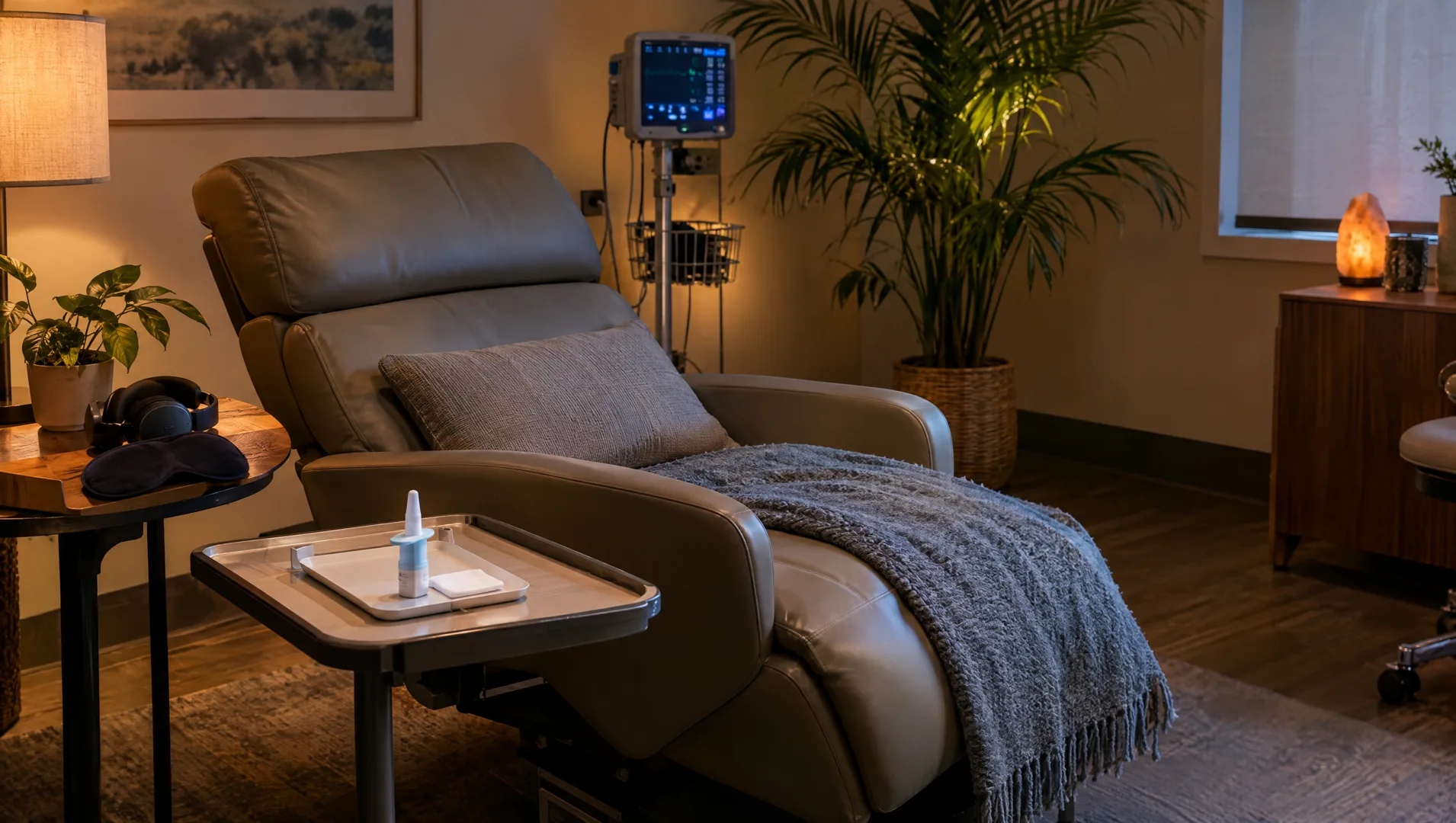
We offer Spravato at three Palm Beach County offices, each with a dedicated monitoring room and staff trained under the Spravato REMS program:
- Boynton Beach: 10301 Hagen Ranch Rd, Suite D720, Boynton Beach, FL 33437
- Palm Beach Gardens: 11641 Kew Gardens Ave, Suite 209, Palm Beach Gardens, FL 33410
- Royal Palm Beach: 420 South State Road 7, Suite 112, Royal Palm Beach, FL 33414
Call the office nearest you or request an appointment online. The first step is an evaluation, in person or by telehealth, to confirm you are a candidate and to start insurance authorization.
Frequently asked questions
What does Spravato REMS mean?
REMS stands for Risk Evaluation and Mitigation Strategy. It is a safety program the FDA requires for Spravato because of sedation, dissociation, breathing suppression and misuse risks. In practice it means the drug is given only in certified offices, shipped only from certified pharmacies to those offices, administered only to enrolled patients, and followed by at least two hours of monitoring and a no-driving rule until the next day.
Can Spravato be self-administered at home?
No. You do self-administer the spray, but only in the office with a staff member present. The REMS prohibits dispensing Spravato to patients, and certified pharmacies ship it only to certified healthcare settings. This is a firm rule, not a clinic policy. Companies offering at-home ketamine are using a different, unapproved product under a different legal framework.
Who can prescribe Spravato?
Any licensed prescriber with DEA registration for Schedule III drugs, usually a psychiatrist, psychiatric nurse practitioner or physician assistant, working in a REMS-certified setting. The prescriber does not need an individual REMS certification, but the office where it is given does, and the patient must be enrolled. At Stedfast Psychiatry, Spravato is prescribed by our psychiatrists and psychiatric nurse practitioners and administered at our three certified offices.
What is a Spravato certified treatment center?
A healthcare setting that has enrolled in the REMS, trained its staff on the drug's risks, established a two-hour monitoring process with discharge criteria, and secured storage for a controlled substance. Certification is per site, which is why a practice with many offices may offer Spravato at only some of them. Our certified sites are Boynton Beach, Palm Beach Gardens and Royal Palm Beach.
What is involved in REMS patient enrollment?
A short counseling session where your provider reviews the risks (sedation, dissociation, blood pressure, misuse), the monitoring requirement and the driving restriction, and you sign an enrollment form that is submitted to the REMS program. It takes a few minutes and is done once per treatment site. There is no fee, no background check and no effect on your medical record beyond the documentation of counseling.
Has the FDA changed the Spravato REMS?
The FDA has approved administrative modifications, such as Spanish-language materials and website updates in 2026, and it reviews the program's safety data on a schedule. The core requirements, a certified setting, certified pharmacy, patient enrollment, two-hour monitoring and the driving restriction, remain in place. Any future loosening would be announced by the FDA and would apply to all certified centers.
Why do I need a ride home if the monitoring period is over?
Because esketamine's effects on attention, reaction time and judgment can persist for hours after the obvious dissociation fades, and the drug is still being cleared overnight. The REMS and the label require that you not drive or operate machinery until the next day after a restful sleep. Ride-share services are acceptable, and we confirm your transportation before every dose.
Where this treatment is offered
- Boynton Beach, FL
10301 Hagen Ranch Rd, Suite D720 and Suite B710 - Palm Beach Gardens, FL
11641 Kew Gardens Ave, Suite 209 - Royal Palm Beach, FL
420 South State Road 7, Suite 112
Conditions this treats
If you are in crisis, call or text 988 or go to the nearest emergency room. Educational content; individual results vary. Reviewed by Dr. David Husted, board-certified psychiatrist.