Stedfast Psychiatry offers individual psychotherapy using cognitive behavioral therapy (CBT), DBT skills, acceptance and commitment therapy (ACT) and supportive therapy, in 45 to 55 minute sessions, in person or by video in Florida and South Carolina. Therapy is coordinated with medication management when both are needed. Most insurance plans and Medicare are accepted. In Jacksonville, this is available at 2950 Halcyon Lane and by video; new patients call (561) 330-5289.
Psychotherapy at our Jacksonville office
The Jacksonville office at 2950 Halcyon Lane, Suite 605 serves Julington Creek, Bartram Park, San Jose, Baymeadows and Southside and the surrounding communities of Orange Park, Fleming Island, St. Johns, Fruit Cove and Ponte Vedra Beach. Baptist Medical Center South is a useful landmark for first-time visitors.
Free surface parking is available at the office park, with accessible spaces near the building entrance. Suite 605 is on an upper floor with elevator access. Hours are Monday to Friday, 8:00 AM to 5:00 PM, with weekend appointments by arrangement. New patients call (561) 330-5289; existing patients use (904) 302-7037.
The Jacksonville office is an entry point to Stedfast Psychiatry's Deep TMS and Spravato programs. Treatment sessions run at our Palm Beach Gardens TMS center and the Palm Beach Gardens Spravato rooms, roughly 270 and 270 minutes away; the evaluation, the screening scales and the prior authorization all happen here.

Who you will see in Jacksonville
The Jacksonville team includes psychiatrists Dr. Sandy Kaufman and Dr. Aileen Lorenzo, psychiatric nurse practitioner Natalie Black and physician assistant Carl Brescia. Visits in Spanish are available with Aileen Lorenzo. Children and teens are seen by Aileen Lorenzo.

Carl Brescia, PA-C
Physician Assistant · Adults 18+

Dr. Sandy Kaufman, MD
Psychiatrist · Adults

Natalie Black, PMHNP-BC
Psychiatric Nurse Practitioner · Adults 18+
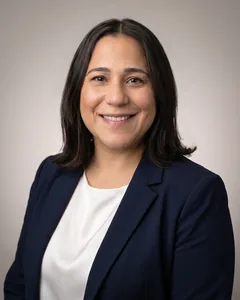
Dr. Aileen Lorenzo, MD
Psychiatrist · Ages 4 into young adulthood · English, Spanish
How psychotherapy works
The first session is an assessment. Your therapist asks what brought you in, what you have tried, what a good outcome would look like, and about your history. Together you set two or three concrete goals: sleep through the night, stop avoiding driving on the highway, get through a week without a panic attack, be able to think about your father without the day collapsing. Goals give the work direction and let you measure progress.
Cognitive behavioral therapy works on the link between thoughts, feelings and behavior. You learn to catch automatic thoughts, test them against evidence, and change behavior that keeps the problem alive, often with homework between sessions. Dialectical behavior therapy skills teach four sets of tools: mindfulness, distress tolerance, emotion regulation and interpersonal effectiveness; they are useful far beyond the borderline personality disorder DBT was developed for. Acceptance and commitment therapy focuses less on changing thoughts and more on changing your relationship to them, so that difficult feelings stop dictating behavior and you can act on what matters to you. Supportive therapy is less structured and is right for people who need a steady place to process a hard period rather than a skills curriculum.
Sessions are weekly at the start, 45 to 55 minutes. Most CBT and ACT courses run 8 to 20 sessions. Progress is checked with the same scales your prescriber uses, so a falling PHQ-9 or GAD-7 tells both of you the plan is working. When therapy and medication are combined, your therapist and prescriber share notes within the practice and adjust together.
Who it is for
Therapy is appropriate for most conditions we treat and is the first-line treatment for several. Mild to moderate depression, generalized anxiety, social anxiety, panic disorder, PTSD, OCD, insomnia, adjustment to a loss or life change, relationship and work stress, and grief all respond to therapy, often without medication. For moderate to severe depression, bipolar disorder and ADHD, therapy works best combined with medication.
Therapy is also for people who are already on medication and are better but not well. Medication can lift the floor of mood; therapy changes the habits of thinking and avoidance that keep problems coming back. And it is for people who do not want medication, or cannot take it, and want an active treatment rather than waiting. We see adults, adolescents and, with some therapists, younger children. If you are not sure whether you need a therapist or a prescriber, start with either; our clinicians refer across the practice.
Psychotherapy produces a medium to large effect size across common mental health conditions, with about 75 percent of people who enter therapy showing benefit.
Source: American Psychological Association, 2012 resolution on the effectiveness of psychotherapy
For moderate to severe depression, combining psychotherapy with antidepressant medication produces higher response and remission rates than either treatment alone.
Source: Cuijpers et al., World Psychiatry, 2020 meta-analysis
CBT delivered by video shows outcomes equivalent to in-person CBT for depression and anxiety across multiple randomized trials.
Source: Journal of Anxiety Disorders and Journal of Affective Disorders meta-analyses, 2018 to 2021
About 55 million US adults received mental health treatment in 2022, including roughly 23 percent who had counseling or therapy.
Source: NIMH / SAMHSA National Survey on Drug Use and Health 2022
What to expect at your first visit
Expect to work. Effective therapy involves practicing between sessions: logging thoughts, doing an exposure, trying a new behavior, tracking sleep. People who do the homework improve faster, and your therapist will say so plainly. Expect the first few sessions to feel slow while the assessment and goals are set, and expect some sessions to be uncomfortable, especially when the work involves facing something you have been avoiding.
Therapy is available at all 13 Stedfast offices and by secure video for patients in Florida and South Carolina. Video therapy performs about as well as in-person therapy for most conditions and is often easier to keep up with. If you are also seeing a Stedfast prescriber, visits can sometimes be scheduled on the same day. You should notice some change by session six to eight; if you do not, we revisit the approach rather than continuing on momentum.
Cost and insurance in Jacksonville
Psychotherapy is covered by most commercial insurance plans and by Medicare under behavioral health benefits. Your cost is the copay or coinsurance for outpatient mental health visits, which under federal parity law must be comparable to your medical copay. Some plans manage behavioral health through a separate company; we verify this before your first session and tell you what to expect. Some plans limit the number of sessions per year or require authorization after a certain number; we track those limits for you.
Self-pay rates for therapy sessions are available for patients without insurance or out of network. Ask our front desk for the current schedule. We do not charge for brief portal messages between sessions, but missed appointments without 24 hours notice may be billed a fee that insurance does not cover.
Full details, risks and research are on the main Individual Psychotherapy and Counseling page.
Emergency and crisis resources near Jacksonville
In an emergency, call 911 or go to Baptist Medical Center South Emergency Room (14550 Old St Augustine Rd, Jacksonville). The 988 Suicide and Crisis Lifeline is available by call or text 24 hours a day. HCA Florida Memorial Hospital Emergency Room and 988 Suicide and Crisis Lifeline are also listed on the Jacksonville office page.
Frequently asked questions
Who provides psychotherapy at the Jacksonville office?
The Jacksonville team includes psychiatrists Dr. Sandy Kaufman and Dr. Aileen Lorenzo, psychiatric nurse practitioner Natalie Black and physician assistant Carl Brescia. Visits in Spanish are available with Aileen Lorenzo. Every provider works under psychiatrist oversight and the same evaluation standard: about an hour for a first visit, validated screening scales, and a written plan.
Can I be seen by video instead of coming to Jacksonville?
Yes. Stedfast Psychiatry providers are licensed in Florida and offer video visits for evaluations and follow-ups. Some situations, including certain controlled-substance prescriptions and first visits for young children, require an in-person appointment at 2950 Halcyon Lane.
Does the Jacksonville office take my insurance?
We accept most major commercial plans and Medicare. Call (561) 330-5289 with your member ID and we will verify benefits before the visit. Self-pay new-patient evaluations are $185.
How soon can a new patient be seen in Jacksonville?
Most new patients are scheduled within one to two weeks. If you need to be seen sooner, ask about a video visit; those often open up within days. If you are in crisis, call or text 988 or go to the nearest emergency room rather than waiting.
Can I get Deep TMS or Spravato as a Jacksonville patient?
Yes. Stedfast Psychiatry is licensed for both. Your Jacksonville provider does the evaluation and the prior authorization; treatment sessions are scheduled at our Palm Beach Gardens TMS center and the Palm Beach Gardens Spravato rooms.
How do I know if I need therapy, medication or both?
Mild to moderate depression and most anxiety disorders can be treated with therapy alone. Moderate to severe depression, bipolar disorder, ADHD and psychotic conditions usually need medication, and do better with therapy added. If you are not sure, a psychiatric evaluation sorts it out, and our prescribers refer to our therapists in the same visit. There is no wrong door.
How long does therapy take?
Most CBT and ACT courses run 8 to 20 weekly sessions. Insomnia often resolves in 4 to 8 sessions of CBT-I. PTSD and OCD typically take 12 to 20. Supportive therapy during a hard stretch of life may be open-ended but is reviewed regularly. You should see movement by session six to eight; if not, we change the approach.
What is the difference between CBT, DBT and ACT?
CBT changes unhelpful thoughts and avoidance behavior through structured exercises and homework. DBT skills teach mindfulness, distress tolerance, emotion regulation and interpersonal effectiveness, and suit people whose emotions run intense and fast. ACT teaches you to make room for difficult thoughts and feelings while acting on your values rather than waiting to feel better first. Many therapists blend them.
Nearby Stedfast offices
If you are in crisis, call or text 988 or go to the nearest emergency room. Educational content; individual results vary. Reviewed by Dr. David Husted, board-certified psychiatrist.