Both are FDA-cleared and both work for depression. Deep TMS (BrainsWay) uses an H-coil that reaches deeper and wider, carries additional FDA clearances for OCD, anxious depression and smoking cessation, and runs shorter sessions. NeuroStar uses a focused figure-8 coil and has the largest outcomes registry. For depression, outcomes are comparable; the clinician matters more than the brand.
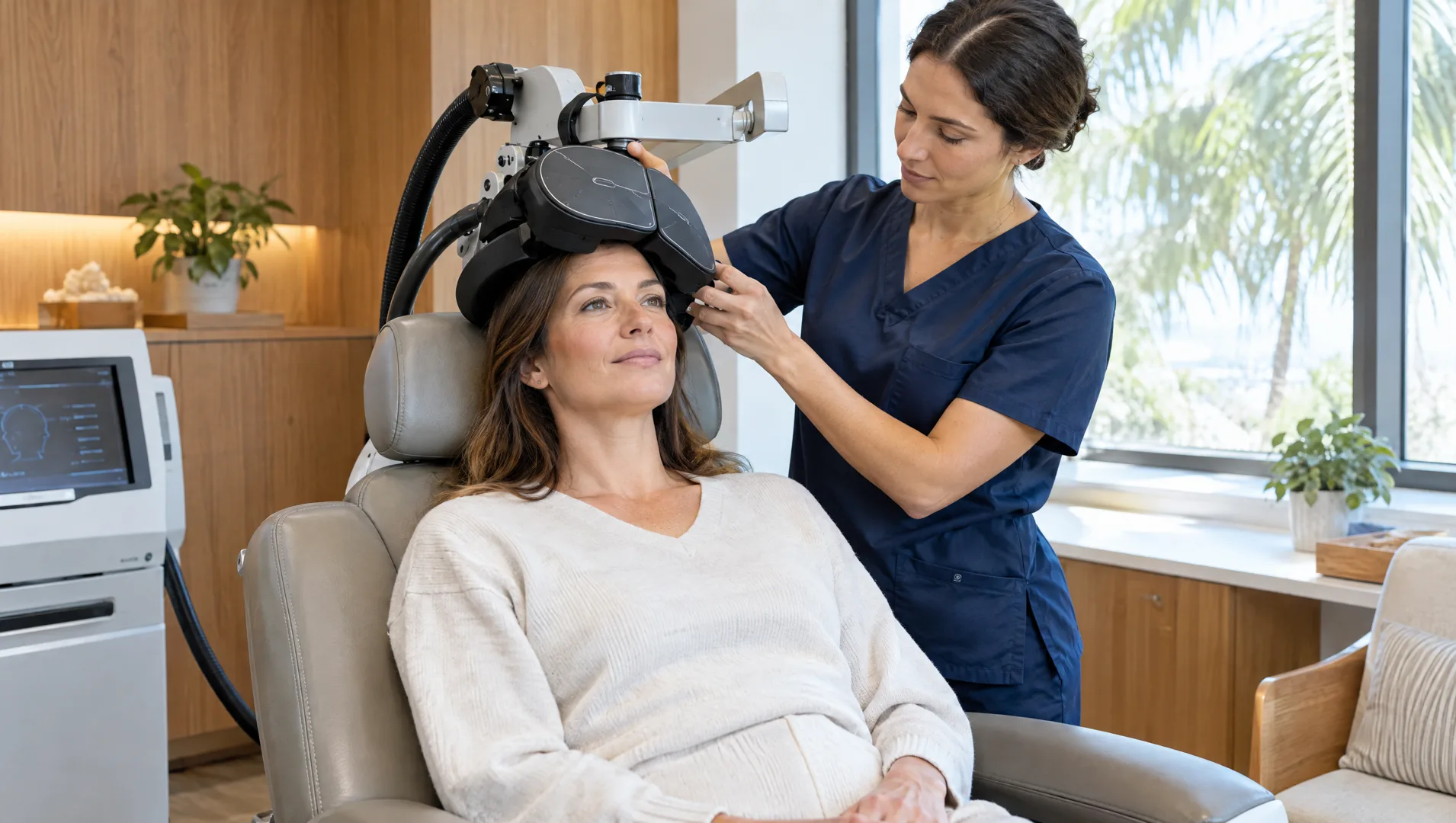
Patients who research TMS quickly run into two brand names: BrainsWay Deep TMS and NeuroStar. Each company's website makes its case, and a lot of clinic blogs repeat whichever brand that clinic owns. I run a Deep TMS program, so I have an obvious interest, which is a reason to lay out the comparison carefully and let the facts carry it.
The basic difference: coil shape
Every TMS system works the same way. An electromagnetic coil placed on the scalp produces brief magnetic pulses that induce electrical current in the cortex beneath it. The difference between systems is the shape of the coil, which determines the shape of the field.
NeuroStar uses a figure-8 coil, two loops side by side. The field is strongest where the loops meet, producing a focused spot that penetrates roughly 1.5 to 2 centimeters below the scalp. This is the classic rTMS design used in most research since the 1990s.
BrainsWay Deep TMS uses an H-coil, a more complex winding built into a helmet. It produces a broader field that reaches roughly 3 to 4 centimeters deep, stimulating a larger volume of prefrontal cortex and, the company argues, more of the connected network beneath it. Different H-coil versions are used for depression (H1), OCD (H7) and smoking cessation (H4).
Neither is "stronger" in any simple sense. Figure-8 is precise and shallow; H-coil is broad and deep. Which matters depends on what you are treating.
Side-by-side comparison
| Feature | BrainsWay Deep TMS | NeuroStar |
|---|---|---|
| Coil type | H-coil (helmet) | Figure-8 (handheld arm) |
| Stimulation depth | About 3 to 4 cm | About 1.5 to 2 cm |
| Stimulated volume | Broad | Focused |
| First FDA clearance | 2013 (MDD) | 2008 (MDD) |
| Other FDA clearances | OCD (2018), smoking cessation (2020), anxious depression (2021) | Anxious depression (2022), adolescent MDD age 15 and up (2024) |
| Standard session length | About 20 minutes; shorter protocols available | About 19 to 37 minutes depending on protocol |
| Standard course | 36 sessions over 6 to 9 weeks | 36 sessions over 6 to 9 weeks |
| Pivotal trial remission | About 32 percent active vs 15 percent sham at 5 weeks | About 14 percent active vs 5 percent sham at 6 weeks (2007 trial; later open-label and registry data higher) |
| Largest real-world data | Multi-site post-marketing data, several thousand patients | Outcomes registry, over 10,000 patients |
| Insurance coverage | Same codes and criteria | Same codes and criteria |
| Available at Stedfast | Yes, Palm Beach Gardens | No |
What the evidence actually shows
There is no large randomized trial directly comparing Deep TMS with NeuroStar in the same patients. What exists is each system's pivotal trial, each system's registry data, and a handful of smaller comparisons and meta-analyses.
The pivotal trials cannot be compared number for number. They used different scales, different durations, different sham designs and different patient populations. The NeuroStar trial from 2007 enrolled patients with more extensive treatment resistance and used a conservative primary endpoint; its remission rate looks low, but subsequent open-label data from the same program and the NIMH-funded OPT-TMS trial found rates near 30 percent. The BrainsWay trial from 2012 reported about 32 percent remission on active treatment. In practice, both systems in ordinary clinics report response rates in the 50 to 70 percent range and remission in the 30 to 45 percent range.
A few meta-analyses have pooled studies by coil type. Some find a small numerical edge for H-coil protocols in depression; others find no difference once protocol and population are matched. My reading is that for uncomplicated major depression, the two are comparable, and the differences in outcome between clinics have more to do with patient selection, coil placement accuracy and whether the full course is completed than with the brand on the machine.
Where Deep TMS has a real advantage
OCD. This is the clearest difference. Deep TMS with the H7 coil is the only TMS system FDA-cleared for obsessive-compulsive disorder, based on a 2018 multi-site sham-controlled trial. The H7 coil targets the medial prefrontal cortex and anterior cingulate, structures that sit deeper than a figure-8 coil can reliably reach. If OCD is your diagnosis, Deep TMS is the evidence-based option.
Breadth of target. Prefrontal targeting with a figure-8 coil depends on hitting a fairly small spot. Clinics have gotten better at this with neuronavigation and scalp measurement rules, but misplacement is a known reason for non-response. The H-coil's broader field is more forgiving of small placement differences.
Smoking cessation. Deep TMS has a specific clearance here; NeuroStar does not.
Where NeuroStar has a real advantage
Track record and data volume. NeuroStar has been cleared longer, is installed in more clinics, and runs the largest outcomes registry in the field. If you value sheer accumulated experience, it has more.
Adolescents. NeuroStar received FDA clearance as an adjunct for major depression in adolescents aged 15 and older in 2024. Deep TMS is cleared for adults.
Focal precision. For research protocols that need a tight target, and for some patients who find the broad H-coil field more uncomfortable on the scalp, a figure-8 coil may be preferable.
Comfort, convenience and cost
Both systems produce scalp discomfort and headache in the first week, at similar rates. Deep TMS patients wear a helmet; NeuroStar patients have a coil arm positioned against the head. Some people find the helmet more secure, others find it heavier. Session times are similar, and both run standard 36-session courses. Insurance reimburses both under the same procedure codes, with the same prior authorization criteria, so cost to you does not depend on the brand.
How to decide
Ask these questions, roughly in order.
- What is being treated? For OCD, choose Deep TMS. For adolescent depression, NeuroStar is the cleared option. For adult depression, either.
- Who is running the program? A psychiatrist who evaluates you properly, confirms the diagnosis, checks for bipolar disorder and substance use, and reviews your medications matters more than the coil.
- How is the target found and checked? Ask how the clinic locates the treatment spot and how often it re-measures.
- What is the clinic's own response rate, and how is it measured? A clinic that tracks outcomes with rating scales can answer this.
- Which one is accessible to you? Thirty-six visits over six weeks means proximity is not a minor factor.
Bottom line
Deep TMS and NeuroStar are both FDA-cleared, well-studied and effective for depression that has not responded to medication. Deep TMS reaches deeper, has more FDA-cleared indications including OCD, and is what we use at our Palm Beach Gardens office. NeuroStar has the longer record and an adolescent clearance. For most adults with depression, you will do well with either in the hands of a careful clinician, and that is the more important thing to look for.
Frequently asked questions
Is BrainsWay better than NeuroStar?
For depression, no system has been shown clearly superior in head-to-head trials; outcomes are comparable. For OCD, BrainsWay Deep TMS is the only FDA-cleared TMS option. For adolescents aged 15 and up, NeuroStar holds the clearance. The clinician and protocol matter more than the brand for most adults.
Does Deep TMS cost more than NeuroStar?
No. Insurers reimburse both under the same procedure codes with the same criteria. Self-pay prices vary by clinic rather than by system, and both fall in the same general range of $200 to $350 per session.
Does Deep TMS hurt more because it goes deeper?
Not in a consistent way. Scalp discomfort and headache rates in the first week are similar between systems. Some patients find the H-coil's broader field more noticeable on the scalp; others find the helmet more comfortable than a coil arm. Both settle within a week or two.
Which TMS system does Stedfast Psychiatry use?
BrainsWay Deep TMS, at our Palm Beach Gardens office. It is FDA-cleared for major depressive disorder, OCD, anxious depression and smoking cessation.
Related reading
- What Is TMS Therapy? A Plain-English Guide
- Does TMS Work? What the Evidence Shows
- OCD Treatment: ERP, Medication and Deep TMS
- TMS vs ECT: Comparing Two Brain Stimulation Treatments
This article is educational and does not replace evaluation by a licensed clinician. If you are in crisis, call or text 988.