TMS, or transcranial magnetic stimulation, is a non-invasive, FDA-cleared treatment that uses focused magnetic pulses to stimulate brain regions that are underactive in depression. Sessions last about 20 minutes, require no anesthesia, and a standard course is 36 sessions over six to nine weeks. It is used mainly when antidepressants have not worked.
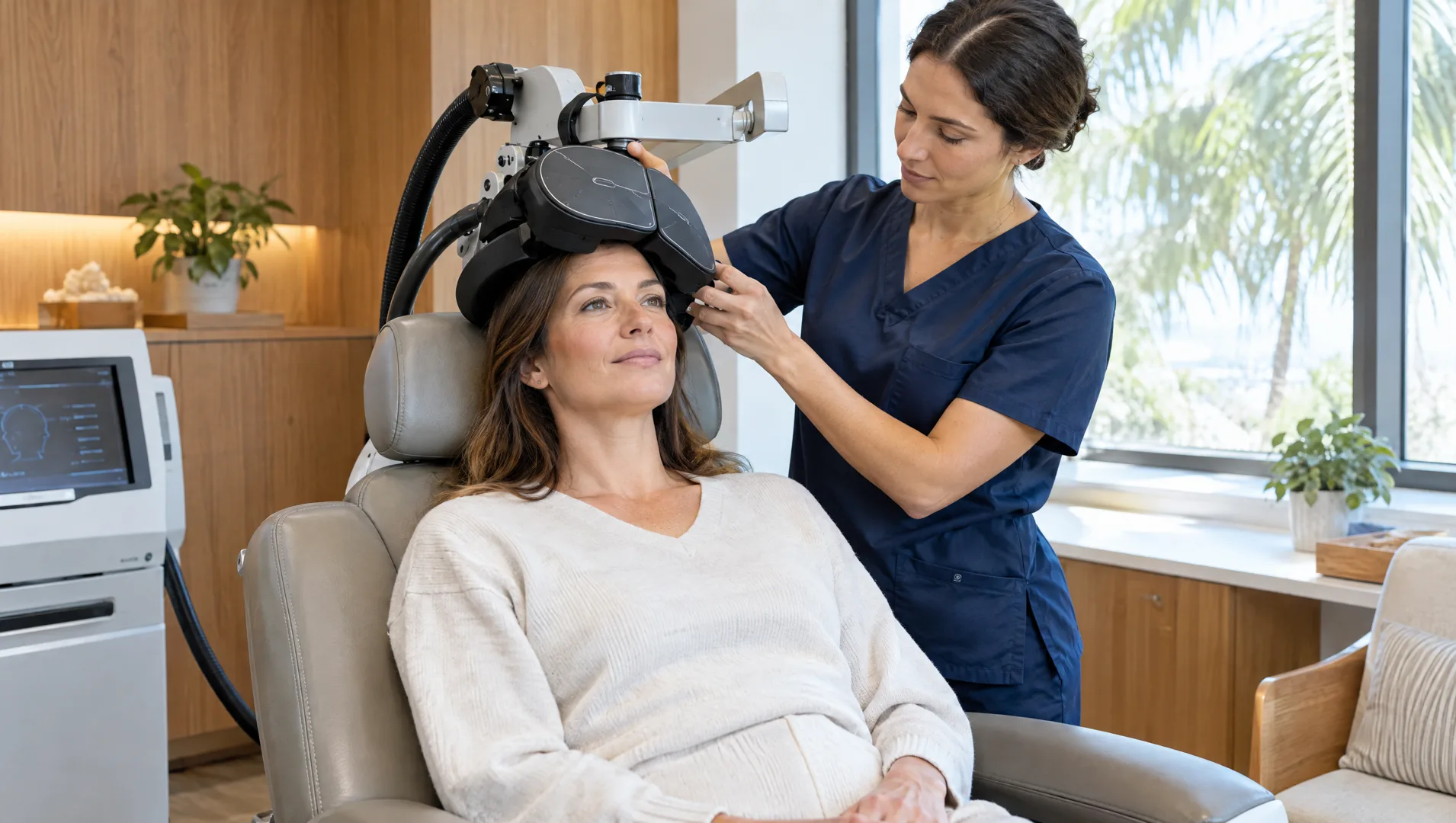
TMS stands for transcranial magnetic stimulation. It is a treatment for depression, and a few other conditions, that uses a magnetic coil placed against the scalp to deliver short pulses into a specific part of the brain. No surgery, no anesthesia, no sedation. You sit in a chair, the coil clicks for about 20 minutes, and you drive yourself home.
The FDA cleared the first TMS device for depression in 2008. Since then the technology has matured, insurance coverage has become routine, and TMS has moved from a last resort to a standard option for people whose depression has not responded to medication. This guide explains how it works and what to expect, without the jargon.
The idea behind it
Depression is not just a chemical imbalance. Brain imaging studies over the past 25 years have consistently shown that in depression, a region at the front of the brain called the dorsolateral prefrontal cortex is underactive, while deeper regions involved in mood and threat are overactive. The prefrontal cortex is the part that helps you plan, regulate emotion and talk yourself down.
TMS targets that prefrontal region directly. A magnetic pulse passes painlessly through the skull and induces a small electrical current in the neurons underneath. Repeated pulses, delivered in a pattern over several weeks, push the circuit toward a more normal level of activity. This is the same basic physics as an MRI magnet, applied in brief, focused bursts.
The effect builds over time. One session does little. Thirty-six sessions over six to nine weeks produce changes that, for many people, persist for a year or longer.
What a session is like
At your first session, the clinician finds your motor threshold: the amount of energy needed to make your thumb twitch when the coil is over the motor cortex. That number calibrates your dose. The coil then moves forward to the treatment spot over the prefrontal cortex.
During treatment you hear a rapid clicking and feel a tapping sensation on your scalp. Some people describe it as a woodpecker. Earplugs are provided. You are awake, you can talk to the technician, and many patients read or listen to music. A standard session runs about 20 minutes; some newer protocols are shorter.
Afterward you walk out and go about your day. There are no restrictions on driving, working or exercising. The most common side effect is scalp discomfort or a mild headache during the first week, which usually fades.
Standard TMS vs Deep TMS
There are two main families of TMS coils.
Figure-8 coils, used by NeuroStar, MagVenture and others, deliver a focused field that reaches roughly 1.5 to 2 centimeters into the brain. This is sometimes called rTMS or standard TMS.
H-coils, developed by BrainsWay and marketed as Deep TMS, are shaped to reach deeper and wider, roughly 4 centimeters, which lets them stimulate more of the prefrontal network in one pass. Deep TMS was FDA-cleared for major depressive disorder in 2013, for OCD in 2018, for smoking cessation in 2020 and for anxious depression in 2021.
Both approaches are FDA-cleared and both have strong evidence for depression. Stedfast Psychiatry uses BrainsWay Deep TMS at the Palm Beach Gardens office. For a detailed comparison, see our Deep TMS vs NeuroStar article.
Who TMS is for
TMS is cleared for adults with major depressive disorder who have not had an adequate response to at least one antidepressant. In practice, most insurers require two to four failed medication trials plus a trial of psychotherapy before they approve coverage. That makes the typical TMS patient someone who has been working at their depression for a while.
Beyond depression, Deep TMS is cleared for OCD and for anxious depression, and smoking cessation. Clinicians also use TMS off-label for some other conditions, with varying evidence.
TMS is not appropriate for everyone. You should not have TMS if you have metal implants in or near your head (cochlear implants, aneurysm clips, some stents), and it is used cautiously in people with a seizure history. Dental fillings and most braces are fine. Your psychiatrist will screen for these before you start.
What a full course looks like
| Phase | Schedule | What happens |
|---|---|---|
| Consultation | One visit | Psychiatric evaluation, review of past treatments, safety screening, insurance authorization |
| Mapping | First session | Motor threshold found, treatment location set, first treatment delivered |
| Acute course | 5 days a week for 6 weeks | 30 sessions of about 20 minutes each; symptoms reassessed every two weeks with rating scales |
| Taper | 3 weeks | 6 sessions spread out as frequency decreases |
| Follow-up | Monthly, then as needed | Psychiatrist visits; maintenance sessions if symptoms begin to return |
The daily commitment is the hardest part for most people. Thirty weekday appointments in six weeks require a schedule that can bend. Most patients fit sessions before work, over lunch or after work, and the practice schedules a standing time so it becomes routine.
How well it works
In large real-world registries and controlled trials, roughly half to two thirds of patients with treatment-resistant depression respond to TMS, meaning their symptoms drop by at least half, and roughly one third reach full remission. Those numbers are notably better than what a third or fourth medication trial typically achieves. Our article on whether TMS works walks through the evidence in detail.
Improvement usually begins in the third or fourth week. Some people notice changes earlier; others not until the fifth week. Finishing the full course matters, because responses that start late can still be complete.
TMS compared with other options
Medication: TMS has no systemic side effects, so no weight gain, sexual dysfunction or emotional blunting. It requires daily visits for six weeks instead of a daily pill. Many patients continue an antidepressant during and after TMS.
Spravato (esketamine): Spravato is an FDA-approved nasal spray for treatment-resistant depression, given in a clinic with two hours of monitoring. It often works faster than TMS, within days to weeks, but involves dissociation during sessions and ongoing maintenance dosing. Some patients do one, some do both in sequence.
ECT (electroconvulsive therapy): ECT remains the most effective treatment for severe depression but requires general anesthesia and causes memory side effects. TMS is gentler and is usually tried first unless the situation is urgent.
Cost and insurance
Most commercial plans and Medicare cover TMS for depression when the medication-failure criteria are met. Out of pocket, a full course typically runs between $6,000 and $12,000 depending on the clinic and protocol. Stedfast Psychiatry handles the prior authorization process for you.
Bottom line
TMS is a well-studied, FDA-cleared, non-drug treatment for depression that works by stimulating underactive brain circuits directly. It asks for six to nine weeks of daily visits and gives, for a majority of patients with treatment-resistant depression, meaningful relief without the side effects of another medication. If you have tried two or more antidepressants without success, it belongs on your list.
Frequently asked questions
Does TMS hurt?
Most people describe it as a tapping or knocking on the scalp, uncomfortable at first but tolerable. Scalp soreness and mild headache are common in the first week and usually fade. Over-the-counter pain relievers before a session help if needed. No anesthesia is used.
Can I drive after a TMS session?
Yes. TMS does not affect alertness, memory or coordination. You can drive yourself to and from every session and go straight back to work.
Is TMS the same as ECT or shock therapy?
No. ECT induces a controlled seizure under general anesthesia and affects the whole brain. TMS uses magnetic pulses on a specific region while you are fully awake, with no seizure, no anesthesia and no memory side effects.
Where does Stedfast Psychiatry offer TMS?
Deep TMS is offered at our Palm Beach Gardens office. Patients from any of our 13 Florida and South Carolina offices can be referred there, and the initial consultation can take place at your home office or by telehealth.
Related reading
- Does TMS Work? What the Evidence Shows
- TMS Side Effects: What Is Normal and What Is Not
- How Much Does TMS Cost With and Without Insurance?
- Deep TMS vs NeuroStar: What the Difference Means for You
This article is educational and does not replace evaluation by a licensed clinician. If you are in crisis, call or text 988.