The common TMS side effects are scalp discomfort and mild headache during the first week, which fade for most patients. Serious effects are rare: seizure risk is well under one in a thousand patients. TMS does not cause memory loss, cognitive impairment or systemic effects like weight gain. Anyone with metal implants in the head should not have TMS.
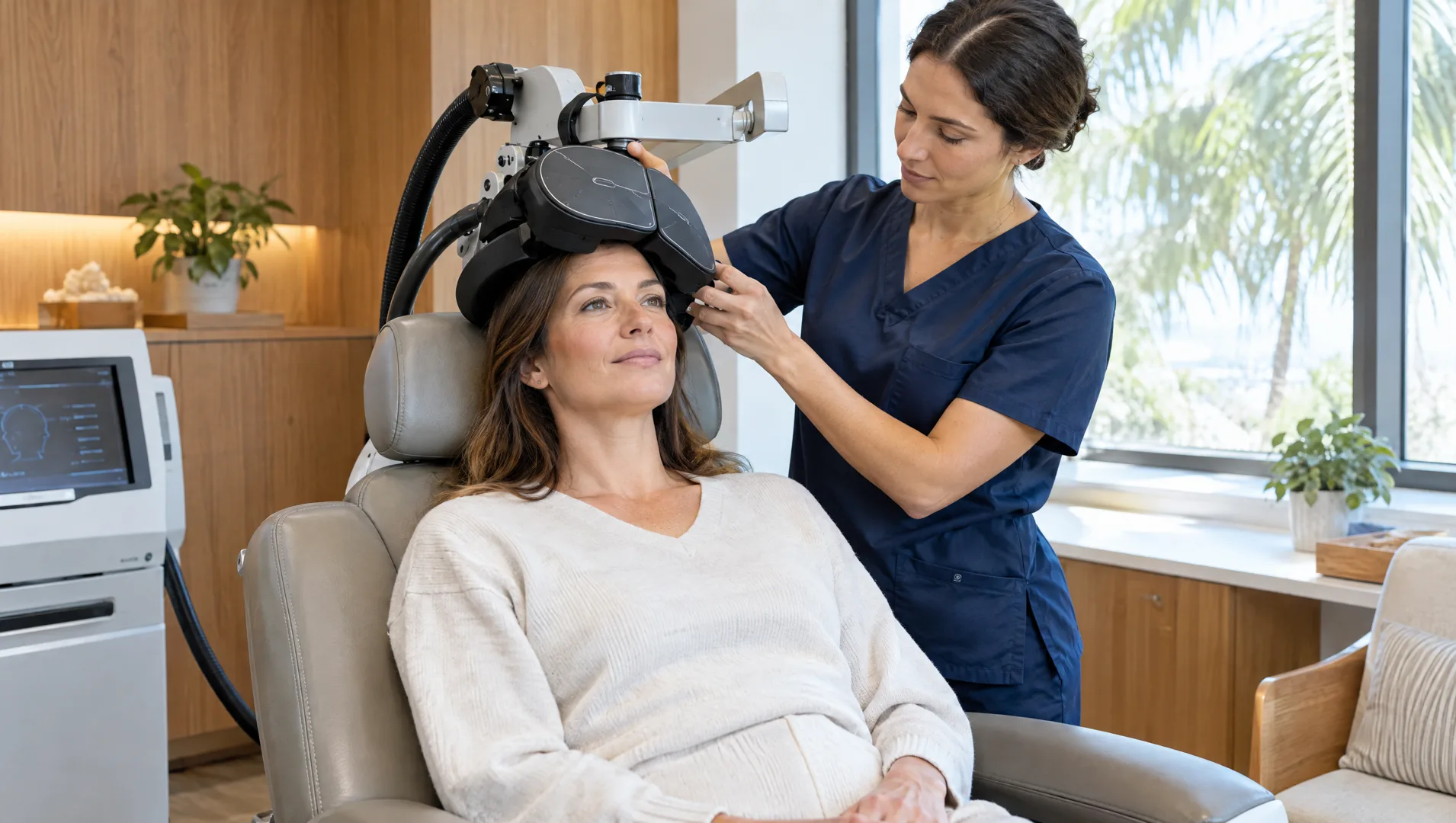
When I explain TMS side effects to patients, I divide them into three groups: the ones almost everyone gets and almost no one minds after the first week, the ones that are rare but serious enough to screen for carefully, and the ones people worry about that do not actually happen. Here is the full picture.
The common, expected side effects
Scalp discomfort
The coil delivers pulses through the scalp, and the muscles and nerves there feel it. Most patients describe a tapping or knocking sensation that is uncomfortable, occasionally sharp, during the first several sessions. In trials, roughly a third of patients report scalp pain or discomfort at the treatment site. It almost always diminishes by the second week as the scalp habituates and as the technician fine-tunes coil placement.
What helps: an over-the-counter pain reliever 30 to 60 minutes before a session, small adjustments to coil angle, and in some cases a brief ramp-up of intensity over the first few days. Tell the technician if it hurts. Gritting your teeth through it is not required and sometimes a small change fixes it entirely.
Headache
Mild to moderate headache after sessions affects roughly a quarter to a third of patients early in the course. It is usually tension-type, responds to acetaminophen or ibuprofen, and resolves within hours. Like scalp discomfort, it fades across the first week or two for most people. Migraine patients sometimes report that TMS neither worsens nor improves their migraines, though a minority notice more headaches during the course.
Facial twitching during pulses
The field can stimulate the nerves that control facial muscles, so some patients notice their jaw, cheek or eyelid twitch in time with the pulses. This is harmless and stops when the pulse train stops. It can be reduced with coil repositioning.
Lightheadedness or fatigue
A small number of patients feel briefly lightheaded standing up after a session, or tired for the rest of the day in the first week. Both are uncommon and short-lived. No one needs a driver.
Hearing
The coil clicks loudly, around 100 decibels at the source, which is why earplugs are mandatory. With earplugs, trials have found no change in hearing. Without them, temporary threshold shifts are possible. Wear the earplugs every session.
The rare but serious side effects
Seizure
This is the one that matters. TMS induces electrical activity in the cortex, and in rare cases that activity can trigger a seizure. Across the published literature and manufacturer safety data, the risk is estimated at less than one in a thousand patients, and most reported cases involved a known risk factor such as a prior seizure, a brain lesion, sleep deprivation, alcohol withdrawal or a medication that lowers seizure threshold. Seizures that occur during TMS are self-limited, happen in the chair with trained staff present, and have not caused lasting harm in reported cases. They are a reason to stop treatment and reassess, not a medical emergency in the usual sense, though the clinic is prepared for one.
We reduce the risk by screening every patient for seizure history, head injury, stroke, brain tumors and medications such as bupropion at high doses, tramadol or certain antibiotics, and by asking you to tell us about poor sleep, heavy alcohol use or new medications during the course. A seizure history is not an absolute exclusion for Deep TMS, but it requires a careful conversation and sometimes a neurology opinion.
Mania or hypomania
In patients with bipolar disorder, any effective antidepressant treatment carries a small risk of switching into mania. TMS is no exception, though the reported rate is low, under one percent, and similar to or lower than antidepressant medication. We screen for bipolar history and, where appropriate, keep patients on a mood stabilizer during the course.
Syncope
Fainting during or right after a session has been reported, usually vasovagal, meaning triggered by anxiety, dehydration or standing too fast. It is not a seizure and does not indicate brain injury. Eat before your session and stand up slowly.
Side effects TMS does not cause
This list matters because many patients arrive having read about ECT and assume the risks carry over.
- Memory loss. TMS does not impair memory. Several trials have specifically tested cognition before and after a course and found no decline; some found small improvements in attention and processing speed as depression lifted.
- Cognitive dulling. No. You can work, study and drive throughout the course.
- Weight gain, sexual dysfunction, emotional blunting. These are medication side effects. TMS acts locally on the brain and has no systemic effect.
- Dependence or withdrawal. There is nothing to become dependent on. When the course ends, it ends.
- Brain damage. Imaging studies and long-term follow-up have found no structural changes from TMS at therapeutic doses.
- Personality change. Patients who respond describe feeling like themselves again, not like someone else.
Who should not have TMS
Absolute contraindications are about metal. Ferromagnetic or electrically conductive objects within about 30 centimeters of the coil can heat, move or malfunction. That includes:
- Cochlear implants
- Aneurysm clips or coils in the brain
- Implanted stimulators (deep brain stimulators, vagus nerve stimulators)
- Metal fragments or shrapnel in the head or eyes
- Some stents and electrodes in the head or neck
Dental fillings, crowns, most braces and dental implants are not a problem. Pacemakers and defibrillators are generally compatible if they are more than 30 centimeters from the coil, but we confirm with the device manufacturer. Pregnancy is not an absolute contraindication, but data are limited and the decision is individual.
Long-term side effects
TMS has been in clinical use since 2008 and in research for far longer. Follow-up studies out to a year and beyond, along with maintenance treatment data spanning several years in some patients, have not identified delayed or cumulative side effects. The absence of long-term harm is one of the strongest arguments for TMS over continued medication trials in people who have not responded.
When to call the clinic
Call during the course if you experience any of the following.
- A headache that does not respond to over-the-counter medication or that is getting worse rather than better over the first two weeks.
- Any episode of loss of consciousness, confusion or involuntary movement outside the session.
- Sudden decrease in need for sleep, racing thoughts or unusual energy, which could indicate hypomania.
- Ringing in the ears or change in hearing.
- Worsening depression or new thoughts of self-harm. These are not caused by TMS but they need attention. In an emergency call or text 988.
- A new medication, a new diagnosis or a night of no sleep, so we can adjust if needed.
Bottom line
Expect a sore scalp and perhaps a headache for the first week, and expect both to fade. Understand that seizure is possible but rare and that we screen for it carefully. Do not expect memory problems, weight gain or any of the systemic effects that come with medication. For most patients, TMS side effects are a minor inconvenience on the way to a result that medication could not deliver.
Frequently asked questions
Can TMS cause a seizure?
Rarely. The published risk is under one in a thousand patients, and most cases involved a known risk factor such as a prior seizure, head injury or a medication that lowers seizure threshold. We screen for these before treatment and monitor sleep, alcohol use and medication changes during the course.
Does TMS cause memory loss?
No. Unlike ECT, TMS does not affect memory. Cognitive testing before and after TMS courses shows no decline, and some patients improve in attention as depression lifts.
How long do TMS headaches last?
Usually a few hours after a session, and they typically stop occurring after the first one to two weeks. Over-the-counter pain relievers taken before the session help. A headache that worsens over time should be reported to the clinic.
Can I have TMS if I have dental fillings or a pacemaker?
Dental fillings, crowns and implants are fine. Pacemakers and defibrillators are usually compatible because they sit well away from the coil, but we confirm with the device manufacturer first. Metal implants in the head, such as cochlear implants or aneurysm clips, rule TMS out.
Related reading
- What Is TMS Therapy? A Plain-English Guide
- Does TMS Work? What the Evidence Shows
- TMS vs ECT: Comparing Two Brain Stimulation Treatments
- Spravato Side Effects and Who Should Not Take It
This article is educational and does not replace evaluation by a licensed clinician. If you are in crisis, call or text 988.