Spravato (esketamine) is FDA-approved for treatment-resistant depression, covered by most insurance and Medicare, and given under a required monitoring program. IV ketamine is used off-label, is rarely covered, and costs $400 to $800 per infusion out of pocket. Both work for many patients; the evidence base and insurance coverage favor Spravato, while some patients respond better to IV ketamine.
Patients who have been through several antidepressants eventually hear about ketamine, and then they hear about Spravato, and then they get confused because clinics describe them as the same thing, different things, or rival things depending on which one the clinic sells. I prescribe Spravato, so take that into account. What follows is my honest read of how the two compare.
What they are
Ketamine is an anesthetic that has been used in hospitals since 1970. It is a mixture of two mirror-image molecules, called enantiomers: R-ketamine and S-ketamine. Around 2000, researchers found that a single low-dose infusion of ketamine produced rapid antidepressant effects in people who had failed other treatments, sometimes within hours. That observation launched two parallel paths.
IV ketamine infusions use the original racemic mixture, given intravenously over about 40 minutes in a clinic. This use is off-label: ketamine is FDA-approved as an anesthetic, not as an antidepressant, and no manufacturer has sought approval for the depression indication because the drug is generic.
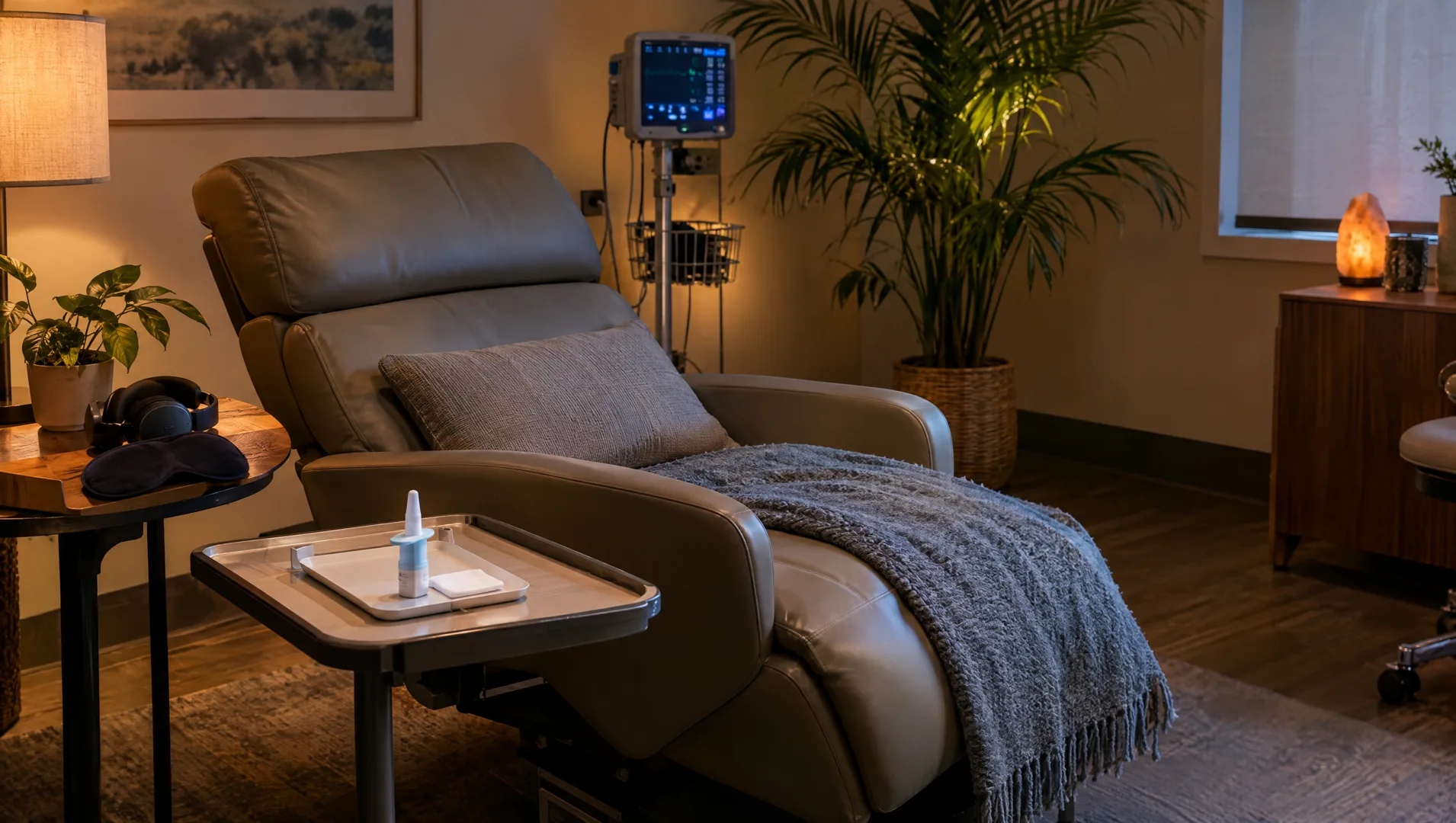
Spravato is esketamine, the S-enantiomer alone, formulated as a nasal spray by Janssen. The FDA approved it in 2019 for treatment-resistant depression in adults, used alongside an oral antidepressant, and in 2020 for major depressive disorder with suicidal thoughts or behavior. It is dispensed only in certified clinics under a Risk Evaluation and Mitigation Strategy (REMS) program, with two hours of monitoring after each dose.
Side by side
| Feature | Spravato (esketamine) | IV ketamine infusion |
|---|---|---|
| Molecule | S-ketamine only | Racemic ketamine (R and S) |
| Route | Nasal spray, self-administered under supervision | Intravenous, by a clinician |
| FDA status for depression | Approved (2019 TRD; 2020 MDD with suicidal ideation) | Off-label |
| Evidence | Multiple phase 3 randomized trials (TRANSFORM, SUSTAIN), long-term safety data | Many smaller randomized trials and meta-analyses; fewer large long-term studies |
| Insurance | Covered by most commercial plans and Medicare with prior authorization | Rarely covered; mostly cash |
| Cost per session (self-pay) | Roughly $600 to $1,200 including drug and monitoring; much less with coverage | $400 to $800 |
| Induction schedule | Twice weekly for 4 weeks, then weekly, then weekly or every 2 weeks | Typically 6 infusions over 2 to 3 weeks, then boosters as needed |
| Session length | About 2 hours (dose plus monitoring) | About 1 to 1.5 hours (infusion plus recovery) |
| Monitoring | Required: blood pressure, sedation, dissociation, under REMS | Varies by clinic; no federal standard |
| Dose control | Fixed doses: 56 mg or 84 mg | Weight-based, adjustable during the infusion |
| Requires oral antidepressant | Yes, by label | No |
| Driving after | Not until the next day | Not the same day |
Effectiveness
Both work, and both work for roughly similar proportions of people. In the Spravato phase 3 trials, about half of patients with treatment-resistant depression responded within four weeks and roughly a third reached remission, compared with placebo spray plus an antidepressant. The SUSTAIN-1 trial showed that continuing Spravato after remission cut relapse risk by about half over the following months.
IV ketamine trials, mostly smaller and shorter, report response rates in a similar or slightly higher range after a series of infusions, with effects that are rapid but tend to fade within one to two weeks after a single infusion unless repeated. A 2023 trial comparing IV ketamine with ECT in non-psychotic depression found ketamine was not inferior, which was a notable result.
Is one better than the other? A handful of small direct comparisons and meta-analyses suggest IV ketamine may have a modest edge in effect size, possibly because dosing can be adjusted to the individual and because the R-enantiomer may contribute antidepressant effects. The honest statement is that the difference, if real, is modest, and both are substantially more effective than another oral antidepressant at this stage.
Safety and monitoring
The side effects are the same family for both: dissociation (feeling detached, dreamlike), dizziness, nausea, sedation and a temporary rise in blood pressure. Both require that you not drive until the next day.
The difference is the structure around them. Spravato is given under a federal REMS program: certified clinic, blood pressure checks before and after, direct observation for two hours, documentation of every dose. This is sometimes described as a burden, and it is, but it also means the safety protocol is uniform wherever you go.
IV ketamine clinics range from psychiatrist-run programs with rigorous monitoring to standalone infusion centers with less psychiatric oversight. Many are excellent. Some are not. If you choose IV ketamine, ask who evaluates you psychiatrically, who monitors the infusion, and what happens if your depression worsens between sessions.
Long-term safety is better documented for Spravato, because the approval process required it. Concerns that apply to both over years of use include bladder irritation (well documented with heavy recreational use, rare at therapeutic doses) and the potential for misuse, which is why Spravato is never dispensed to take home.
Cost and insurance
This is often the deciding factor. Spravato is covered by most commercial plans and by Medicare Part B with prior authorization, and Janssen offers a copay assistance program for commercially insured patients that can reduce the drug cost substantially. A patient with good coverage may pay a specialist copay per session.
IV ketamine is almost never covered because it is off-label. At $400 to $800 per infusion and six infusions in the induction series, the first month alone runs $2,400 to $4,800, with boosters afterward. Some clinics will bill insurance for the evaluation and monitoring but not the drug.
Who is a better fit for which
Consider Spravato if you have insurance or Medicare, you want FDA-approved treatment with a standardized safety protocol, you are already on an oral antidepressant you can continue, and you are comfortable with the twice-weekly induction schedule.
Consider IV ketamine if you can afford self-pay, you have not responded to Spravato, you have a strong reason to want weight-based adjustable dosing, or you cannot use a nasal spray because of nasal or sinus problems.
Some patients try one and then the other. Non-response to Spravato does not predict non-response to IV ketamine, and the reverse is also true.
Where we stand
Stedfast Psychiatry offers Spravato at our Boynton Beach, Palm Beach Gardens and Royal Palm Beach offices, in REMS-certified treatment rooms with a psychiatrist on site. We chose Spravato because the evidence base, FDA approval and insurance coverage make it accessible to the most patients, including Medicare patients, without a cash barrier. We do not offer IV ketamine, and we refer patients to reputable programs when it is the better choice.
Bottom line
Spravato and IV ketamine are close relatives with similar effectiveness and similar side effects. Spravato has the FDA approval, the larger long-term evidence base, the standardized safety program and the insurance coverage. IV ketamine has adjustable dosing, a possible modest edge in effect, and a cash price. For most patients with treatment-resistant depression who have insurance, Spravato is the practical first choice; for those who can pay and have exhausted it, IV ketamine remains a reasonable option.
Frequently asked questions
Is Spravato the same as ketamine?
Not quite. Ketamine is a mix of two mirror-image molecules; Spravato is one of them, esketamine, in nasal spray form. They work through the same mechanism and have similar effects, but Spravato is FDA-approved for depression and IV ketamine is used off-label.
Is esketamine weaker than ketamine?
Esketamine is actually the more potent of the two enantiomers at the NMDA receptor, which is why Spravato doses are lower in milligrams. Whether IV racemic ketamine produces a somewhat larger antidepressant effect in practice is debated; small studies suggest a modest edge, but both are effective.
Which is cheaper, Spravato or ketamine infusions?
With insurance, Spravato is far cheaper because it is covered and IV ketamine usually is not. Without insurance, IV ketamine's per-session price ($400 to $800) is typically lower than Spravato's self-pay price, but the Spravato manufacturer copay program can offset the drug cost for commercially insured patients.
Can I get Spravato and ketamine infusions at the same time?
No. They act on the same system and combining them would add risk without benefit. If one has not worked, a psychiatrist may recommend switching to the other after an appropriate interval.
Does Medicare cover ketamine infusions?
Generally no, because the use is off-label. Medicare does cover Spravato under Part B when the criteria for treatment-resistant depression are met, which is one of the main reasons Spravato is the accessible option for Medicare patients.
Related reading
- How Much Does Spravato Cost?
- What Does a Spravato Session Feel Like?
- Spravato Side Effects and Who Should Not Take It
- Treatment-Resistant Depression: What to Try Next
This article is educational and does not replace evaluation by a licensed clinician. If you are in crisis, call or text 988.