A Spravato session lasts about two and a half hours. You self-administer the nasal spray under supervision, then rest in a reclined chair. Within 20 to 40 minutes most people feel dissociation: detached, floaty, dreamlike, sometimes with altered perception. This peaks around 40 minutes and fades by 90 minutes. Staff monitor blood pressure. You leave with a driver.
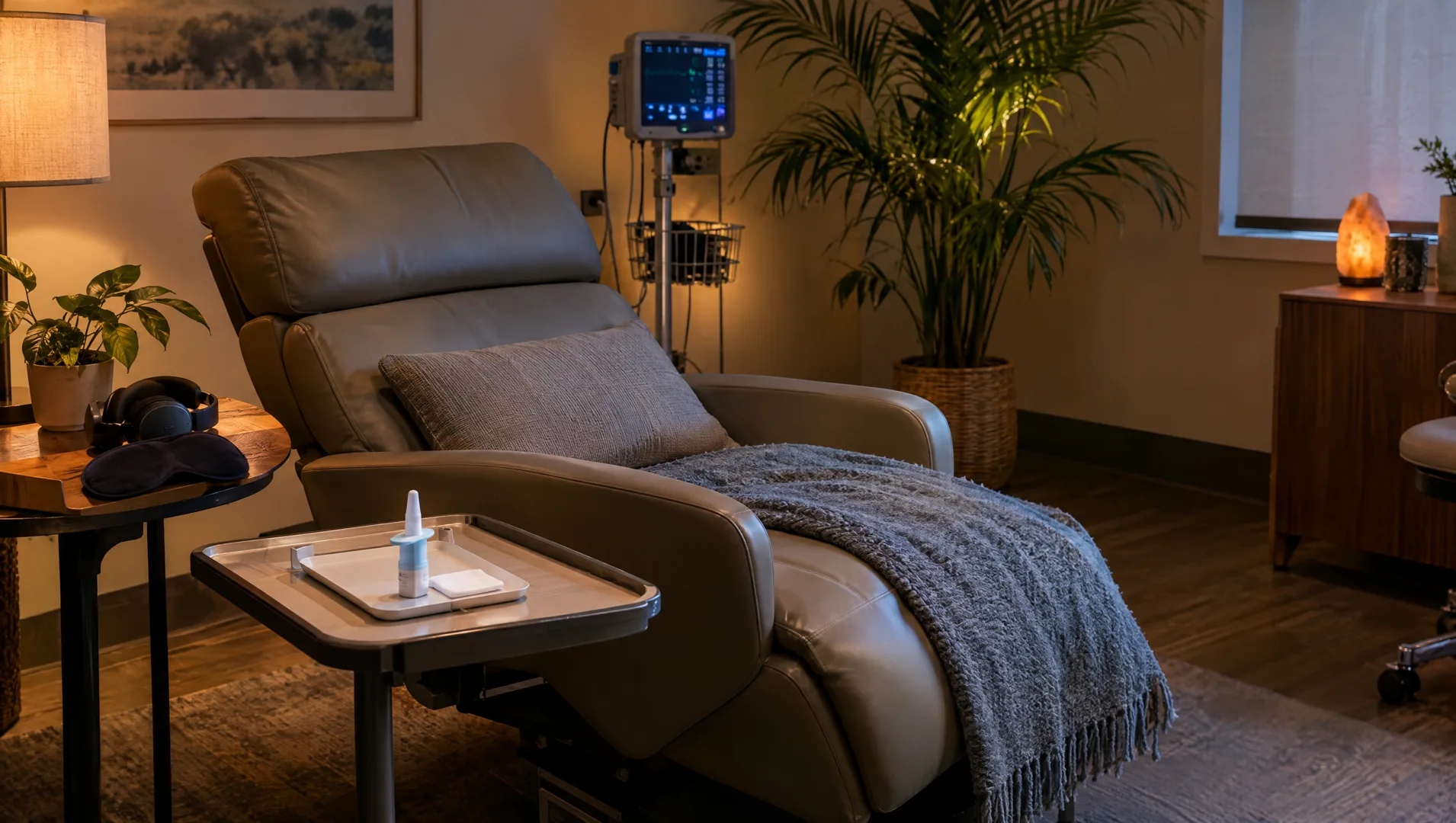
Most people considering Spravato have read the clinical description: an esketamine nasal spray taken in a clinic with two hours of monitoring. What they want to know is what it is actually like to sit in that chair. Here is a session from start to finish, drawing on what our patients tell us and what the FDA label and trials describe.
Before your first session
You will have had a psychiatric evaluation confirming the diagnosis and treatment history, a review of your medications and blood pressure, and an explanation of the REMS program. You will sign the REMS enrollment form, which commits you to not driving until the next day after each session and to arranging a ride home.
Practical instructions for the day: do not eat for two hours before the session and do not drink liquids for 30 minutes before, because nausea is a known side effect and an empty stomach reduces it. Do not use a nasal decongestant within an hour of dosing. Bring headphones, a blanket if you like, and whatever helps you relax. Wear comfortable clothes.
Check-in and pre-dose checks: the first 15 minutes
A staff member takes your blood pressure and asks how you are feeling. If your blood pressure is elevated above the threshold on the label, the session is postponed. You complete a short mood questionnaire, usually the PHQ-9, so we can track your response over time. The clinician confirms your dose, 56 mg for the first session and either 56 or 84 mg afterward, and brings the sealed devices to you.
Taking the spray: about 5 minutes
You administer Spravato yourself, under direct observation. Each device delivers two sprays, one per nostril. For 56 mg you use two devices, for 84 mg three, with a five-minute rest between each device, reclining and sniffing gently. The staff member watches to confirm each device is used correctly and discards them; no device leaves the room. It tastes slightly bitter if it drips to the back of the throat. That is normal.
The first 40 minutes: onset
You recline in a comfortable chair in a quiet, dimly lit room. Within 10 to 20 minutes, most people begin to notice the effects. Patients describe them in different ways:
- "Floaty, like being in a warm bath."
- "Everything felt far away, including my own body."
- "Colors and sounds were more vivid. Music sounded incredible."
- "Time stretched. Ten minutes felt like an hour."
- "Like the moment just before you fall asleep, but awake."
- "I felt separate from my thoughts. I could look at them without being inside them."
This is dissociation, the most common Spravato effect. In the trials, a majority of patients experienced some degree of it, and it is more pronounced in the first few sessions. Some people find it pleasant; some find it strange; a minority find it unsettling, particularly in the first session. It is not the same as being high in the recreational sense, and most patients say it becomes familiar and easier after two or three sessions.
Other common sensations during this window: dizziness if you sit up quickly, mild nausea, a feeling of heaviness in the limbs, and sleepiness. Blood pressure typically rises during this period and peaks at around 40 minutes. Staff check it at the 40-minute mark.
40 to 90 minutes: the plateau and fade
The dissociation plateaus and then recedes. Many patients doze. Others listen to music or guided meditation. Talking is possible but most people prefer not to. By 60 to 90 minutes, the dreamlike quality has faded and you feel more or less yourself, usually calm, sometimes a little tired. Staff check in periodically and take another blood pressure reading.
90 to 120 minutes: recovery and discharge
The final half hour is waiting out the label requirement. You can sit up, use your phone, have a snack, and talk to staff. Before discharge, the clinician checks that your blood pressure has returned to baseline, that you are alert and steady on your feet, and that your ride is present. Then you go home.
The rest of the day
Most patients feel tired for several hours, and some feel unusually calm or clear-headed. Some notice an immediate lift in mood; others notice nothing until a few sessions in. Mild headache or nausea can linger for an hour or two. You should not drive, operate machinery, or make important decisions until you have had a full night's sleep. Returning to work the same day is not recommended. By the next morning, the effects are gone.
How the experience changes over time
The first session is usually the most intense in terms of dissociation, partly because it is unfamiliar and partly because anxiety amplifies it. Sessions two through four typically feel more predictable, and most patients settle into a routine: arrive, dose, rest, listen to the same playlist, go home. Over weeks, many report that the dissociation becomes milder even at the same dose. Sessions do not get longer or shorter; the two-hour monitoring is fixed by the label.
Patients often ask whether the dissociation is necessary for the antidepressant effect. The research is mixed. Some studies find a relationship between the intensity of dissociation and later improvement; others do not. We do not aim for a particular experience during the session. The dose is set by response and tolerability.
What the room is like
At our Spravato offices in Boynton Beach, Palm Beach Gardens and Royal Palm Beach, treatment rooms are private, with a reclining chair, dimmable lighting, a blanket and a call button. A staff member is nearby throughout and a psychiatrist is on site. You can bring one support person to wait in the lobby, though they do not stay in the treatment room.
What if the experience is unpleasant?
A minority of patients, more often those with a trauma history or panic disorder, find the onset of dissociation frightening rather than neutral. If that happens, tell the staff member. Simple measures help: a reminder that the sensation peaks within minutes and passes, a hand on the chair arm, turning the lights up slightly, or switching from music to a familiar voice recording. If a session was distressing, the clinician may lower the next dose back to 56 mg, slow the interval between devices, or add a short pre-session relaxation routine. Very few patients stop treatment for this reason once it is addressed.
Tips from patients
- Make a playlist in advance. Calm, instrumental or familiar music works best for most people.
- Eat a light meal two to three hours before, not right before.
- Use the restroom before dosing.
- Tell staff if you feel anxious during onset. A few words of reassurance and a reminder that it passes often helps.
- Plan nothing for the rest of the day.
- Book a standing appointment time so the routine becomes automatic.
Bottom line
A Spravato session is two and a half quiet hours in a reclining chair: a few minutes of nasal spray, 40 minutes of floaty detachment that peaks and fades, an hour of recovery, and a ride home. It is unfamiliar the first time and routine by the third. Knowing the shape of it in advance makes the first session considerably easier.
Frequently asked questions
Do you feel high on Spravato?
Most people feel dissociated: detached, dreamy, floaty, with altered perception of time and sound. It is related to the recreational ketamine experience but at a controlled dose in a clinical setting, and most patients describe it as strange rather than euphoric. It peaks around 40 minutes and fades within 90.
Can someone sit with me during a Spravato session?
A support person can accompany you to the office and wait in the lobby, and must drive you home. The treatment room itself is for you and clinic staff, in keeping with the monitoring requirements.
Can I go to work after Spravato?
Not the same day. You should not drive, operate machinery or make significant decisions until after a full night's sleep. Most patients schedule sessions in the afternoon or on days off and rest afterward.
Does the dissociation get better over time?
Usually. The first session is often the most intense, partly because it is unfamiliar. By the third or fourth session most patients know what to expect and find it milder and easier to settle into.
Related reading
- How Long Does Spravato Take to Work?
- Spravato Side Effects and Who Should Not Take It
- Spravato vs Ketamine Infusions: An Honest Comparison
- How Much Does Spravato Cost?
This article is educational and does not replace evaluation by a licensed clinician. If you are in crisis, call or text 988.